Tradition is not the worship of ashes, but the preservation of fire.—Gustav Mahler

Saturday, October 10, 2015

John Adams on the Puritan contribution to liberty

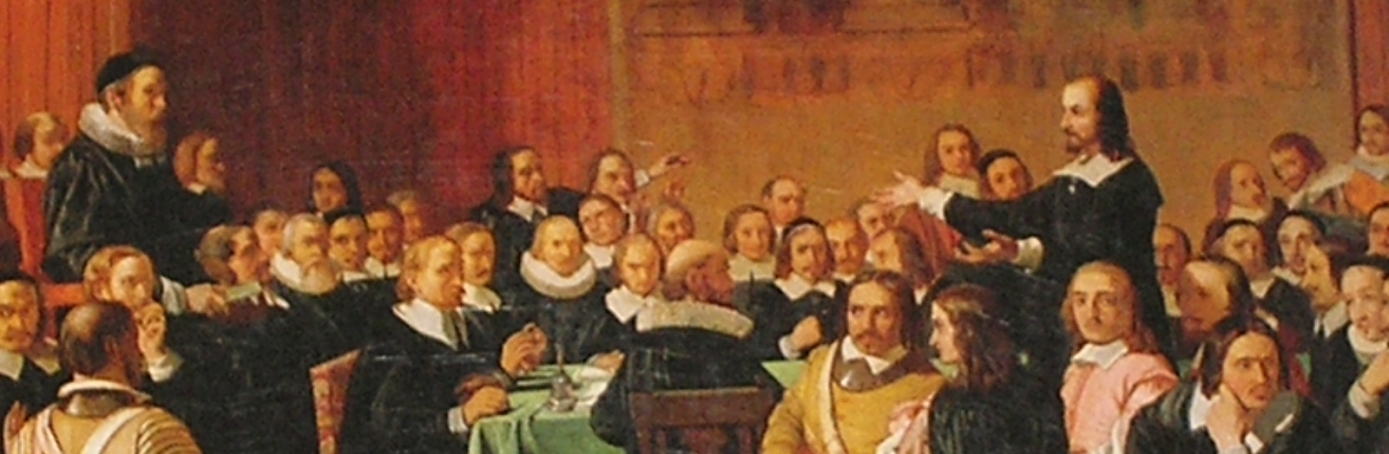
John Adams (1735-1826) wasn't just a politician, but also had a long career as a political theorist and commentator, a career that pre-dated the American Revolution by over two decades. And in his work as a theorist and commentator, Adams addressed the Puritan contribution to human liberty. Interestingly enough, Adams's religious views do do not fit within the mould of orthodox Protestants. That being the case, it is noteworthy that in his early work Adams had a very high regard for those most orthodox of Calvinists, the Puritan fathers of New England.

In A Dissertation on the Canon and Feudal Law, written in 1765 (circa the time of the French and Indian War), Adams wrote as a subject of the British crown and a patriot of the Empire. He begins his discussion of the Puritans in that text by noting that the Puritans were seen as "enthusiastical, superstitious, and republican" by many of the proper people of Adams's day. Adams strongly attacks such views of the Puritans, stating that they were "grossly injurious and false." The Puritans, Adams contends, were no more enthusiasts than the other sects within the Christian religion, and that their religious fervor, while a "noble infirmity," was also a source of strength for the group: "far from being a reproach to them," Adams wrote, their devotion "was greatly to their honor." Adams then goes on to describe how the Puritans sought to fuse reason and religion, a commitment to biblical faith with the prudential considerations of practical men. "Human and benevolent principles," Adams wrote, were the basis of Puritan policy.

While modern readers and scholars might object to Adams's characterization of motivations of the Puritans, Adams saw in the Puritans a resolute commitment to fight "Tyranny in every form, and shape, and appearance." The Puritans were willing to face punishment and even death rather than to compromise their beliefs. Their convictions serve, Adams' contends, as an example of "steady, manly, pertinacious spirit." As noted above, at the time he wrote A Dissertation, Adams was still a loyal monarchist and he went out of his way to note that the Puritans, despite their resistance to certaion policies of the British kings, were not foes of the monarchy. They rather sought a balanced government, with proper checks on the authority of both the king & the church. "[T]hey saw clearly, that popular powers must be placed as a guard a control, a balance, to the powers of the monarch and the priest, in every government, or else it would soon become the man of sin, the whore of Babylon, the mystery of iniquity, a great and detestable system of fraud, violence, and usurpation."

The Puritan commitment was to limited government, not to any one particular form of it. And the reason for their commitment to limited government was grounded in their ultimately religious view that human nature is such to render a limitless government a mechanism of tyranny. The Puritans had a strong commitment to secular reform & an even stronger commitment to religious renewal, so much so that Adams characterizes ecclesiastical reform as "[t]heir greatest concern." For them, secular & religious reform were not separate & distinct, but built off each other. Thus, the Puritans sought, according to Adams, to live in a state that upheld "the dignity of human nature." This two-fold commitment lead the Puritans to seek thoroughgoing reform of both secular and ecclesiastical institutions, removing "feudal inequalities and dependencies as could be spared."

Undergirding all this, as Adams notes, was the Puritan hostility to the Catholic religion, with its rituals & its ecclesiastical doctrines. The idea of a priest, Adams writes, was one which "no mortal could deserve, and as always must, from the constitution of human nature, be dangerous in society." Thus, the Puritans sought to purge the Protestant church of the vestiges of Catholicism, to preserve the spiritual & secular liberty that they saw due to every man. Instead of a priesthood, Adams contents the Puritans looked to establish ministry "on the foundation of the Bible and common sense." In doing so, the Puritans stressed, in Adams's account, the characteristics of "industry, virtue, piety, and learning." This had the effect of creating a people who were far more "independent on the civil powers" than those who lived in "a scale of subordination, from a pope down to priests and friars and confessors -- necessarily and essentially a sordid, stupid, and wretched herd." That the church of England continued, in modified form, to uphold the same system of subordination earned it the same disdain from the Puritans & Adams alike.

With Adams's early presentation of the Puritans, one sees the blossoming of "the Puritan myth" in American history. While much of his analysis may be disputed in light of modern scholarship, Adams's overview encapsulates what was to become the dominant view of the Puritans in the early American Republic. And there is little doubt that the Puritan refusal to compromise principle when faced with the demands of unlimited government did much to inspire the American patriots in the time prior to, during and immediately after the break with the British Empire.

[Edited from a post I originally wrote for American Creation.]

Friday, October 09, 2015

Teaching the History of the American Civil War: Flies of a Summer (Part II)

Which of these three statements is the most egregious?

American History -- Part 110 -- Lincoln -- Lee surrenders at Appomattox, The Making of a Nation—American history in Voice of America Special English [YouTube]
#1: Id. at 2:06ff “But [Lee] failed [to break the ring of Union soldiers surrounding his army]. Nothing was left. Nothing but surrender. Lee sent a note to General Grant asking to meet with him to discuss surrender terms.”

#2: Id. at 11:48ff “General Grant left Appomattox Court House to return to his headquarters a few kilometers away.”  
American History -- Part 113 -- A Johnson -- War Officially over, The Making of a Nation—American history in Voice of America Special English [YouTube] 
#3: Id. at 12:00ff “There was also the question of the 4,000,000 former slaves. They were free now. But few could take care of themselves. They needed jobs and training.”
Seth Barrett Tillman
Twitter: https://twitter.com/SethBTillman  ( @SethBTillman )


PS: My prior post is: Seth Barrett Tillman, The Veil: Tolkien, Rowling, and the American Civil War, The New Reform Club (Oct. 6, 2015, 4:58 PM), http://reformclub.blogspot.ie/2015/10/the-veil.html

PPS: I have a paper which, among other things, discusses errors in Civil War era historiography. See Seth Barrett Tillman, Ex parte Merryman: Myth, History, and Scholarship, Military Law Review (forthcoming circa Summer 2016) (peer reviewed), available at http://ssrn.com/abstract=2646888.


PPPS: Seth Barrett Tillman, The Decline of American Martial Culture—Flies of a Summer (Part III), The New Reform Club (Oct. 23, 2015, 8:23 AM), http://reformclub.blogspot.ie/2015/10/the-decline-of-american-martial.html;

and,


Seth Barrett Tillman, American Culture: The Flies of a Summer (Part I), The New Reform Club (Sept. 29, 2015, 6:33 PM), http://reformclub.blogspot.ie/2015/09/american-culture-flies-of-summer.html. 

Tuesday, October 06, 2015

The Veil: Tolkien, Rowling, and the American Civil War

He heard whisperings of things beyond the vail, and with smiles upon his face passed on to the land of eternal freedom. 
—Fernando G. Cartland, Southern Heroes: The Friends in War Time (Cambridge, Riverside Press 1895) (note: “vail” is obsolete for “veil”). 

[E]ither in his dreams or out of them, he could not tell which, Frodo heard a sweet singing running in his mind: a song that seemed to come like a pale light behind a grey rain-curtain, and growing stronger to turn the veil all to glass and silver, until at last it was rolled back, and a far green country opened before him under a swift sunrise. 
—1 J.R.R. Tolkien, The Fellowship of the Ring, in The Lord of the Rings (1954).

[Harry] had just heard something. There were faint whispering, murmuring noises coming from the other side of the veil. 
‘What are you saying’ he said, very loudly, so that his words echoed all around the stone benches.    
     . . . .  
‘Oh come on. You heard them, just beyond the veil, didn’t you?’ [said Luna] 
‘You mean ... [?]’ [said Harry] 
‘In that room with the archway. They were just lurking out of sight, that’s all. You heard them.’ [said Luna] 

—5 J.K. Rowling, Harry Potter and the Order of the Phoenix, in The Harry Potter Series (2003).
Seth Barrett Tillman
Twitter: https://twitter.com/SethBTillman  ( @SethBTillman )
 

PS: My prior post is: Seth Barrett Tillman, Beautiful English Prose and the Reigning Literary Zeitgeist, The New Reform Club (Oct. 1, 2015, 6:52 AM), http://reformclub.blogspot.ie/2015/10/beautiful-english-prose-and-some-self.html 

Catholic social teaching needs to be lived and understood in the Church

Building on Tom's post from yesterday, here's a link to a call for a greater appreciation and integration of Catholic social teaching in the life of the Church, posted a good bit ago over at The Western Confucian: Inculturating Catholic Social Teaching. One of the problems with the way Catholic social teaching is commonly discussed is that it almost always gets simplified along the lines of standard statist interventionism in the economy.  Catholic social teaching is far more sophisticated than that, dealing with the interplay of both state action & private property within the context of the overarching values of solidarity between people, the need to pursue the common good, and the practice of subsidiarity within levels of government. This sophisticated approach to the Catholic way of thinking about political & legal questions, grounded deeply in Thomistic thought, gets lost too much of the time. That's a real shame.

As Br. Charles over at A Minor Friar has pointed out, there's another negative consequence to misunderstanding Catholic social thought: a separation between social justice and evangelization. Catholic social teaching is part of the Church's broader message about redemption and the reconciliation between God and man brought about through Jesus Christ. Br. Charles writes:
There is a sense that we have our faith, we celebrate it at the Eucharist, and then we are called to go out into the world and work for justice. This is true as far as it goes, but I think we sometimes forget that the love of God and the Eucharist are themselves the social program par excellence. Yes, goods like a living wage, honest work, and access to health care and education are all things we should work for on behalf of those who need them, but in the end the old cliche holds: Jesus is the answer. In other words, we are good at remembering that we are called to struggle against social injustice, but because the world tells us to keep our religion to ourselves, we conveniently forget that God himself is the remedy for the ills of society.
That's exactly right.  The struggle for proper order in society must involve the preaching of the Gospel, because ultimately the only deep answer to the problems of this earthly sojourn are found in God's revelation of himself through his Son Jesus Christ.  As Christians, our concern for others is rooted in the love of God that we have been shown through Jesus Christ.  As St. John tells us, "The command we have from Christ is blunt: loving God includes loving people. You've got to love both" (1 John 4:21, The Message translation).  The reason Christians love & care for people is because of the love they have for God, a love which is itself a gift from God manifested in the Gospel. To quote St. John once again, "We love because he first loved us" (1 John 4:19, New American Bible translation). Once that truth is obscured, work for justice becomes divorced from faith in Christ, and a meaningful commitment to Catholic social teaching becomes impossible.

A spiritual life in Christ is a necessary component to Catholic social teaching.  They are linked . And it is from the spiritual life, which comes from God and is oriented to him, that Catholic social teaching gains its power. As Bl. Oscar Romero put it:
When we struggle for human rights, for freedom, for dignity, when we feel that it is a ministry of the church to concern itself for those who are hungry, for those who have no schools, for those who are deprived, we are not departing from God’s promise. He comes to free us from sin, and the church knows that sin’s consequences are all such injustices and abuses. The church knows it is saving the world when it undertakes to speak also of such things.
¡Bl. Oscar Romero, ruega por nosotros!

Monday, October 05, 2015

To Francis & Bernie re Catholic Social Teaching: Pope Leo on Why Socialism Sucks

Nowhere in the Bible will you find Jesus say
"Go thou to the rich man's house, take his stuff and give it to those who have less."

The wind lifts Pope Francis' mantle as he delivers his speech in front of Independence Hall in Philadelphia, on Sept. 26, 2015.

Long after Pope Francis's musings on global warming and capitalism [as he understands it] are likely obviated and forgotten, Pope Leo's XIII's bedrock Rerum Novarum, "of revolutionary change," (1891), written as the dust and smoke and dirt and noise and grime of the great Industrial Revolution finally began to settle, will likely continue to stand as the bedrock of modern Catholic social thought.  

Center-left organs such as Time magazine have taken a shine to the Catholic Church of late, that Francis is just a continuation of Catholic social science's congeniality to the modern progressive welfare state. But this is not so. Leo. 100 years later, it's eerily prophetic:
The door would be thrown open to envy, to mutual invective, and to discord; the sources of wealth themselves would run dry, for no one would have any interest in exerting his talents or his industry; and that ideal equality about which they entertain pleasant dreams would be in reality the leveling down of all to a like condition of misery and degradation…
Socialists may in that intent do their utmost, but all striving against nature is in vain. There naturally exist among mankind manifold differences of the most important kind; people differ in capacity, skill, health, strength; and unequal fortune is a necessary result of unequal condition. Such unequality is far from being disadvantageous either to individuals or to the community. Social and public life can only be maintained by means of various kinds of capacity for business and the playing of many parts; and each man, as a rule, chooses the part which suits his own peculiar domestic condition… 
But although all citizens, without exception, can and ought to contribute to that common good in which individuals share so advantageously to themselves, yet it should not be supposed that all can contribute in the like way and to the same extent. No matter what changes may occur in forms of government, there will ever be differences and inequalities of condition in the State. Society cannot exist or be conceived of without them… 
[N]either justice nor the common good allows any individual to seize upon that which belongs to another, or, under the futile and shallow pretext of equality, to lay violent hands on other people's possessions.
This is "conservatism" of the sort practiced around here, BTW, although we prefer the term "classical liberalism." Leo was a Thomist, after all.

[Bernie Sanders is not.]

HT: Ed Feser. Read the whole thing.

Saturday, October 03, 2015

Champagne Socialism: Elton John on John Lennon

John Lennon (right, with his bereaved wife Yoko Ono) was voted the seventh greatest Briton of all time 

By now Lennon was the head of a property empire and owner of a prize herd of Holstein cattle, a collection of Ancient Egyptian relics and an original Renoir painting. His wife worked at a desk inlaid with gold.
During this period, Lennon was often portrayed as a recluse, but in fact the couple were surrounded by assistants, psychics, tarot readers, masseurs, maids, acupuncturists and odd-job people, as well as one man whose sole job was to polish the apartment's brass doorknobs.
Some visitors were struck by the contrast between his millionaire lifestyle and the sentiments of his most famous song. Elton John was astounded to discover that Yoko had a specially refrigerated room just for her fur coats.
In 1980, to mark Lennon's 40th birthday, Elton sent him a little verse:


Imagine six apartments
It isn't hard to do 
One is full of fur coats 
The other's full of shoes

An older friend, the Beatles' former personal assistant Neil Aspinall, once heard Lennon moaning about the costs of running his business empire. 'Imagine no possessions, John,' Aspinall said. Lennon glared back. 'It's only a bloody song,' he said.

The [New] Reform Club, past and present


(L to R) George Bernard Shaw, Hilaire Belloc, GK Chesterton, 1928.

It will not do to paper over the fundamentals.

Every society reaches a point where it must examine its principles and choose whether to recommit to them or toss 'em out for new ones. Although in 2015 it gets clearer every day that Western Civilization has reached that point, the question of the Crisis of the West was brought into exquisite focus 100 years ago by a group of British gentlemen who called themselves The Reform Club.

Orthodoxy or modernity? That's the tension lying behind almost every issue of our times, and to recognize that is the first step to understanding not only our times, but our society, our own lives, and the human condition.

In 1928, that great champion of orthodoxy GK Chesterton debated his existential enemy, the modernist George Bernard Shaw (with Hilaire Belloc as moderator), on how our society should order itself economically. It took me half an hour to relocate the transcript, which can be found here. The discussion was playfully and wisely entitled "Do We Agree?" To understand what they were after, the presentation of unique and foundational views peppered with not a little bit of wit so that the proceedings are not just substantive but downright fun, is to understand our aspirations for this blog.

(Aristotle called wit "educated insolence." The original Reform Club basked in it. Insolence is invaluable, but without education, it's only insolence and it isn't the least bit fun.)

One concession Shaw made to orthodoxy and classicism is that we must leave our rhetorical barbarism at the door. Civility is essential, but is the merest of requirements to get where we can go. To parrot the prevailing arguments elsewhere serves no purpose either: it is a waste of time and cyberink (yes, the latter can be wasted because it consumes the former). Quality over quantity, inquiry over debate, original voices over echo chambers,The New Reform Club, rhetorically at least, recommits itself to its principles, and this is non-negotiable. We will not and cannot gear ourselves to the lowest common denominator. 

The rest of our principles we shall leave open to examination, as honest inquirers and seekers of truth are honor-bound to do. We leave the doors of our modest club open to those of like mind and spirit, and rely on them to help us preserve what we are, and to help us toward what we aspire to be.

Thursday, October 01, 2015

Beautiful English Prose and the Reigning Literary Zeitgeist (and some self-promotion)

Patrick Devlin, a British jurist who died in 1992, remains one of my favourite authors. He had a taste for plain speaking and plain writing. Here is a sampler:

“[Chief Justice Hewart] has been called the worst chief justice since Scroggs and Jeffreys in the seventeenth century. I do not think that is quite fair. When one considers the enormous improvement in judicial standards between the seventeenth and twentieth centuries, I should say that, comparatively speaking, he was the worst chief justice ever.”—Patrick Devlin, Easing the Passing: The trial of Dr John Bodkin Adams 92 (rev. ed. 1986).

Do you see how the passage works. After Devlin indicates that the standard view of the Chief Justice is not “quite fair,” the reader naturally expects some words of kindness or in defence of Hewart. But no. Devlin sticks the sword in deeper, and then twists it for good measure. It is reminiscent of Edgar Allan Poe’s The Cask of Amontillado (1846).

I make some stylistic efforts along these lines in one of my own publications:

But if you prefer pathos over bathos ...

Seth Barrett Tillman, Purim & My Bangladeshi Friend, Gadfly: Culture that Matters (Feb. 11, 2013).

I was very glad to find venues for both of these pieces (along with a few favourable online reviews and links--thank you Instapundit!). Except within science fiction and fantasy circles, there are surprisingly few fora to publish parody and fiction which do not fit the current reigning literary zeitgeist, i.e., focusing on authenticity, identity, and politics rooted in race, class, and gender.

Seth Barrett Tillman
Twitter: https://twitter.com/SethBTillman  ( @SethBTillman )


PS: My prior post is: Seth Barrett Tillman, American Culture: The Flies of a Summer (Part I), The New Reform Club (Sept. 29, 2015, 6:33 PM), http://reformclub.blogspot.ie/2015/09/american-culture-flies-of-summer.html

PPS: Devlin's book is quite good, although it has a period flavour. It is primarily about the trial of a doctor for allegedly murdering one of his elderly patients. Motive: The doctor was in the patient's will! Devlin presided at the trial. Years later, after the prosecutor and defendant had both died, Devlin published his book. Such a book--by a presiding judge--was considered quite controversial. Devlin responded to his critics in a lengthy postscript, which came out in the revised edition. The postscript alone is worth the cost of the book. 


Russell Kirk and a conservatism of continuity

Mark C. Henrie has posted an analysis of Kirk's approach to conservatism, available over at ISI's First Principles website.  As Henrie notes, Kirk's conservatism was non-ideological and that makes it difficult to categorize, particularly in light of Kirk's rather difficult baroque style of composition.  However, within Kirk's writings is a developed idea of conservatism -- not an ideology but an intuition about the Permanent Things and about how those Permanent Things are known and lived out.  Henrie's overview of Kirk's approach to conservatism helps to understand Kirk's approach to the ideas that animated his work.  For those interested in reading Kirk himself and his take on American civilization, I would recommend the following by the Sage of Mecosta:
  • Rights and Duties: Reflections on Our Conservative Constitution. 
  • The Roots of American Order
  • The American Cause
One of the key parts of Kirk's approach to conservatism is the principle of continuity. It is this principle of continuity that leads American conservatism to incorporate significant elements from the classical liberal tradition As Patrick J. Deneen writes over at Front Porch Republic in his post Is There a Conservative Tradition in America?, from the time of the Founding forward much of American conservatism has been rooted in liberalism.  After describing some of what he sees as basic tenets of American conservatism, Deneen explains: 
[E]very characteristic that I’ve listed is actually a species of liberalism. I don’t mean that they are liberal in the way that we typically use the word to describe people like Nancy Pelosi or Michael Dukakis; rather, I mean liberal in its classical conception, that political philosophy that arose in the seventeenth and eighteenth centuries with its deepest origins in the Social Contract theory of Thomas Hobbes, further refined by John Locke, amended by Adam Smith and Montesquieu, and put into effect by our Founders, especially in those two founding documents The Declaration of Independence and the Constitution. To be clear – there is a species of conservatism within this tradition, to be sure – about which I’ll say more – but at the outset it needs to be acknowledged that we are speaking here of the difference between conservative liberals and progressive liberals, and not typically non- or anti-liberal conservatives and liberals per se. 
The point is well taken.  Unlike European conservativism, which developed out of the altar and throne alliances that were the principal political fruit of the Reformation, American conservatism largely developed within a cultural and political milieu that strongly emphasized individual natural rights as understood through the British Enlightenment, along with some critical thinkers like Montesquieu who reflected on the British political tradition. 

This helps us understand, for example, how someone as central to the modern American conservative tradition like Ronald Reagan could cite Thomas Paine so much (more than any other Founder, as historian John Patrick Diggins discusses in his biography of Reagan).  American conservatism is not a refutation of the liberal tradition as much as it is a strand within that tradition.  This is one of the things that makes American conservatives stand out from their Tory counterparts in Canada and the UK, and from their Christian Democratic counterparts in Germany and Italy.  

Deneen makes another point in his post, which is to identify a more traditional, non-liberal conservatism with the anti-federalist movement during the debate over the Constitution.  According to Deneen, it is the anti-federalists, with their aversion to centralized government and the mechanisms for national action located within the then-novel Constitution, who represent the conservative spirit in the early American context.  Modern American conservatives, Deneen contends, defend a Constitution that leads inexorably towards the kind of big-government activism that they claim to eschew.  As Deneen puts it at the close of his article:

It’s true that “conservative liberalism” is more “conservative” than “progressive liberalism,” if we mean by that it takes at least some of its cues from an older, pre-liberal understanding of human beings and human nature. Still, its dominant liberal ethic – summed up in the five points I suggested at the outset – means that in nearly every respect, its official allegiances end up eviscerating residual pre-liberal conservative allegiances. In particular, it could be argued that conservative commitments 1-4 – that end by favoring consolidation (in spite of the claim to favor “limited” government), advancing imperial power and capitalism (i.e., why consolidation is finally necessary), and stressing individual liberty, are all actively hostile to commitment number 5 – the support for family and community. It is a rump commitment without a politics to support it, and one that daily undergoes attack by the two faces of contemporary liberalism, through the promotion of the Market by the so-called Right and the promotion of lifestyle autonomy by the Left. A true conservatism has few friends in today’s America.
Deneen's thesis here is worthy of some considerable discussion. To properly understand the nature of conservatism during the founding period through today, one needs to grasp one of Kirk's key insights, namely that conservatism properly understood is non-ideological.  This understanding of conservatism, developed here in America by Kirk and in the UK by by British political philosopher Michael Oakeshott, views conservatism as primarily concerned about preserving custom, tradition and usage in the face of unnecessary change.  It is about depending upon the tried and the true, upon the consensus of community culture, upon the established patterns of family, religion and voluntary associations.  

In this view, while conservatism has certain common principles and practices, it evidences pluralism as well, differing from country to country, from time to time, from place to place.  Italian conservatism, Chinese conservatism, Argentinian conservatism, Yankee conservatism not only vary greatly, they should vary greatly.  As both Kirk and Oakeshott consistently wrote, there is no single conservative ideology upon which to build a political program. It is diverse. Conservatism can be thought of more as a disposition than a doctrine, more of a way of approaching the world than a specific agenda that is uniform across time and space.  And that is part of its strength and appeal, not a weakness to be overcome by ideological purity. 

From that perspective, Kirk approached the Constitution as a fundamentally conservative document, as an attempt to preserve the best elements of the English legal and political tradition, adapted to the culture and context of America, as possible, while allowing for the prudential and necessary increase in the powers of the federal government that were necessary to preserve the nation from the disaster that was brewing under our first constitution, the Articles of Confederation. 

As for the anti-federalists as conservatives, Kirk himself did not think of them as such. Kirk mostly viewed the anti-federalists as representatives of radicalism within American public life.  They were ideological thinkers, caught in abstraction, unable to understand that the science of statesmanship was the study, as Burke noted, of necessary change.  Politics cannot remain unchanging; just as change is the pattern of biological life, reform is part of the life of the body politic.  However reform should only be undertaken when necessary, not simply because revolutions, as Jefferson once said, help to "clear the atmosphere."  


For Kirk, the conservatives of the early American Republic were the Federalists, particularly John Adams, and the Tertium Quids led by John Randolph of Roanoake.  He wrote at length about both men in his masterwork about the conservative intellectual tradition, The Conservative Mind. Adams and Randolph embodied the kind of cautious statesmanship, attached to principle but not to ideology, concerned with preserving order, justice, hearth and home  that exemplifies, in Kirk's view, the conservative approach to politics.  Such an approach is concerned with continuity more than ideology, with the coherence of a civilization in support of the Permanent Things rather than the imposition of a pure agenda on the communities and individuals that make up a nation. 

Wednesday, September 30, 2015

Madison's Hamiltonian interpretation of the Constitution

In light of Tom's post last Friday quoting Madison on constitutional interpretation, I thought I would pass along a link to this this book review posted over at The American Conservative: What Madison Meant.  Author Ralph Ketcham notes that Madison in his later years drew increasingly close to the Hamiltonian judicial theories of the great Federalist chief justice of the Supreme Court, John Marshall.  The review is well worth a read, to help counter some of the more recent Jeffersonian fixation on the Right regarding the best approach to take regarding constitutional interpretation.

As Russell Kirk wrote in his book on the American Constitution, Rights and Duties, an originalist approach to the Constitution is not necessarily an approach that requires strict construction.  Hamilton certainly would have agreed with that, as would have Marshall & his ally on the bench, Joseph Story, Madison's greatest appointment to the judiciary.  And, as Ketcham's review demonstrates, Madison would have agreed to that sentiment as well. For those familiar with Madison and the arc of his views on government, it is little surprise that in his later years he moved away from Jefferson's views of the Constitution & back towards his original insights, hammered out with his past friend Alexander Hamilton.

Madison's shift towards a more Hamiltonian approach to the Constitution needs to be balanced with his long-term commitment to the diversity of local communities and the liberties of individual citizens.  One of the key building blocks of American order has been the pluralism that has existed within our country since the colonial  period.  It was precisely the coalescing of the various colonies into a  single American nation that solidified that pluralism, as no single  colony had sufficient weight to dominate the entirety of the country. Thus New England remained separate from the South, Pennsylvania from  Virginia, South Carolina from its neighbors in Georgia and North  Carolina. The fragmented cultures, demographics and economies of the various colonies, later states, prevented the country from taking on one  particular characteristic.

As a consequence, there were a variety of  religious, economic, political & social interests throughout America  at the time of the Founding, and it was this diversity that spurred on the growth of liberty. Since no single state, demographic group, religion or economic interest could control the whole, it was in the  interest of each differing segment of the country to support freedom. Madison embraced this pluralism through his public career, often in opposition to Hamilton and the policies that brilliant if flawed statesman favored.  At the same time, Madison's commitment to political & regional diversity was deployed to defend a vibrant & strong general government in his greatest collaborative work with Hamilton, The Federalist Papers.

This point was emphasized brilliantly by James Madison in one of his most notable contributions to The Federalist, Essay # 51, dated February 6, 1788, where Madison wrote to console fears that the proposed Constitution would stamp down religious & political rights through the creation of a federal leviathan. Madison emphasized that the true foundation of liberty in the United States came not from paper guarantees but from the vibrant & varied interests within the country, interests that emphasize not the centralization of power but rather the pursuit of the common good through federalism. As Madison put it so well:
In a free government the security for civil rights  must be the same as that for religious rights. It consists in the one  case in the multiplicity of interests, and in the other in the  multiplicity of sects. The degree of security in both cases will depend  on the number of interests and sects; and this may be presumed to depend  on the extent of country and number of people comprehended under the  same government. This view of the subject must particularly recommend a  proper federal system to all the sincere and considerate friends of  republican government, since it shows that in exact proportion as the  territory of the Union may be formed into more circumscribed  Confederacies, or States oppressive combinations of a majority will be facilitated: the best security, under the republican forms, for the  rights of every class of citizens, will be diminished: and consequently  the stability and independence of some member of the government, the  only other security, must be proportionately increased. Justice is the end of government. It is the end of civil society. It ever has been and  ever will be pursued until it be obtained, or until liberty be lost in  the pursuit. In a society under the forms of which the stronger faction  can readily unite and oppress the weaker, anarchy may as truly be said  to reign as in a state of nature, where the weaker individual is not  secured against the violence of the stronger; and as, in the latter  state, even the stronger individuals are prompted, by the uncertainty of  their condition, to submit to a government which may protect the weak  as well as themselves; so, in the former state, will the more powerful  factions or parties be gradually induced, by a like motive, to wish for a  government which will protect all parties, the weaker as well as the  more powerful. It can be little doubted that if the State of Rhode  Island was separated from the Confederacy and left to itself, the  insecurity of rights under the popular form of government within such  narrow limits would be displayed by such reiterated oppressions of  factious majorities that some power altogether independent of the people would soon be called for by the voice of the very factions whose misrule had proved the necessity of it. In the extended republic of the  United States, and among the great variety of interests, parties, and  sects which it embraces, a coalition of a majority of the whole society could seldom take place on any other principles than those of justice and the general good; whilst there being thus less danger to a minor  from the will of a major party, there must be less pretext, also, to  provide for the security of the former, by introducing into the government a will not dependent on the latter, or, in other words, a will independent of the society itself. It is no less certain than it is  important, notwithstanding the contrary opinions which have been  entertained, that the larger the society, provided it lie within a  practical sphere, the more duly capable it will be of self-government. And happily for the republican cause, the practicable sphere may be  carried to a very great extent, by a judicious modification and mixture of the federal principle.
Federalism, in  Madison's presentation, thus forms perhaps the principal guarantee of liberty in the American Republic. Such federalism means a balanced government, with proper powers vested in a general government as well as proper powers retained by the states to deal with properly local issues. Madison was no radical. His defense of "the federal principle," the idea of both a strong general government & robust local governments, was then & remains today an almost perfect  expression of that unique American ideal of the pluralism of interest guaranteeing liberty within the construct of a constitutional order that was itself divided between general & particular structures, between national & state governments.

It would not be a stretch to say that Madison's turn toward Hamiltonian principles was in many ways a return to his own.

More on Radicalism

"The Reformer is always right about what's wrong. However, he is often wrong about what is right."

-- G.K. Chesterton (1874-1936). 

Tuesday, September 29, 2015

American Culture: The Flies of a Summer (Part I)


“Civil war and the Emancipation Proclamation of Abraham Lincoln followed, freeing nearly four million slaves, many of whom hardly knew their right hand from the left.”—Fernando G. Cartland, Southern Heroes: The Friends in War Time (Cambridge, Riverside Press 1895).

“The Court was in the process of sowing a wind, with the whirlwind to be reaped years later.”—William H. Rehnquist, The Supreme Court 115 (rev. ed. 2002).

I wonder how many history teachers today—even at the university level—and all those others who would transmit our American cultural heritage and civilization to the next generation—would understand the literary tradition used here by Cartland and by Rehnquist? And if that heritage is not transmitted, then this generation may become “little better than the flies of a summer.” [In a better world, my using quotation marks here would not be necessary.]

FYI: Cartland’s book is a treat. You can find it on Internet Archive. It turns out that much of the “business” of the underground railroad, particularly after the Emancipation Proclamation, was helping Unionist whites escape secessionist drafts. It makes good sense, but it was news to me.

Seth
Twitter: https://twitter.com/SethBTillman  ( @SethBTillman )


PS: My prior post is: Seth Barrett Tillman, Why Punish Wrongdoing?, The New Reform Club (Sept. 26, 2015, 6:24 PM), http://reformclub.blogspot.ie/2015/09/why-punish-wrongdoing.html.

PPS: Seth Barrett Tillman, The Decline of American Martial Culture—Flies of a Summer (Part III), The New Reform Club (Oct. 23, 2015, 8:23 AM), http://reformclub.blogspot.ie/2015/10/the-decline-of-american-martial.html;

          and,

Seth Barrett Tillman, Teaching the History of the American Civil War: Flies of a Summer (Part II), The New Reform Club (Oct. 9, 2015, 4:01 AM), http://reformclub.blogspot.ie/2015/10/teaching-history-of-american-civil-war.html.