Tradition is not the worship of ashes, but the preservation of fire.—Gustav Mahler
Showing posts with label John Adams. Show all posts

Tuesday, October 10, 2017

The flowering of the West in the American Founding

What are the roots of the West, that civilization that has given birth to so much that the modern world takes for granted: the rule of law, human rights, limited government, free enterprise, and so much else? Among conservatives, it is often said that the roots of the West are in Athens and Jerusalem, symbols of the classical Greek culture and the Judeo-Christian tradition that informs the moral, ethical and political basis of the Western patrimony. Others point to the great synthesis of classical philosophy and Christian faith that took place in the late classical and medieval period, when the light of faith centered in the Rome kept the fires of civilization burning in the West as barbarian waves reshaped the map and peoples of Europe. Still others look to the Enlightenment as the basis of the modern West, with its combination of optimism and skepticism, boundlessness and tragedy.

The roots of the West are undoubtedly found in Athens and Jerusalem and Rome, but that those three are insufficient to explain the full flowering of Western civilization and the full development of its ideals. It was the Enlightenment that adds to the full picture of the West and its meaning, but not the Enlightenment that so many look too -- the Enlightenment of Kant and Voltaire, of pure reason devoid of tradition, custom and context. Instead, the Enlightenment that mixed with Athens and Greece and Rome to form the great currents of the West at its zenith is the British Enlightenment. Informed by the great well-springs of English culture and law, nourished by study of the classical tradition and the Christian faith, the British Enlightenment built upon the traditions of the West rather than seeking to tear them down and replace them with the fancies of decultured reason. Not reason devoid of connection to real life but common sense bolstered by experience were the guideposts of inquiry. Rather than the rights of man viewed in terrible abstract, the rights of Englishmen were the concern of the British Enlightenment's ethics. The names of the men who brought us this British Enlightenment are familiar to any student of 18th century Britain: David Hume, Adam Smith, Edmund Burke.

And in America too the British Enlightenment took root, further vitalized by the frontier revivalism of Whitfield and the early Methodists. Benjamin Franklin -- great friend of philosophers and evangelists alike -- is the exemplar of this American Enlightenment, but others of the Founding Generation were part and parcel of this movement, perhaps none moreso than John Adams. America's British culture, as Russell Kirk called it, drank deep of the well-springs of Athens, Jerusalem, Rome and England, and it is in the Founding Period in America that the ideals of the West blaze forth fully in clarity and power, in many instances beyond the realization of the Founders themselves. As the late Peter Lawler put it so insightfully, "they built better than they knew."

The Founders were well-grounded in the law and theory of the British system of government, and many of them were quite well-read in the principles not only of the British Enlightenment but of the Continental Enlightenment as well. And to a degree difficult for many modern Americans to understand, the Founding generation was shaped by classical literature from Greece and Rome. Nearly every literate person had a least a passing acquaintance not only with the ancient Hebrew and Christian patrimony of the Bible, but with the stories, myths and literature of the ancient Mediterranean as well. A significant number of Americans could approach that classical heritage in one or both of its original languages -- Latin or classical Greek. Yet, classical education in colonial and early republican America wasn't primarily about learning Latin or Greek to read the classics -- it was about training people in virtue and civic responsibility. As a result, for America at the Founding, the great strands of the West all came together in a unique synthesis that resulted in the finest flowering of Western ideas in forms of the culture of the young American Republic.

To know the West, look to Aristotle and Cicero, to the Gospels and to Augustine, to Aquinas and Dante, and also to the American experiment of ordered liberty manifested in its public record: the Declaration of Independence; the Constitution of the United States; the constitutions of the individual States in Union; and the dialogues, speeches and letters of the American Founders.

Thursday, October 20, 2016

What's the foundation of national pride? Pres. John Adams gives us an answer!

"If national pride is ever justifiable or excusable it is when it springs, not from power or riches, grandeur or glory, but from conviction of national innocence, information, and benevolence."

Inaugural Address (March 4, 1797). 

Monday, December 07, 2015

Thoughts on liberty & electoral integrity

We should be unfaithful to ourselves if we should ever lose sight of the danger to our liberties if anything partial or extraneous should infect the purity of our free, fair, virtuous, and independent elections.
If an election is to be determined by a majority of a single vote, and that can be procured by a party through artifice or corruption, the Government may be the choice of a party for its own ends, not of the nation for the national good. If that solitary suffrage can be obtained by foreign nations by flattery or menaces, by fraud or violence, by terror, intrigue, or venality, the Government may not be the choice of the American people, but of foreign nations. It may be foreign nations who govern us, and not we, the people, who govern ourselves; and candid men will acknowledge that in such cases choice would have little advantage to boast of over lot or chance.
- John Adams (1735-1826), second president of the United States, Inaugural Address (1797).

Sunday, November 01, 2015

A quote for Sunday: providence & American order

And may that Being who is supreme over all, the Patron of Order, the Fountain of Justice, and the Protector in all ages of the world of virtuous liberty, continue His blessing upon this nation and its Government and give it all possible success and duration consistent with the ends of His providence.
John Adams (1735-1826), American Founding Father and second president of the United States, First Inaugural Address (1797).

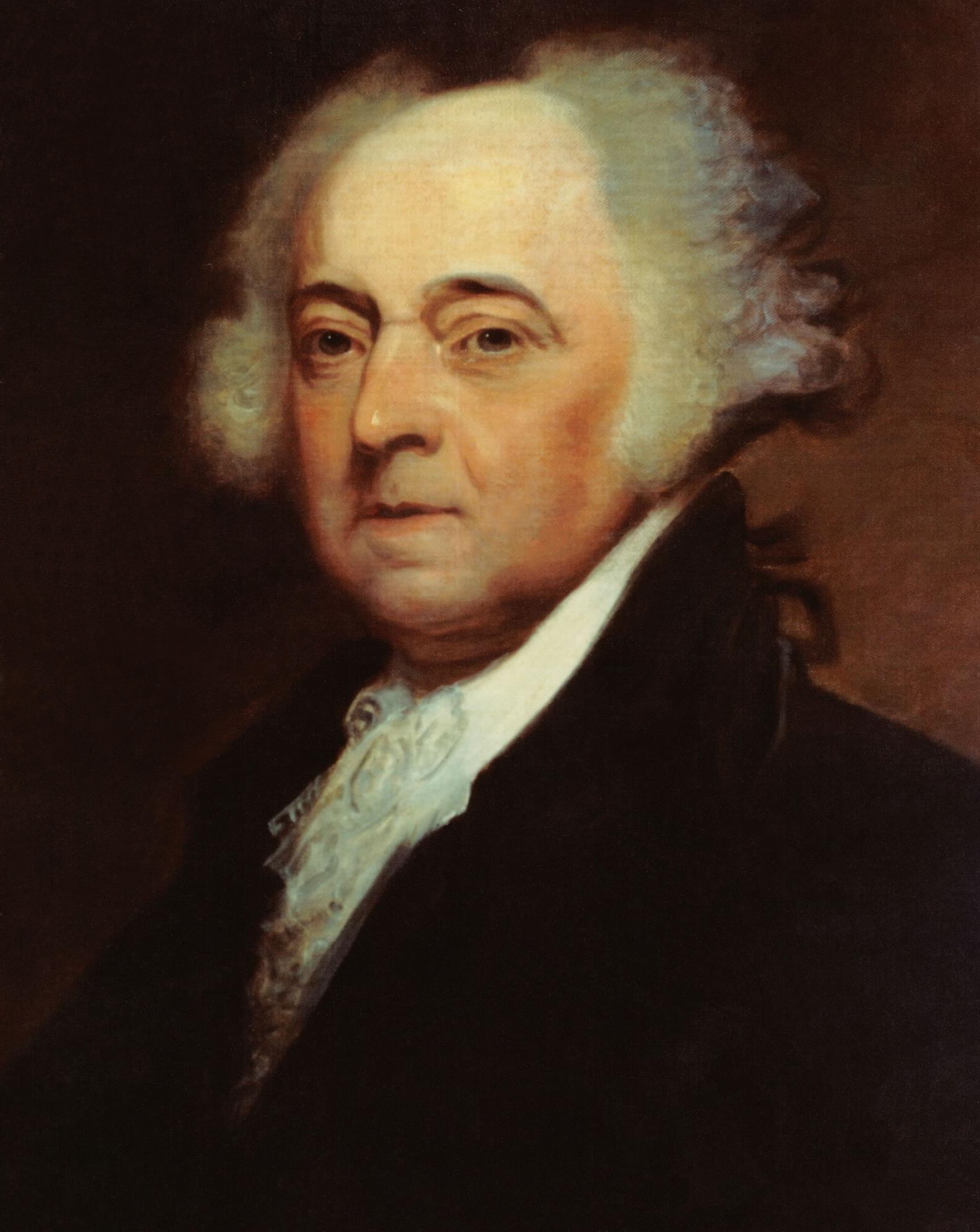
Adams is an overlooked member of the founding generation, and he was easily the most accomplished scholar of that group. Trained as a lawyer but with a deep grounding in the classics (with a command of both Latin & Greek), Adams was well-versed not only in English legal theory but in the theological and philosophical controversies of the day. While Jefferson has a reputation of being a deep thinker, Adams actually was one. For Russell Kirk, Adams was an intellectual giant among our nation's presents. Thanks to the work of David McCulloch and the miniseries based on his book about Adams there has been a bit more appreciation of Adams, but not nearly enough.

Monday, October 26, 2015

John Adams on Judaism's influence on human history

From one of our most important founding fathers and the second president of the United States:
I will insist the Hebrews have [contributed] more to civilize men than any other nation. If I was an atheist and believed in blind eternal fate, I should still believe that fate had ordained the Jews to be the most essential instrument for civilizing the nations ... They are the most glorious nation that ever inhabited this Earth. The Romans and their empire were but a bubble in comparison to the Jews. They have given religion to three-quarters of the globe and have influenced the affairs of mankind more and more happily than any other nation, ancient or modern.
- John Adams, Letter to F.A. Van der Kemp, dated Feb. 16, 1808.

Of the three pillars supporting western civilization -- Greco-Roman culture, the legacy of Judaism, and the prudential insights of the Enlightenment -- the most important is the legacy of Judaism.

Saturday, October 10, 2015

John Adams on the Puritan contribution to liberty

John Adams (1735-1826) wasn't just a politician, but also had a long career as a political theorist and commentator, a career that pre-dated the American Revolution by over two decades. And in his work as a theorist and commentator, Adams addressed the Puritan contribution to human liberty. Interestingly enough, Adams's religious views do do not fit within the mould of orthodox Protestants. That being the case, it is noteworthy that in his early work Adams had a very high regard for those most orthodox of Calvinists, the Puritan fathers of New England.

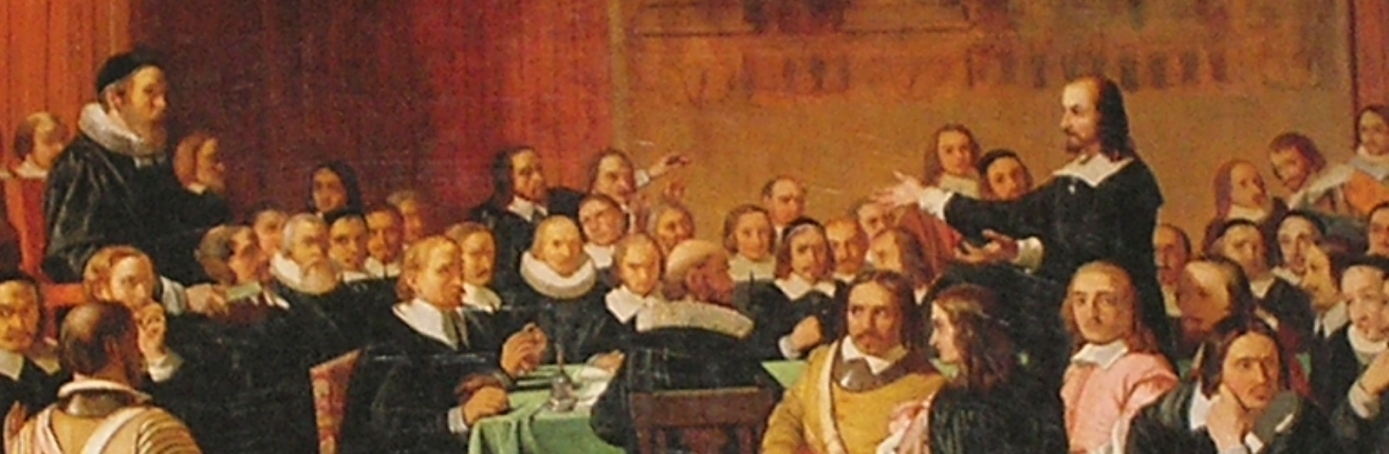
In A Dissertation on the Canon and Feudal Law, written in 1765 (circa the time of the French and Indian War), Adams wrote as a subject of the British crown and a patriot of the Empire. He begins his discussion of the Puritans in that text by noting that the Puritans were seen as "enthusiastical, superstitious, and republican" by many of the proper people of Adams's day. Adams strongly attacks such views of the Puritans, stating that they were "grossly injurious and false." The Puritans, Adams contends, were no more enthusiasts than the other sects within the Christian religion, and that their religious fervor, while a "noble infirmity," was also a source of strength for the group: "far from being a reproach to them," Adams wrote, their devotion "was greatly to their honor." Adams then goes on to describe how the Puritans sought to fuse reason and religion, a commitment to biblical faith with the prudential considerations of practical men. "Human and benevolent principles," Adams wrote, were the basis of Puritan policy.

While modern readers and scholars might object to Adams's characterization of motivations of the Puritans, Adams saw in the Puritans a resolute commitment to fight "Tyranny in every form, and shape, and appearance." The Puritans were willing to face punishment and even death rather than to compromise their beliefs. Their convictions serve, Adams' contends, as an example of "steady, manly, pertinacious spirit." As noted above, at the time he wrote A Dissertation, Adams was still a loyal monarchist and he went out of his way to note that the Puritans, despite their resistance to certaion policies of the British kings, were not foes of the monarchy. They rather sought a balanced government, with proper checks on the authority of both the king & the church. "[T]hey saw clearly, that popular powers must be placed as a guard a control, a balance, to the powers of the monarch and the priest, in every government, or else it would soon become the man of sin, the whore of Babylon, the mystery of iniquity, a great and detestable system of fraud, violence, and usurpation."

The Puritan commitment was to limited government, not to any one particular form of it. And the reason for their commitment to limited government was grounded in their ultimately religious view that human nature is such to render a limitless government a mechanism of tyranny. The Puritans had a strong commitment to secular reform & an even stronger commitment to religious renewal, so much so that Adams characterizes ecclesiastical reform as "[t]heir greatest concern." For them, secular & religious reform were not separate & distinct, but built off each other. Thus, the Puritans sought, according to Adams, to live in a state that upheld "the dignity of human nature." This two-fold commitment lead the Puritans to seek thoroughgoing reform of both secular and ecclesiastical institutions, removing "feudal inequalities and dependencies as could be spared."

Undergirding all this, as Adams notes, was the Puritan hostility to the Catholic religion, with its rituals & its ecclesiastical doctrines. The idea of a priest, Adams writes, was one which "no mortal could deserve, and as always must, from the constitution of human nature, be dangerous in society." Thus, the Puritans sought to purge the Protestant church of the vestiges of Catholicism, to preserve the spiritual & secular liberty that they saw due to every man. Instead of a priesthood, Adams contents the Puritans looked to establish ministry "on the foundation of the Bible and common sense." In doing so, the Puritans stressed, in Adams's account, the characteristics of "industry, virtue, piety, and learning." This had the effect of creating a people who were far more "independent on the civil powers" than those who lived in "a scale of subordination, from a pope down to priests and friars and confessors -- necessarily and essentially a sordid, stupid, and wretched herd." That the church of England continued, in modified form, to uphold the same system of subordination earned it the same disdain from the Puritans & Adams alike.

With Adams's early presentation of the Puritans, one sees the blossoming of "the Puritan myth" in American history. While much of his analysis may be disputed in light of modern scholarship, Adams's overview encapsulates what was to become the dominant view of the Puritans in the early American Republic. And there is little doubt that the Puritan refusal to compromise principle when faced with the demands of unlimited government did much to inspire the American patriots in the time prior to, during and immediately after the break with the British Empire.


[Edited from a post I originally wrote for American Creation.]

Wednesday, July 08, 2015

John Adams on divine providence, liberty & equality under the law

An interesting essay on that topic by J.W. Cooke is now posted over at the First Principles blog: The Fragile Balance: John Adams on Liberty and Equality. Adams' view of liberty was grounded in a belief in divine providence, as Cooke points out, a providence that decreed not only the fate of nations but also the fate of individuals. Since providence would place different people in different circumstances, strict equality was not only undesirable, it was impossible.

What was possible, Adams believed, was equality of personhood before the law. And as Cooke explains, Adams saw four vehicles by which such equality could be brought about:
Adams looked to four sources for a tolerable solution to this painful dilemma. The first was Christianity. “The only equality of man that is true,” he wrote,“was taught by Jesus: ‘Do as you would be done by.’ The same Jesus taught ‘Render to Caesar the things that are Caesar’s.’’’ A second source of amelioration involved the inculcation of virtue and knowledge. “The way to improve society and reform the world,” he admonished his readers, “is to enlighten men, spread knowledge, and convince the multitude that they have, or may have, sense, knowledge, and virtue.” The latter, in particular, required a negation of selfishness that would do much to mitigate the rapacity of the rich and the misery of the poor. Third, if the poor could be indoctrinated in the virtues of thrift and industry, if they could be taught that their property might be improved by hard work and self-denial, then much envy would be deflected and much social unrest averted. A more mundane key to peace was balanced government. Adams argued that the Constitution had gone as far as man ought in establishing an “equality of rights.” The interests of the poor were balanced against those of the rich in the legislature, while the powers of the executive and those of the legislative and the judicial in turn were matched. The result, Adam hoped, would be an equilibrium of power (a balance of forces) that would prevent a factional or individual despotism.
Cooke's essay is an insightful glimpse into the thought of one of our most philosophical founders. Well worth a read.

[Cross-posted over at American Creation.]

Monday, June 29, 2015

Politics in the pulpit: two views from two Johns (John Jay & John Adams)

John Jay is an often-overlooked Founding Father when it comes to questions of religion in the public square. An orthodox Protestant Christian with a strong aversion to Roman Catholicism, Jay was nonetheless a proponent of religious liberty as a general proposition who believed that while religion should have a role in guiding the moral development of society, it should also refrain from stating positions on every political issue.

This is evident in one of Jay's letters to Jedidiah Morse, where Jay wrote as follows:
Although the mere expediency of public measures may not be a proper subject for the pulpit, yet, in my opinion, it is the right and duty of our pastors to press the observance of all moral and religious duties, and to animadvert on every course of conduct which may be repugnant to them. 
- Letter dated January 1, 1813.

Jay is far from advocating a naked public square in his work, but his statement to Morse demonstrates a concern that pastors not address political issues beyond the specific competency of religion to address -- those issues that directly impacted on moral & religious duties. This active though restrained role was, to Jay, one that was supported by the witness of the Old Testament.

John Adams also addressed the role that religious preaching should play in the political life of the commonwealth. As he wrote prior to the formal outbreak of the American Revolution:
It is the duty of the clergy to accommodate their discourses to the times, to preach against such sins are most prevalent, and recommend such virtues as are most wanted. For example, -- if exorbitant ambition and venality are predominant, ought they not to warn their hears against those vices? If public spirit is much wanted, should they not inculcate this great virtue? If the rights and duties of Christian magistrates and subjects are disputed, should they not explain them, show their nature, ends, limitations, and restrictions, how much soever it may move the gall of Massachusettensis?
- John Adams, Novanglus (1774) reprinted in In God We Trust: The Religious Beliefs and Ideas of the American Founding Fathers, ed. by Norman Cousins (Harper & Brothers: 1958), pg. 90.

For Adams as much as for Jay, the role of preachers was to stir the hearts of their listeners to do good and to emulate virtue, while not avoiding necessary public issues in an explanation of the duties that believers have in the political arena.  When thinking on the role of formal religion in public life, it might be a good idea to pay attention to John Jay's sage words regarding the proper role intersection of politics and the pulpit.