Tradition is not the worship of ashes, but the preservation of fire.—Gustav Mahler

Tuesday, March 29, 2022

Monday, March 28, 2022

Academics Predicting the Future

Volume 2 Steven Gow Calabresi, The History and Growth of Judicial Review, ch 11—‘The European Union and the Council of Europe’ 267, 277 (NY: Oxford University Press, 27 April 2021), <https://global.oup.com/academic/product/the-history-and-growth-of-judicial-review-volume-2-9780190075736?q=calabresi&lang=en&cc=us>:


“I expect that once confronted with the economic consequences of Brexit, one year from now, U.K. voters will come to rue the day they voted by a tiny margin in favor of Brexit.”

Tillman adding: I wonder how many who read this passage saw (or now see) the ambiguity in Professor Calabresi’s wording?

Seth


Seth Barrett Tillman, ‘Academics Predicting the Future,’ New Reform Club (Mar. 28, 2022, 5:16 AM), <https://reformclub.blogspot.com/2022/03/academics-predicting-future.html>; 


Tweet: <https://twitter.com/SethBTillman/status/1508372863413325826>; 


Friday, March 25, 2022

Zephyr Teachout on Inflation


Seth Barrett Tillman, ‘Zephyr Teachout on Inflation,’ New Reform Club (Mar. 25, 2022, 12:20 PM), <https://reformclub.blogspot.com/2022/03/zephyr-teachout-on-inflation.html>; 

Tweet: <https://twitter.com/SethBTillman/status/1507390787822268418>; 

Welcome Instapundit Readers!


Sunday, March 20, 2022

Bill the Pony and Windfola


“Tolkien made sure we knew that Bill the [P]ony was ok, but never once stopped to tell me that Windfola [Eowyn’s horse] was ok.” (@spectraling)


Bill the Pony came from Bree. He is one of us—one of ours—we take a personal or familial interest in Bill. On the other hand, Windfola was part of a foreign heroic warrior culture. We sympathize and hope for Windfola’s wellbeing. But Windfola is not one of ours (i.e., one of the readers’). Tolkien’s world only makes coherent sense if our local attachments are meaningful and remain so in spite of [our] meeting the greater wider world—even where that wider world is in some sense more ancient, more beautiful, and more noble than our own. At Mt Doom, Sam was reluctant do die NOT so that he might return to the ‘west’ of Middle Earth. Rather, he wanted to return to his home—the Shire, Hobbiton, and Bag End. That is why the loss of the Party Tree was a real, significant, personal loss ... in a way that a whole forest elsewhere would not be (to Sam Gamgee and to us).


Seth Barrett Tillman, ‘Bill the Pony and Windfola,’ New Reform Club (Mar. 20, 2022, 5:11 AM), <https://reformclub.blogspot.com/2022/03/bill-pony-and-windfola.html>; 

Tweet: <https://twitter.com/SethBTillman/status/1504836615281201155>; 

Glenn Reynolds, ‘BILL THE PONY AND WINDFOLA,’ Instapundit (Mar. 20, 2022, 6:44 PM), <https://pjmedia.com/instapundit/510534/>; 

Welcome Instapundit Readers! 


Friday, March 18, 2022

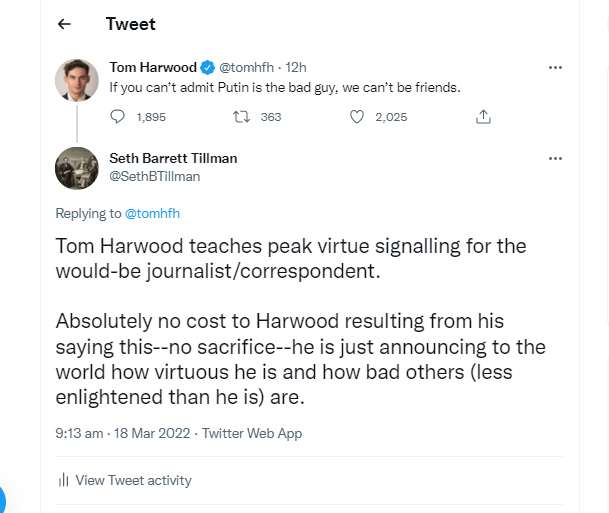
Teaching Peak Virtue Signalling


Seth Barrett Tillman, ‘Teaching Peak Virtue Signalling,’ New Reform Club (Mar. 18, 2022, 5:20 AM), <https://reformclub.blogspot.com/2022/03/teaching-peak-virtue-signalling.html>; 


Thursday, March 17, 2022

On Jacob Henry and 1809

 This is how my most recent article ends:

So why did [Jacob Henry] do it? We can only guess. Henry wanted to smooth things over; he wanted to fit in; he probably thought no one would notice. What followed were consequences he did not plan, and what he came to stand for in the popular mind may have been principles to which he did not subscribe. The service he did his country through the popular reimagination of November 20, 1809 was not of his own making.

By the 1820 census, Henry had migrated to Charleston, South Carolina, and established connections with its relatively large and affluent, by New World standards, Jewish community. One guesses that among them, Henry would find some comfort—among his coreligionists and the descendants of Marranos, and other crypto-Jews. He could enjoy basking in their and others’ pleasant admiration, and they would not ask too many uncomfortable questions.

As few have since.

Dublin, on the Liffey, 16 Adar 5781


From: Seth Barrett Tillman, What Oath (if any) did Jacob Henry take in 1809?: Deconstructing the Historical Myths, 61(4) Am. J. Legal Hist. 349–384 (2021) (footnotes omitted) (peer review), <https://tinyurl.com/3etu53m3>, <https://ssrn.com/abstract=3790115>.


Seth Barrett Tillman, ‘On Jacob Henry and 1809,’ New Reform Club (Mar. 17, 2022, 1:56 PM), <https://reformclub.blogspot.com/2022/03/on-jacob-henry-and-1809.html>.

Armchair Warrior


Seth Barrett Tillman, ‘Armchair Warrior,’ New Reform Club (Mar. 17, 2022, 3:46 AM), <https://reformclub.blogspot.com/2022/03/armchair-warrior.html>; 


Wednesday, March 16, 2022

U.S. and Mexico: COVID19


Seth Barrett Tillman, ‘U.S. and Mexico: COVID19,’ New Reform Club (Mar. 16, 2022, 4:17 AM), <https://reformclub.blogspot.com/2022/03/us-and-mexico-covid19.html>; 


Tuesday, March 15, 2022

Global Free Trade


Seth Barrett Tillman, ‘Global Free Trade,’ New Reform Club (Mar. 15, 2022, 6:23 AM), <https://reformclub.blogspot.com/2022/03/global-free-trade.html>; 


Friday, March 11, 2022

An Academic Coda on Kyle Rittenhouse


On October 22, 2021, Professor Jon D. Michaels & Dean David L. Noll posted Legal Vigilantes and the Institutionalization of Anti-Democratic Politics on the Social Science Research Network. See <https://ssrn.com/abstract=3915944>. On page 23, the two law professors wrote: “Kyle Rittenhouse, the heavily-armed murderer of two BLM protestors, has been hailed as a heroic vigilante . . . .” (emphasis added) In support of the position they took at that time, they cited an article by Paige Williams in The New Yorker. See Seth Barrett Tillman, ‘Rittenhouse, Murder, and the Use of “See” as Direct Support in Legal Writing,’ New Reform Club (Nov. 21, 2021, 7:47 AM), <https://reformclub.blogspot.com/2021/11/rittenhouse-murder-and-use-of-see-as.html> (reproducing extracts from Michaels and Noll’s original 2021 publication).

On February 14, 2022, Michaels and Noll posted a new draft, appearing at the same Social Science Research Network link: <https://ssrn.com/abstract=3915944>. The revised paper is now titled: Vigilante Federalism. [The Michaels and Noll’s paper is now marked as forthcoming in Cornell Law Review.] At page 35, they now write: “Kyle Rittenhouse, who shot and killed two BLM protestors, has been hailed as a heroic vigilante . . . .” (emphasis added) And again, they support their position with a citation to Williams’ article in The New Yorker.

One would think a shift from “murderer” to “shot and killed” might call for some explanation. “Murderer” is a term of opprobrium—it carries with it the judgment that the person acted illegally, or acted without moral justification, or both. “Shot and killed” is less judgmental. This latter characterization leaves open the possibility that: the defendant was not a wrongdoer, or the defendant acted with a recognized legal defense, or both. In other words, the difference between murderer and shot and killed is no small thing, and an exploration of the authors’ shift in position might be part of a thoughtful publication.

It strikes me that there are several possible explanations for the authors’ shift in position. Here, I discuss two of those possible explanations.

First, it is possible that the authors have not shifted their position at all. Rather, they have just changed their tack or tactics, if only to avoid their being defendants in a defamation action brought by Rittenhouse. In other words, their opinion of Rittenhouse has not changed. If so, their lack of transparency and directness with the reader, would seem to undermine some of the worthiness for publication.

Second, the authors now understand, in light of the jury’s verdict, that their original position lacks clear support. Their new position is accurate, but it refrains from making any direct judgment about the rightness of Rittenhouse’s conduct. Perhaps, the authors believe that Rittenhouse may be a legal wrongdoer, and he will or would be judged a wrongdoer under the more lenient civil standard. In other words, the authors are acknowledging that they do not know if Rittenhouse acted illegally or morally wrongfully. And they are leaving it to the reader to figure out if Rittenhouse’s conduct was illegal or otherwise wrongful. But if they cannot reach a judgment on the matter, and if they are unwilling to affirm their own lack of clarity, then why write on the topic? And, why do so a second time? Would it not make more sense to acknowledge that the situation is less than fully clear?

What the authors could have done—is to acknowledge that legal academics (and academics generally) suffer from all the limitations the rest of humanity suffers from.


Academics make mistakes.

They join in group think.

They retract.

Sometimes they do not even notice that they are retracting.

And they cover their tracks.

It is not a very pretty picture.


Seth Barrett Tillman, ‘An Academic Coda on Kyle Rittenhouse,’ New Reform Club (Mar. 11, 2022, 4:32 AM), <https://reformclub.blogspot.com/2022/03/an-academic-coda-on-kyle-rittenhouse.html> (the language of the original post was amended for clarity); 

and,

Seth Barrett Tillman, ‘Rittenhouse, Murder, and the Use of “See” as Direct Support in Legal Writing,’ New Reform Club (Nov. 21, 2021, 7:47 AM), <https://reformclub.blogspot.com/2021/11/rittenhouse-murder-and-use-of-see-as.html>.


The Left and Public Transportation


Seth Barrett Tillman, ‘The Left and Public Transportation,’ New Reform Club (Mar. 11, 2022, 2:32 AM), <https://reformclub.blogspot.com/2022/03/the-left-and-public-transportation.html>; 


Monday, March 07, 2022