Tradition is not the worship of ashes, but the preservation of fire.—Gustav Mahler
Showing posts with label rule of law. Show all posts

Saturday, February 13, 2016

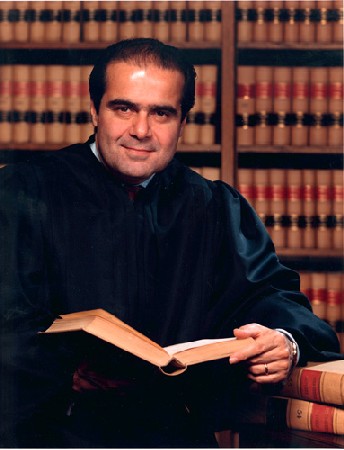
Antonin Scalia on living constitutionalism and "the brooding omnipresence in the sky"

"If there was any thought absolutely foreign to the founders of our country, surely it was the notion that we Americans should be governed the way that Europeans are - and nothing has changed."

So said Justice Scalia at the American Enterprise Institute on 2/21/06.  Full text here, C-SPAN video here. As the now departed justice said:
The American people can make their will well enough known by creating new rights legislatively, or in the last analysis by amending the Constitution per Article V. One who believes that it falls to the courts to update the list of rights guaranteed by the constitution tends to be one who believes in a platonic right and wrong, which wise judges are able to discern when the people at large cannot.
In fact, it has occurred to me that this notion of an overarching moral law that is binding upon all of the nations of the world -- and with which all the judges of all of the nations of the world are charged with interpreting -- has replaced the common law.
Those of you who are lawyers will remember that, in the bad old days, that is to say, before Erie RR v. Tompkins [304 US 64, 78 (1938)], the courts believed that there was a single common law, it was up there in the stratosphere. Now, the state courts of California said it meant one thing, the state courts of New York said it meant something else, and the Federal Courts might say it meant a third thing. But one of them was wrong! Because there really is a common law, and it's our job to figure out what it is. So in those days, any common-law decision of one state would readily cite common-law decisions of other states, because all the judges were engaged in the enterprise of figuring out the meaning of what Holmes called "the brooding omnipresence in the sky" of the common law.
Well, I think we've replaced that with the law of human rights. Which is a moral law, and surely there must be a right and a wrong answer to these moral questions -- whether there's a right to an abortion, whether there's a right to homosexual conduct, what constitututes cruel and unusual punishment, and so on -- surely there is a right and wrong moral answer. And I believe there is, but the only thing is, I'm not sure what that right answer is. Or at least, I am for myself, but I'm not sure it's the same as what you think.
And the notion that all the judges in the world can contemplate this brooding omnipresence of moral law, cite one another's opinions, and that somehow, they are qualified by their appointment to decide these very difficult moral questions . . .
It's quite surprising to me, but I am sure that this is where we are. There really is a brotherhood of the judiciary who indeed believe that it is our function as judges to determine the proper meaning of human rights, and what the brothers and sisters in one country say is quite relevant to what the brothers and sisters in another country say. And that's why I think, if you are a living constitutionalist, you are almost certainly and internationalist living constitutionalist.
... 
If there was any thought absolutely foreign to the founders of our country, surely it was the notion that we Americans should be governed the way that Europeans are - and nothing has changed. I dare say that few of us here would like our life or liberty subject to the disposition of French or Italian criminal justice, not because those systems are unjust, but because we think ours is better. What reason is there to believe that other dispositions of a foreign country are so obviously suitable to the morals and beliefs of our people that they can be judicially imposed through constitutional adjudication? And is it really an appropriate function of judges to say which are and which aren't? I think not.
Thank you. [applause]
Requiescat in pace, brother Nino.  Applause.

Tuesday, December 22, 2015

Helpful clarity about the Declaration of Independence

One of the things that amazes me, as a lawyer and as an educator, is how much confusion there is about what the Declaration of Independence is and what it isn't, and not just among regular citizens but among historians and legal scholars.  In my day job, I've published on the non-binding legal character of the Declaration, and over at the Law & Liberty blog Greg Weiner has published a helpful post reinforcing that point by pointing out the nature of the document: What the Declaration Doesn't Say.  In words that echo the fundamental insights of men like Russell Kirk and M.E. Bradford, Weiner writes:
[T]he Declaration must be properly contextualized. It is a founding document but not a framing document, which is to say it does not have legal standing in the same way the Constitution does. When Justice Brennan, for example, grounded his activist jurisprudence partly in the ideals of the Declaration, he imported a document into constitutional law that simply has no place there. But this is not a liberal trope alone. As Ralph Rossum has shown, the Declaration plays a prominent role in Justice Thomas’ jurisprudence as well: the Constitution, in his understanding, was meant to fulfill the aspirations of the Declaration. 
While there is no question that the Declaration is a key document in American history and expresses in a unique and almost sacred way the key principles of the American Revolution, it is not a constitutional document. It is a pre-constitutional one, establishing the conditions upon which the American Republic could frame its fundamental legal charters -- first the Articles of Confederation and then the Constitution of 1789. While the Constitution builds upon many of its insights (particularly the protection of natural rights through the due process clauses of the 5th and the 14th Amendments), the Declaration is not a legally authoritative document.

Tuesday, December 15, 2015

Where do our rights come from?

  • "We, the people of the state of Idaho, grateful to Almighty God for our freedom, to secure its blessings and promote our common welfare do establish this Constitution." -- Preamble to the Idaho State Constitution.
  • "We, the people of the Commonwealth of Pennsylvania, grateful to Almighty God for the blessings of civil and religious liberty, and humbly invoking His guidance, do ordain and establish this Constitution." -- Preamble to the Pennsylvania State Constitution.
  • "We, therefore, the people of Massachusetts, acknowledging, with grateful hearts, the goodness of the great Legislator of the universe, in affording us, in the course of His providence, an opportunity, deliberately and peaceably, without fraud, violence or surprise, of entering into an original, explicit, and solemn compact with each other; and of forming a new constitution of civil government, for ourselves and posterity; and devoutly imploring His direction in so interesting a design, do agree upon, ordain and establish the following Declaration of Rights, and Frame of Government, as the Constitution of the Commonwealth of Massachusetts." -- Preamble to the Constitution of the State of Massachusetts.

Monday, November 30, 2015

Remembering Corizon Aquino

[Picture: Corazon Aquino in 1986 during the People Power movement that lead to the downfall of the regime of dictator Ferdinand Marcos.]

I was thinking recently about politicians of faith who stand up to restore ordered liberty to their societies, and former Philippine president Corizon Aquino came to mind. Here's a news story about her passing in 2009: Sad news today on the death of former Philippine president Corazon Aquino. The widow of slain democracy activist Benigno Aquino, Cory (as she was known) led the People Power uprising that ousted dictator Ferdinand Marcos from power in 1986, bringing democracy and the promise of human rights to the people of the Philippines.

A woman of faith, she was motivated by her strong Catholic convictions into standing up for the rights of the people. A woman who loved her family, she worked to carry on her murdered husband's legacy. A proud patriot who believed in a Republic with the rule of law and respect for each human person, she was a symbol of hope for the millions of people who took to the streets during the People Power movement, ushering in the first of many revolutions for freedom in the late 1980's.

Like Lech Walensa in Poland, she was convinced that her mission to stand for human liberty was part of her vocation as a Christian. After she became president, there were constant coup attempts against her -- questioned as to how she could hold on to preserve the rule of law in the country in the face of such relentless lawlessness, she responded simply, "If the country needs me, God will spare me." She was an example not only to the people of the Philippines, but to freedom-loving people the world over. I remember as a high school student here in the States watching the news reports of the People Power revolution in the Philippines, and seeing her pride and dignity and determination to vindicate the legitimate rights of the Filipino people.

Like the other great leaders of the 1980's -- Ronald Reagan, St. John Paul II, Margaret Thatcher -- she understood the call of freedom, and the yearning of the human heart to be free. Aquino was not a perfect president, and her regime had its fair share of problems. The corruption within Philippine politics was more than any single politician could remove. But she served the people as best she could, and she always kept in the forefront the interests of her country. She was an example of all who live in challenging times, to all who face choosing to give in to tyranny or to fight -- peacefully, non-violently and in the power of the Gospel -- for liberty and human rights. Maraming salamat po sa inyo, Corazon Aquino.

Monday, November 02, 2015

Russell Kirk on Magna Carta

The old Western Confucian blog has a very good post quoting the late Russell Kirk on the origins of the Anglo-American concept of constitutional government and the rule of law: Russell Kirk on the Great Charter. Well worth a read.

As Kirk was wise to point out, and not just on this topic, American institutions and American approaches to law and politics are grounded on the English experience upon which the American colonies built. That history is part of the web and woof of our country's laws, customs and traditions. To be ignorant of that history is to be ignorant of ourselves.

If interested, here's an online English translation of the original Latin text of Magna Carta, available through Fordham University's website.

Thursday, October 15, 2015

Why do human beings have laws?

As in most things, there is wisdom to be found in the works of the Angelic Doctor:
Man has a natural aptitude for virtue; but the perfection of virtue must be acquired by man by means of some kind of training. Thus we observe that man is helped by industry in his necessities, for instance, in food and clothing. Certain beginnings of these he has from nature, viz. his reason and his hands; but he has not the full complement, as other animals have, to whom nature has given sufficiency of clothing and food. Now it is difficult to see how man could suffice for himself in the matter of this training: since the perfection of virtue consists chiefly in withdrawing man from undue pleasures, to which above all man is inclined, and especially the young, who are more capable of being trained.
Consequently a man needs to receive this training from another, whereby to arrive at the perfection of virtue. And as to those young people who are inclined to acts of virtue, by their good natural disposition, or by custom, or rather by the gift of God, paternal training suffices, which is by admonitions. But since some are found to be depraved, and prone to vice, and not easily amenable to words, it was necessary for such to be restrained from evil by force and fear, in order that, at least, they might desist from evil-doing, and leave others in peace, and that they themselves, by being habituated in this way, might be brought to do willingly what hitherto they did from fear, and thus become virtuous. Now this kind of training, which compels through fear of punishment, is the discipline of laws. Therefore in order that man might have peace and virtue, it was necessary for laws to be framed: for, as the Philosopher [Aristotle] says (Politics. i, 2), "as man is the most noble of animals if he be perfect in virtue, so is he the lowest of all, if he be severed from law and righteousness"; because man can use his reason to devise means of satisfying his lusts and evil passions, which other animals are unable to do.
St. Thomas Aquinas (1225-1274), Summa Theologica/Treatise on Law, I, II, Q. 95, Art. 1, translated by the Fathers of the English Dominican Province (Benzinger Bros., 1947).

Monday, September 28, 2015

The public value of religious faith

In the midst of the "new atheist" attack on the value of religion as a public good, British philosopher Roger Scruton took part in a discussion regarding that topic over at the UK Independent online: Scruton defended religion as a force for good in society. As Scruton stated:
The rituals of religion are shared and those who participate in them are drawn into another kind of relationship with their neighbours than those that prevail in the world of "getting and spending". People hunger for this kind of membership and the power of religion resides in its ability to provide it. In the rituals of a religion all worldly differences are overcome: the Sultan bows in submission beside his subjects and the good-natured fool takes communion beside the crook who cheated him. The ritual shines on both of them from a place beyond their ordinary experience and includes them in a community whose home is in some way not of this world. And in the Christian case the ritual records a primeval sacrifice, born of love.
In addition to its ability to provide consolation and to help people deal with "metaphysical loneliness," Scruton contends that religion can incubate fundamental virtues like humility & justice as well as reinforce the principle of human equality:
[Religion] contains idiocy, prejudice, ignorance and stupidity in all the proportions that these are displayed by mankind as a whole. But that is its great virtue: it can draw people, whatever their talents and intellectual powers, into a shared apprehension of their condition. It can teach humility and justice, and remind the one with power, knowledge, wealth or artistic talent, that he is the equal of the one beside him in the moment of worship, however ignorant, weak or sinful that person might be. And to both of them it offers hope.
I would add one point to Scruton's argument -- that religion can serve as a counterweight to both radical individualism and overwhelming state power.  Religion at its best calls human beings beyond themselves to care for others and to be concerned not with their own wants and desires, but with transcendent moral truth.  For the same reason, religion can serve as a balance against the power of the state -- when the state demands immoral action, religion can provide the intellectual framework and moral tradition to thwart tyranny.  Martin Luther King, Jr., Oscar Romero, Franz Jäggerstatter, Lech Walesa, and others too numerous to mention testify to this fact.  


This point is so strong that even Christopher Hitchens acknowledged it. As the dying writer said during a public discussion with his younger brother Peter: 
When Lech Walesa was starting his work in the Polish shipyards and the Polish Militia and the outer ring of the Polish Army were closing in on Gdansk, he was interviewed with his then fairly small group, and he was asked: “Aren't you frightened, aren't you afraid? You've taken on a whole powerful state and army - aren't you scared?” And he said: “I'm not frightened of anything but God or anyone but God.”
Christopher Hitchens then went on to acknowledge that he wouldn't have been able to say anything like that and that it was a "noble" idea; he was spot on with that observation. Almost to a man, the American Founders understood that it was faith in God, a God who stood above and beyond the State, that makes the idea of limited government possible, that makes the idea of human rights possible, that makes the idea of common, ordinary people rising up to resist tyranny possible. It is this concept that underpins some of the most soaring language in the Declaration of Independence:
We hold these truths to be self-evident, that all men are created equal, that they are endowed by their Creator with certain unalienable Rights, that among these are Life, Liberty and the pursuit of Happiness.--That to secure these rights, Governments are instituted among Men, deriving their just powers from the consent of the governed, --That whenever any Form of Government becomes destructive of these ends, it is the Right of the People to alter or to abolish it, and to institute new Government, laying its foundation on such principles and organizing its powers in such form, as to them shall seem most likely to effect their Safety and Happiness.
This concept of transcendent authority in support of liberty was part and parcel of republican principle at the time of the American Founding. As Benjamin Rush put it:
I have always considered Christianity as the strong ground of republicanism.  The spirit is opposed, not only to the splendor, but even to the very forms of monarchy, and many of its precepts have for their objects republican liberty and equality as well as simplicity, integrity, and economy in government.  It is only necessary for republicanism to ally itself to the Christian religion to overturn all the corrupted political and religious institutions in the world.
-- Letter from Benjamin Rush to Thomas Jefferson, August 22, 1800, quoted in The Founders on Religion:  A Book of Quotations, edited by James H. Hutson (Princeton:  2005), pg. 195.

The American abolitionists during the 19th century understood this.  The civil rights movement was built on this idea.  As Hitchens points out, one of the great leaders in modern Europe's struggle for liberty, Lech Walesa, lived this principle. Without religious faith, without the belief that God stands above all merely human institutions and will hold all of us accountable for the good and evil that we do, the tapestry of human rights, the rule of law and the freedom of the human person is difficult if not impossible to maintain over time.

As a consequence, religious faith, particularly Christianity, has a critical public role in the preservation of liberty & the idea of the limited state. Human beings will look for an ultimate authority -- as St. Augustine observed in his Confessions, "our hearts are restless until they rest in Thee, O Lord" -- and if people seek it not from heaven, they will look for it here on earth. And for examples of where an earthly ultimate authority leads, one needs only look at the slaughterhouses of the 20th century.

Tuesday, June 30, 2015

"The greatest security in a Republic"

Alexander Hamilton on the best defense of the American system of government, namely respect for the laws that govern us: 
If it were to be asked, What is the most sacred duty and the greatest security in a Republic? the answer would be, An inviolable respect for the Constitution and Laws -- the first growing out of the last.  It is by this, in a great degree, that the rich and powerful are to be restrained from enterprises against the common liberty -- operated upon by the influence of a general sentiment, by their interest in the principle, and by the obstacles which the habit it produces erects against innovation and encroachment.  It is by this, in a still greater degree, that caballers, intriguers, and demagogues are prevented from climbing on the shoulders of faction to the tempting seats of usurpation and tyranny.
- Alexander Hamilton (1755-1804), Tully No. III, Aug. 28, 1794, reprinted in Alexander Hamilton:  Writings (Library of America:  2001), pg. 830.

Of course, it helps if those laws are themselves respectable.