Let me paint with a very broad brush and offer my best explanation. The primary reason, I think, is the nature of the Supreme Court's docket in the last fifty years. During that period, most high profile Supreme Court constitutional law decisions have considered whether to ban practices embraced by conservatives rather than whether to ban practices embraced by liberals. For conservatives — especially social conservatives, and especially religious conservatives — the question has been whether the courts will allow their views, not whether the courts will mandate them. Think about abortion, school prayer, gay rights, flag burning, the death penalty — you know, the real "hot button" issues. In each of these areas, a victory for the conservative side means that the political process is left unaltered. On the other hand, a victory for the liberal side means that the court intervenes and mandates that the majority preference — the generally conservative view — is out of bounds. That's generally the opposite of the experience for those on the liberal side of the political spectrum over the last few decades. For liberals, the key question usually has been whether the courts will mandate their views, not whether the courts will allow them. On most of the hot button issues, a victory for the liberal side means that liberals are saved the trouble of going through the political process. A loss doesn't mean their view is not permitted, only that the issue is dealt with in the elected branches like most other issues.Perspective.
Tradition is not the worship of ashes, but the preservation of fire.—Gustav Mahler
Showing posts with label Supreme Court. Show all posts
Thursday, March 31, 2016
The key reason conservatives care about Supreme Court appointments
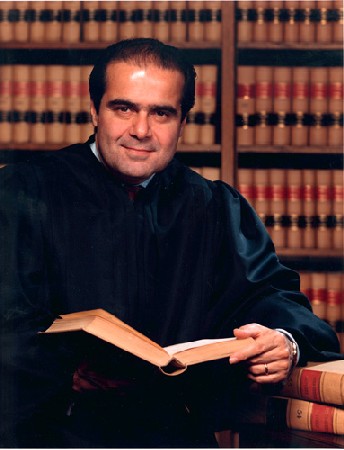
Given the current status of the Supreme Court after the passing of Justice Scalia, and the various maneuvers by politicians on both sides of the aisle regarding the appointment of another jurist to the Supreme Court, it might be helpful to look at an older piece by legal scholar Orin Kerr exploring the importance that conservatives and Republicans (not always the same thing) put on Supreme Court appointments. Read his thoughts here. Kerr hits the nail right on the head when he writes:
Saturday, February 13, 2016
Antonin Scalia on living constitutionalism and "the brooding omnipresence in the sky"
"If there was any thought absolutely foreign to the founders of our country, surely it was the notion that we Americans should be governed the way that Europeans are - and nothing has changed."
So said Justice Scalia at the American Enterprise Institute on 2/21/06. Full text here, C-SPAN video here. As the now departed justice said:
The American people can make their will well enough known by creating new rights legislatively, or in the last analysis by amending the Constitution per Article V. One who believes that it falls to the courts to update the list of rights guaranteed by the constitution tends to be one who believes in a platonic right and wrong, which wise judges are able to discern when the people at large cannot.
In fact, it has occurred to me that this notion of an overarching moral law that is binding upon all of the nations of the world -- and with which all the judges of all of the nations of the world are charged with interpreting -- has replaced the common law.
Those of you who are lawyers will remember that, in the bad old days, that is to say, before Erie RR v. Tompkins [304 US 64, 78 (1938)], the courts believed that there was a single common law, it was up there in the stratosphere. Now, the state courts of California said it meant one thing, the state courts of New York said it meant something else, and the Federal Courts might say it meant a third thing. But one of them was wrong! Because there really is a common law, and it's our job to figure out what it is. So in those days, any common-law decision of one state would readily cite common-law decisions of other states, because all the judges were engaged in the enterprise of figuring out the meaning of what Holmes called "the brooding omnipresence in the sky" of the common law.
Well, I think we've replaced that with the law of human rights. Which is a moral law, and surely there must be a right and a wrong answer to these moral questions -- whether there's a right to an abortion, whether there's a right to homosexual conduct, what constitututes cruel and unusual punishment, and so on -- surely there is a right and wrong moral answer. And I believe there is, but the only thing is, I'm not sure what that right answer is. Or at least, I am for myself, but I'm not sure it's the same as what you think.
And the notion that all the judges in the world can contemplate this brooding omnipresence of moral law, cite one another's opinions, and that somehow, they are qualified by their appointment to decide these very difficult moral questions . . .
It's quite surprising to me, but I am sure that this is where we are. There really is a brotherhood of the judiciary who indeed believe that it is our function as judges to determine the proper meaning of human rights, and what the brothers and sisters in one country say is quite relevant to what the brothers and sisters in another country say. And that's why I think, if you are a living constitutionalist, you are almost certainly and internationalist living constitutionalist.
...
If there was any thought absolutely foreign to the founders of our country, surely it was the notion that we Americans should be governed the way that Europeans are - and nothing has changed. I dare say that few of us here would like our life or liberty subject to the disposition of French or Italian criminal justice, not because those systems are unjust, but because we think ours is better. What reason is there to believe that other dispositions of a foreign country are so obviously suitable to the morals and beliefs of our people that they can be judicially imposed through constitutional adjudication? And is it really an appropriate function of judges to say which are and which aren't? I think not.
Thank you. [applause]
Requiescat in pace, brother Nino. Applause.
Labels:
Constitution,
constitutional law,
rule of law,
Supreme Court
Subscribe to:
Posts (Atom)