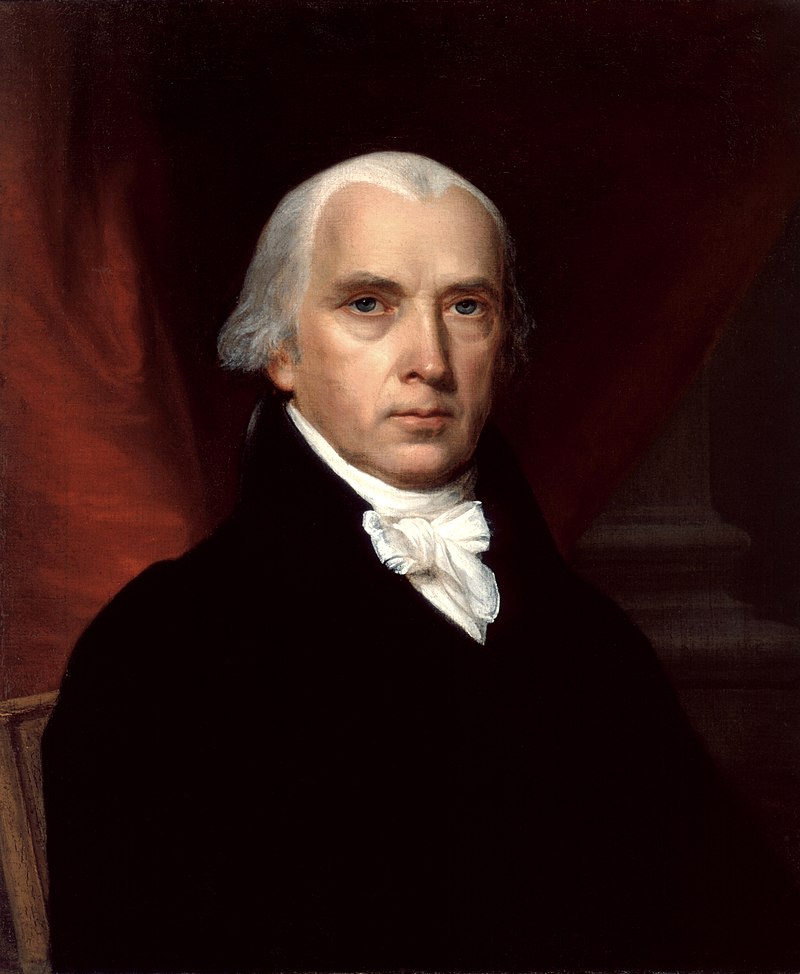
"It may not be easy, in every possible case, to trace the line of separation between the rights of religion and the Civil authority with such distinctness as to avoid collisions and doubts on unessential points. The tendency to usurpation on one side or the other, or to a corrupting coalition or alliance between them, will be best guarded agst. by an entire abstinence of the Govt. from interference in any way whatsoever, beyond the necessity of preserving public order, and protecting each sect agst. trespasses on its legal rights by others."-- Letter to the Reverend Jasper Adams, January 1, 1832.
Tradition is not the worship of ashes, but the preservation of fire.—Gustav Mahler
Showing posts with label conscience rights. Show all posts
Wednesday, May 24, 2017
James Madison on church-state separation
Wednesday, March 25, 2015
A Madisonian defense of freedom of conscience
That's provided by Ken Masugi over at the Liberty Law Blog: The Conscience of a Madisonian Conservative. I'm more of a Hamiltonian myself, but Masugi makes some very good points, particularly in light of the collapse of the distinction between public & private life that life that lies at the heart of modern liberalism. As Masugi writes, in the current state of the culture & polity, both conservatives & libertarians share a common task:
In their appreciation of the American founding, conservatives and libertarians need to recover the comprehensiveness of its understanding of man, for both external goods and those of the mind. And that means a coherent doctrine of natural right.Of course, Masugi's call for collaboration between conservatives & libertarians is premised on something which I think is very much an open issue, namely, whether libertarianism as an ideology is capable of properly discerning the line between the public & the private. While libertarian theorists generally draw the line differently than modern liberalism, many suffer from the same fundamental malady as liberalism, the tendency to make ideologically-driven category errors, in the case of libertarians assigning legitimate state functions to the private sphere.
Sunday, March 22, 2015
A libertarian argument in favor of religious liberty
Euripedes over at Self-Evident Truths provides one in this short essay on the need to stand up for the rights of religious believers: Why We Must Protect Religious Freedom in the U.S. As he writes:
By emphasizing the autonomy of faith & by fostering an atmosphere where institutions can flourish outside of the micro-managing grasp of the state, religious liberty fosters the practice of limited government. Organized religion and religious believers function to provide an alternative voice to state power. This is one reason why one of the tells of tyranny is its hostility to traditional religion, believers & institutions.
One does not need to be religious to understand this point and to come to the defense of religious believers & institutions when under attack.
You nor I may like a particular religion, or particular religious beliefs of certain individuals, but we must protect the free exercise of religion in this country if, for no other reason, than to prevent the state from dictating what is right and what is wrong. When the state defines morality, we, as people of a free society, will cease to be free.I would quibble with this argument a bit -- the state defines morality through the law all the time -- but the basic point is sound not only from a libertarian but also a conservative perspective. Aside from its theological value, religious liberty serves a critical function in limiting the power of the state to dictate moral norms without criticism. Absent religious liberty -- and coherent religious institutions within a society -- there is very little tangible limitation to the power of government.
By emphasizing the autonomy of faith & by fostering an atmosphere where institutions can flourish outside of the micro-managing grasp of the state, religious liberty fosters the practice of limited government. Organized religion and religious believers function to provide an alternative voice to state power. This is one reason why one of the tells of tyranny is its hostility to traditional religion, believers & institutions.
One does not need to be religious to understand this point and to come to the defense of religious believers & institutions when under attack.
Subscribe to:
Posts (Atom)