Tradition is not the worship of ashes, but the preservation of fire.—Gustav Mahler

Wednesday, March 23, 2016

The best thing about illegal immigration is that it's illegal

Milton Friedman:

Because it is one thing to have free immigration to jobs. It is another thing to have free immigration to welfare. And you cannot have both. If you have a welfare state, if you have a state in which every resident is promises a certain minimal level of income, or a minimum level of subsistence, regardless of whether he works or not, produces it or not. Then it really is an impossible thing.

Look, for example, at the obvious, immediate, practical example of illegal Mexican immigration. Now, that Mexican immigration, over the border, is a good thing. It’s a good thing for the illegal immigrants. It’s a good thing for the United States. It’s a good thing for the citizens of the country. But, it’s only good so long as its illegal.

That’s an interesting paradox to think about. Make it legal and it’s no good. Why? Because as long as it’s illegal the people who come in do not qualify for welfare, they don’t qualify for social security, they don’t qualify for the other myriad of benefits that we pour out from our left pocket to our right pocket. So long as they don’t qualify they migrate to jobs. They take jobs that most residents of this country are unwilling to take. They provide employers with the kind of workers that they cannot get. They’re hard workers, they’re good workers, and they are clearly better off.
So the rub is when legal immigrants have the same rights, privileges and endowments as citizens, like a $15 minimum wage or welfare or free Obamacare or food stamps or free tuition or home loans or OSHA inspectors or disability and unemployment checks...

Then we'll have to import illegal immigrants to do the work legal immigrants won't do. So it goes.

Tuesday, March 22, 2016

Illegals and the Unionized States of America

It is often said that illegal immigrants take jobs from Americans. The assertion is laughable. Let me demonstrate.

Assume an employer has contracted with a union to employ only union labor. Over time, the employer decides to find cheaper labor and brings in non-union workers. Now, in reference to the agreement the employer has with the union, the non-union workers are illegals. But, from the non-union workers point of view, they have not violated any agreement. They aren't part of the union, they haven't violated any contract because they are not under contract with anyone. The employer has violated his contract, but the scab labor, the "illegal" labor, has not.

Union leaders often characterize the "illegals" in this situation as having taken jobs, but they haven't taken anything. They didn't force the employer to hire them. They simply took a job that was offered. What was the last job anyone "took" from an employer? Can someone walk in with a gun and force The Man to hire him? Can I seriously threaten a prospective employer with car-jacking if I don't get the position or don't get my paycheck? Does anyone get a job by zip-tying a prospective employer during the interview and savagely beating him down to the ground until the position is attained? Do we actually think that's what illegals are doing? Are they "taking" the job from the employer?

How do these illegals even get jobs? Employers give them jobs. Period. We act as if America is really just one big union shop, where everyone has to have the union card before being allowed to work here. But is that what America stands for? Seriously? Even when it comes to government welfare, the situation is not significantly different. Government pays farmers to keep fields lying fallow. Government pays workers not to work. We call it "welfare". Government offers the job, hands out the money. Half of the Mexican population lives below the poverty line. When your kids are hungry, what kind of fool would turn down free money?

Conservatives like to decry union violence. How are Americans who try to stop illegals from getting jobs any different from the union thugs who prevent men and women from crossing picket lines to feed their families? Are the same conservatives who endlessly complain about the shortcomings of the "blue model" and the unions now seriously going to treat illegals as if they were scab labor in the Unionized States of America? Yet, isn't that precisely our beef against things like the perfectly legal H-1B visa? Doesn't the H-1B feel like the employer is bringing in scab labor?

We need to stop saying illegal immigrants take American jobs.
Quite obviously, that statement is completely erroneous.
American employers take those jobs ... and give those jobs to whomever they please. American hiring practices are 100% of the problem. But, once you acknowledge that, you simultaneously acknowledge that your beef isn't with the illegal immigrant at all. Your beef is with the American employer.

The point is, the employment of illegals is not up to illegals.
American business leaders are the ones who supplant American workers.
Illegals literally have no control over that.

So, if you don't like seeing illegals working for a living in these United States, take it to the employer and leave the illegal out of it. The illegal doesn't control who hires him OR who pays him. He's just trying to win the lotto, same as anyone else. He can't even get a ticket (a job) unless an American employer, whether government welfare officer or private industrialist, gives it to him.

Ask yourself: why it is that so many of us adhere to the same script when it comes to illegals and jobs? Why do we suddenly become the voice defending American Big Business? Trump and his friends trained us to do this, they taught us to attack each other. We compete for jobs against each other. How many times have we had to roll over and beg just to keep our paychecks? In that respect, in the respect that we hold jobs at the mercy of our employers, are we any different than the illegals?

Regardless of our citizenship, it is you and I who go down into that mine and dig out that coal at the risk of our own lives so the employer can live in the mansion on the hill. If you honestly think Trump and his friends are going to change the way they work to please either the citizen worker or the illegal, if you really think they don't enjoy watching us attack each other, don't enjoy busting up our quasi-union, then we will get what every union miner ever got from union management - the shaft.

Friday, March 18, 2016

Transparently Awful

Photo: Twilight Wasteland by Julia DeBarri
I empathize with Steve's ambivalence about the idea of a constitutional convention. On our ossified two-party system, I'm in a mugwumping mood myself lately. Except for life and judging, I'd pox 'em all. Even conservative intellectuals seem resistant to acknowledge that those who aren't making a living off fighting permanent political wars have a right to object to continue paying for them with their votes for another cycle of empty promises. Pundits lament that not only wishy-washy independents and the un- and under-educated but responsible conservatives – the ones who ought to know better – are breaking Trumpward; yet the same pundits proceed to give their best impression of a pretzel by, having berated revolving-door cronyism and bureaucratic inertia and autopilot budgets (er, I mean, "continuing resolutions") and rent-seeking and professional officeholders for the past generation, now carefully explain that a political "establishment" is just the silly talk one could only expect from a reality-star-gazing dopey-voter class.

I don't buy it. Many good people balk at getting just another shipment of the same old elixir, and don't care for the hucksters insisting you don't know how to read the label and no wonder you're voting for a reality-tv star. That's a false choice. You can be both anti-anti-Trump and anti-Trump.

But on the Court and the Constitution, the left and Democrats are dishonest and intellectually bankrupt. No getting around that. And it's hard to justify throwing votes away with those hanging in the balance. Politically, my calculus these days is whether it's worth keeping the GOP around just for the Court's sake and to try to win a lasting victory against abortion. But I worry the GOPe [GOPe = Republican establishment--Ed.] knows this is why people like me stick around, and that should they ever accomplish these big things, they could no longer justify their existence. Similar to the “milker bills” then-majority-leader Harry Reid used in 2006, threatening to hike taxes on hedge funds before Sen. Schumer sat down to dinner with top hedge fund managers. The industry tripled its lobbying and campaign spending in 2008. Rational voters will suspect current majority-leader McConnell might be doing the same on abortion: "nothing-doing on ending abortion just now; maybe you should consider increasing your contributions."

This is my trouble: I hate Trump for all the usual reasons except for the reason that he's "destroying the party." Perfect is the enemy of the good and all, but on the key issue where I've held the GOP is good – life – the cowardly surrender on Planned Parenthood sent me reeling. To his credit, though, McConnell is playing it right on the Court: no hearings, no votes. But frankly, the corruption and ineptitude is so great that if they fold on that, I have to ask what's left to make it worth keeping the band together.

The answer, I fear, is that the GOP is the only thing keeping the burn-it-all-down Trumpoids at bay, and that in this environment, the alternative could only be worse. This is the same reason I give why a constitutional convention would be terrible: yes, our Constitution is made unintelligible under modern living-constitution jurisprudence, but a dying star still outshines the brightest lightbulb. The alternative might be more transparent, but more transparently awful. Just like Trump himself.

___________
Tim Kowal is an attorney, an adjunct professor at the Fowler School of Law at Chapman University, a director of the Orange County Federalist Society, and a commissioner on the OC Human Relations Commission. Follow Tim on Twitter at @timkowal.

Part I: Does the President Have A Duty To Nominate Supreme Court Candidates? Does the Senate Have A Duty To Consider Nominees?


There is some recent discussion on The Originalism Blog on the purported duty of a President to nominate persons to Supreme Court vacancies, and on the purported duty of the Senate to consider nominees in its (the Senate’s) advice and consent role.

Much of this discussion focuses on the Constitution’s use of “shall,” and that discussion further assumes that “shall” is mandatory. The widespread view in modern statutory interpretation that “shall” expresses a mandatory command does not easily cohere with 18th century constitutional drafting and 18th century American-English usage. Some years ago my co-author & I wrote a four-page paper on this subject. See Nora Rotter Tillman & Seth Barrett Tillman, A Fragment on Shall and May, 50 American Journal of Legal History 453 (2010) (peer reviewed). 


As my co-author & I explain, “shall” sometimes indicates mere futurity. It is easy to forget that the Constitution was drafted in 1787. Ratification took place in 1787 and 1788: all prior to the first meeting of the First Congress (post-Articles of Confederation) in 1789. “Shall” in this 1787 document, in some clauses, merely meant who or which body would act in the future or be empowered to act in the future once the new Constitution (our Constitution) and government went into operation. The idea that “shall” was meant as a command in every clause where it was used is under theorized. See, e.g., U.S. Const. art. II, § 1, cl. 6 (“[T]he Congress may by Law provide for the Case of Removal, Death, Resignation or Inability, both of the President and Vice President, declaring what Officer shall then act as President, and such Officer shall act accordingly, until the Disability be removed, or a President shall be elected.” (emphasis added)). The first two shalls may be mandatory, but I think it is odd to suggest that the third shall is mandatory. 

I also see some discussion suggesting that the Senate has told the President not to nominate anyone or that the Senate has told the President to send over no nominees, and further suggesting that in doing so the Senate has defaulted on its duty. I know of no proceedings by the Senate—as a collective body—taking any such course of action. I know of no order, resolution, or vote (per Article I, Section 7, Clause 3) committing the Senate to rejecting the President’s current or future Supreme Court nominees. The position of individual senators (even if in the leadership) makes for good politics, but it does not answer the question of whether the Senate has acted in good faith and in compliance with the law of the Constitution, its norms, aspirational purposes, and historical conventions. 

Finally, I make this last point with some trepidation. It will strike some as ad hominem. But it is not meant to be so. It is put forward only to clarify the issues. The position that a President has a duty to put forward a Supreme Court nominee is narrowly elitist and overtly judicial-centric. Nothing distinguishes the President in his role here in regard to nominating Supreme Court nominees from (1) his role in regard to nominating other judicial nominees and (2) his coordinate role in regard to nominating persons for any and every other office (however humble) within the President’s orbit. If the President fails to nominate a person to one of these less prominent offices who would say that the President failed in his constitutional duty? I think few, and perhaps no commentators would make such an argument. And if you will not make that argument for each and every one of the less prominent positions subject to presidential nomination, I think there is no good reasoned basis for making it for Supreme Court vacancies—except that the great & good all think the Supreme Court was, is, and must be the center of our attention and political life. In other words, this Supreme Court-centered view is exactly the position that AS fought tooth-and-nail. He was right to do so. 

Seth

Twitter: https://twitter.com/SethBTillman ( @SethBTillman )

My prior post is [here]. Seth Barrett Tillman, Cologne, Rape, and “Purim & My Bangladeshi Friend,” The New Reform Club (Feb. 23, 2016, 3:05 AM).


See Jonathan H. Adler, The Senate Has No Constitutional Obligation to Consider Nominees, 24(1) George Mason L. Rev. 15, 19 nn.22–23, 32 n.85 (2016) (citing Tillman & Tillman’s Fragment on Shall and May and two NRC posts), http://tinyurl.com/zvd7o3r, http://ssrn.com/abstract=2823802.

See Ed Whelan, Another Feeble Argument About Senate Confirmation Role, National Review Online Bench Memos (Nov. 3, 2016, 2:07 PM), http://tinyurl.com/h4u2e3l (citing Tillman’s NRC post). 

Immigration Up, Crime Down

Image 1


Image 2


Thursday, March 17, 2016

How James Madison rewrote the history of the Constitution (and why it doesn't matter)


Via John Fea at his The Road of Improvement Leads Home blog:

A book on the 1787 Constitutional Convention and two books on the way encounters with Native Americans shaped the emerging American nation have won the Bancroft Prize, considered one of the most prestigious honors in the field of American history.
Mary Sarah Bilder, a professor at Boston College Law School, won for “Madison’s Hand: Revisiting the Constitutional Convention”(Harvard University Press), which uses both digital technology and traditional textual analysis to study how James Madison continuously revised his influential notes on the event, thus sharply challenging their claim to be an objective contemporaneous account.

I never trusted Madison anyway, so long after the fact. The story is interesting--Madison never intended to release them until after his death [1836], but when a rival account of the Framing appeared in 1821, Madison set to work to reconcile with it--and now we learn it's heavily edited if not rife with revisionism to make himself look good, and on "the right side of history."


A nice summary of Bilder's work can be found in this WaPo review.

For example, as the slave trade fell further and further into disfavor in the years after the convention, [Madison] added language that made it seem like he had condemned it during the convention itself as “dishonorable to the National character,” words never uttered by him in public before that time, Bilder said in an interview.

Of course, this is all academic for those of us who prefer Constitutional "textualism": I find Madison's overarching advice wise and true--
“As a guide in expounding and applying the provisions of the Constitution, the debates and incidental decisions of the Convention can have no authoritative character. However desirable it be that they should be preserved as a gratification to the laudable curiosity felt by every people to trace the origin and progress of their political Institutions, & as a source perhaps of some lights on the Science of Govt. the legitimate meaning of the Instrument must be derived from the text itself; or if a key is to be sought elsewhere, it must be not in the opinions or intentions of the Body which planned & proposed the Constitution, but in the sense attached to it by the people in their respective State Conventions where it recd. all the authority which it possesses.”
The Ratifiers are the last word, not the Framers.  The words of the Constitution are no more or less than their "original public meaning."


Wednesday, March 16, 2016

Time for a Constitutional Convention

"...While it is rioting in rapine and insolence, this country will be the most miserable habitation in the world; because we have no government armed with power capable of contending with human passions unbridled by morality and religion. Avarice, ambition, revenge, or gallantry, would break the strongest cords of our Constitution as a whale goes through a net. Our Constitution was made only for a moral and religious people. It is wholly inadequate to the government of any other."

Proposition: If the electorate produces a Clinton-Trump matchup, we will have conclusively demonstrated the Constitution is wholly inadequate to govern us.

Thus, it is only right and proper to call a Constitutional Convention, because we are no longer worthy of the original document. We must take on an oligarchy, an aristocracy, socialism, communism, or some other form of government better suited to the wretches that we have become.

Discuss.

Sunday, March 13, 2016

The American founding as restoration

One question that keeps coming up in conservative & libertarian circles regards the relationship of the American founding with the deeper and broader traditions of Western civilization. Were the American revolutionaries as a whole seeking to create the world anew, or were they seeking to a re-establish the fundamental norms of civilized government that they had known and learned about during the colonial period -- the rights of Englishmen & the natural rights of all human beings?

This question is recurring because it goes to the heart of what conservatives & many libertarians view as a key aspect of political legitimacy in America: the rootedness of policy & political theory in the founding genus of American order. Here's one answer:
[T]he founding was the rearticulation of Western civilization in its Anglo-American mode. The founders were thoroughly educated in the Greek, Latin, and Hebrew sources of this civilization, often knowing the classic writings in the original tongues, in addition to French and English literature. While substantially influenced by the secularizing tendencies of the movement from Humanism to Enlightenment, the American Revolution was essentially restorative and retrospective, in the primary meaning of the term as a movement to re-establish truth and justice on a primordial foundation, one lost through corruption and rebellion by men motivated by the perversities of valuting ambition and the lust for power engendered by selfishness, sin, and evil. This model of revolution as the "turn of a wheel" represents the primary -- not exclusive -- tendency of the American and perhaps of all earlier Western revolutions to be restorations.
Elias Sandoz, A Government of Laws: Political Theory, Religion, and the American Founding (University of Missouri Press: 2001), pg. 151.

Saturday, March 12, 2016

"Tolerance," Liberalism, and End of Excellence


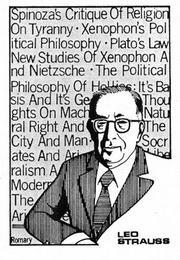
Per Lawrence Serewicz' fine essay here, Leo Strauss on the current crisis of virtue:


Scholarship, which is meant to be a bulwark of civilization against barbarism, is ever more frequently turned into an instrument of rebarbarization...

[T]his time the danger is greater than ever before. For this time the danger stems from the inspiration of scholarship by what is called a philosophy: Through that philosophy the humane desire for tolerance is pushed to the extreme where tolerance becomes perverted into the abandonment of all standards and hence of all discipline, including philological discipline. But absolute tolerance is altogether impossible; the allegedly absolute tolerance turns into ferocious hatred of those who have stated most clearly and most forcefully that there are unchangeable standards founded in the nature of man and the nature of things... 
True liberals today have no more pressing duty than to counteract the perverted liberalism which contends “that just to live, securely and happily, and protected but otherwise unregulated, is man’s simple but supreme goal”, and which forgets quality, excellence, or virtue.
--From "The Liberalism of Classical Political Philosophy"Review of Metaphysics, Vol. 12, No. 3 (March 1959) 

Wednesday, March 09, 2016

When the White Knight Triumphs

The federal government sends foreign aid, in the form of both economic and military assistance, to other countries every year. Something less than 1% of America's four trillion dollar budget is spent in this way. Broken down, it looks like this:
In fiscal year 2013, the U.S. government allocated the following amounts for aid:
Total economic and military assistance: $40.11 billion
Total military assistance: $8.03 billion
Total economic assistance: $32.08 billion
of which USAID Implemented: $17.46 billion
Recently, I have seen a lot of very liberal people, people who applaud our foreign aid contributions, get deeply upset that private corporations ship jobs overseas. US corporations paid roughly $6 trillion in wages each year from 2001 to 2011. So, ten years at $6 trillion per year: $60 trillion in wages. Meanwhile:
... over the 2001-2011 period, U.S. workers who were directly displaced by trade with China lost a collective $37 billion in wages as a result of accepting other lower paying jobs.
Notice: the feds handed over $32 billion out of $4 trillion in one year in direct payments overseas. US corporations handed over $37 billion out of $60 trillion in jobs and wages overseas (while giving out an additional $4 to $5 billion a year in straight-up charity). Liberals celebrate the former and lament the latter. Why?

If the federal government can send federal money to overseas in order to provide economic assistance, why can't private companies do the same thing? That's all the corporations are doing when they ship out jobs - corporations are just making wealth transfer payments. Which I thought Democrats loved?

So, for those of you on the liberal left, explain why the dissonance. Do people in China not have a right to work for a living? Mexicans shouldn't be employed... is that it?

"Ah," I hear them say, "but those people deserve a living wage!" Ok. But what kind of living wage comes with a free check from the American government? When all the bribes are done, how much of these government-to-government transfer moneys end up in the pockets of corrupt officials? Meanwhile, how much of the corporation-to-individual transfer payments get lost that way?

At least with Nike, IBM, Apple, et. al, we are relatively sure we know how much money each individual worker walked away with. We can count very precisely how many poor people now have at least some change in their pockets. With government-to-government transfers, we don't ever really find out. For all we know, that money gets transferred straight from a government bank account to the local president's private Swiss account. Even better, with corporation-to-individual transfers, we actually get something back: an iPhone, a pair of sneakers, something. The poor get a chance to contribute, to make a difference in the world. With government transfers, we get the fleeting good will of a ruler who may be assassinated tomorrow, and the poor get nothing at all.

So, I ask again, on what grounds do liberals get upset about American jobs getting shipped overseas? What precise liberal principle is violated? Individual poor people get money, Americans get cheaper goods, accountants get paid well to tax-shelter the profits... aside from the American worker, who loses?

And even the American worker isn't really any worse off. As a result of job transfers, he gets the same cheaper goods every American non-worker gets, and, if government transfers were to replace the corporate transfers, he would have gotten shafted ten times worse on the taxes anyway. After all, the government has to get the 10-fold increase in money they give way from someone. America's middle class is richer than 95% of the rest of the world. It's not like anyone else was ever going to pay for this wealth transfer, no matter who initiated it.

So, again, why the outrage on the left when corporations move jobs overseas? Do you not like the fact that we can actually track poor people and watch them become wealthier because of their new jobs? Is that what upsets you? Or do you just not like anyone but government acting as a white knight?

Tuesday, March 08, 2016

America, How much is too much? The Inside Job, Money Never Sleeps, the Big Short


The documentary film Inside Job, the movies Money Never Sleeps (the sequel to Wall Street), and the Big Short, tried to teach us lessons about the danger of excessive gain. Yet, they failed in their main educative goal. Instead of showing us the folly of an excessive appetite, the desire for more profit to the point of destruction, they showed us that it works as the main players within the various scandals have succeeded. The main players and even most of the major players have kept their fortunes, avoided prison, and continue to run their firms. Even though some firms, like Lehman Brothers went bankrupt, most involved in the crisis continued to operate despite the crash.


The cautionary tale became a how to manual for greed, excess and instability.
Both Oliver Stone and Michael Lewis, the author of the Big Short, were concerned that their cautionary tales, their jeremiads, had become instruction manuals for others to emulate. Instead of being seen as a villain, Oliver Stone’s character Gordon Gecko, the predatory trader, became lionized as a Wall Street icon to emulate. I know when I was at university many students in the senior year economic seminar (I was an economics graduate) saw the film as a template for what they wanted to achieve. Even 25 years and two stock market crashes later, viewer still remember Gordon Gecko. He has come to epitomize the tantalizing potential of financial system. Charles Ferguson, by contrast, had a more direct goal. He wanted to explain "the systemic corruption of the United States by the financial services industry and the consequences of that systemic corruption." In this, he partially succeeded, yet the final lesson, though, appears to be that if you are big enough, financially or politically, you can get away with it. Even if the firms corrupted the public, they ensured they appeared to work within the greater public morality the rule of law. Even when they did fall afoul of the law, they ensured they appeared to comply by sacrificing “rogue traders” to satisfy the public and legal outrage. What all three films miss with their focus on the symptoms is the cause. The regime has become corrupted not by the financial system or the desire for financial gain, but by America’s educational system. The American regime has become habituated to a disordered love of gain. We are now educated to pursue gain no matter the cost to others so long as we benefit. It is not so much that gain occurs or even great gain occurs, it is that the immoderation that drives the gain beyond its beneficial limits has become celebrated as normal behaviour.

Gain is good but greed is bad.
To start to understand the crisis and its effect on the regime, we need to understand the difference between good and bad gain. For that we turn to Plato’s Hipparchus or the profiteer.[1]  We could stay on the surface and express our indignation that excessive gain has been made by Wall Street and the individual executives.[2] We could look at that gain as shameful, excessive, and potentially fraudulent. Yet, that would only leave us on the surface without an understanding of the deeper threat to the regime. We miss the deeper connection between a love of gain that drives the pursuit of money and the love of gain that drives the pursuit of wisdom. At a crude level, the two loves of gain are connected within a regime. When they are mismanaged, which is increasingly the case in the United States, will lead to corruption, decay, and ruin. The love of gain is necessary for markets and for life to succeed. In that sense, gain is good, although greed, its perversion, is not. We have to understand what is good about gain and what can make it bad. What Plato’s dialogue helps us to consider is that the gain pursued on Wall Street is a crude, or low, form of gain which needs to be moderated, or restrained, or guided by a higher form of gain. As Plato’s Socrates intimates in the dialogue, philosophy is a love of gain. What distinguishes them, though, are the ends to which the gain serves. The love of gain has become distorted and because it has been distorted, the regime is in danger. Yet, what is the source of the crisis?

Education: has the love of knowledge become the love of corporate sponsorship?
The regime is only in trouble to the extent that our young are educated to pursue gain as love of money, a lower form of safety and comfort, rather than higher, noble, goals in public service as public virtue. To the extent that the educational establishment has encouraged our best and brightest to go to Wall Street, to pursue private gain, rather than Washington, a public service, then it has failed the regime. Even when it does encourage them to go to Washington it is based on the love of a lower gain, power, so that the goal is less the common good than the private interests. “What can I get for being in public service becoming a well-paid lobbyist?” We are in danger of having generations that are no longer being educated to the good or even the noble. Instead, they are being educated to a lower goal, the pursuit of profit to achieve safety and comfort, or simply the pleasant. In themselves, these goals are not problematic. They become problematic because they have replaced the higher, nobler goals for a republic serving the public good. We have become corrupted; the regime has become disordered by the pursuit of wealth without limit. The love of gain is in danger of becoming a love of tyranny.
Having been left almost empty of the noble and the good, their understanding is such that the high is only now understood and pursued in terms of the low. In particular, the brightest minds are attracted to money, status, and celebrity rather than fame through service, and duty to the republic. Students, but more importantly their teachers, appear to have forgotten moderation of an education in republican virtue. They have been seduced, because their teachers have been indoctrinated in it, by a Machiavellian immoderation that replaces virtue with a tyrannical virtu. Instead of a healthy thymos needed to sustain the republic freedom, we see an immoderate pursuit of profit without regard to the public consequences.

Wall Street’s excess where bad gain has replaced good gain
The financial crisis revealed a pursuit of profit has become shockingly immoderate even by Wall Street standards. For the firms operating within the financial system, there is no deal too big, there is no profit too large, there is no financial instrument too complex to pursue, there is no law that cannot be bent or changed to enable a deal. The immoderate ethos is expressed in the use of Collateral Debt Obligations (CDOs) and associated financial instruments. The instruments were designed on Wall Street for Wall Street because of the need to deal with risk to protect one’s profit. The underlying reason for the instruments was to create something, a compact between financial houses to avoid suffering loss (an injustice), yet, the parties involved did not believe that justice was desirable (explaining the risks) and thus gave a decent veneer to what could be called a swindle. In this, the parties were involved not to gain, or to show their clients the best gain and how it was achieved, but to avoid loss and insulate themselves from any loss that may be inflicted upon themselves. They ensured that someone, preferably someone else, would have to take the loss (suffer the injustice). In such a transaction, there is no common good only the desire to ensure that the loss is inflicted on someone else. All of this was done with the appearance that the risks had been controlled so that the investment, as any investment can be, was “safe”.  Built on a risk foundation that was becoming increasingly tenuous, the market became increasingly unstable, but the demand for these “risk free” instruments increased.

How much is too much for the stability of democracy? 
The question haunts America because the financial crisis is not simply about unemployment, jobs, or economic growth. The financial crisis reveals a crisis within the regime. The low gain, the one pursued by Wall Street can no longer be separated from the political health of the regime. The ethos that has infused Wall Street has influenced the political regime. In this, the nexus provided by the educational system within universities becomes important. As Montesquieu warned, Republics fail when they become gorged on luxury and consumption in which status is related to celebrity and measured by wealth.[3]

We have moved from the pursuit of happiness to the pursuit of hedonism
The love of gain has been diverted from the ends of the regime. The issue is more than going beyond the pursuit of happiness. It is that the regime’s definition of happiness has been corrupted. The love of gain has become an end in itself it no longer serves the common good. The higher end of virtue or the health of the regime has been lost. The challenge is not about protecting Main Street from Wall Street’s excesses through increased regulation. Such an approach is treating the symptom.  Americans need to reconsider how they became ruled by love of gain which is less than love of wisdom or at least love of wisdom as practices by political men. Americans cannot find political men guided by a teaching instil a love of wisdom (good gain) over gain simply. To reverse the crisis, we need reform. America needs reform within the education system is paramount because it is what shapes the young. The lessons from history are there, the question about their future is there for Wall Street and Main Street; will they do the right thing? More deeply, is America’s future Wall Street or Main Street? Does anyone have the courage to reform the system?


[1] ^ Thomas L. Pangle, (1987), The roots of political philosophy: ten forgotten Socratic dialogues, page 78. Cornell University Press.  My analysis follows Bloom’s analysis within this book as well as Jason A. Tipton’s Love of Gain, Philosophy and Tyranny: A Commentary on Plato's Hipparchus Vol. 26/2 (Winter 1999) Interpretation: A Journal of Political Philosophy for a general overview see http://en.wikipedia.org/wiki/Hipparchus_%28dialogue%29