As a person with hundreds of friends and thousands of readers, I am startled by the fact I only have 49 votes recorded so far for my entry in Simon and Schuster's First Chapters book competition. And the deadline for voting on my submission is Feb. 2 at 6 p.m. Eastern time.
The competition, billed as the American Idol of publishing, is structured as follows. Chapter 1 of your book is put up for 14 days. Readers vote by rating it 1 to 10, 10 being highest.
The top twenty rated pieces will go to Round 2 beginning April 1. You will put up Chapter 2 for 14 days.
The top five go to Round 3 and put up Chapter 3. One of the five wins and gets a book contract from Simon & Schuster.
My novel is entitled The Life and Times of Pfc. Ernest Taylor. Chapter 1 has been up for 11 days already, so we are down to the last 72 hours. I invite all my friends and readers to read and vote. Here is how:
1) Go to www.gather.com
2) Sign in or register now to get a user name.
3) Using the user name, go back to the Home page.
4) Where it says Search Articles at top of page, type Ernest Taylor, then Enter.
5) Click on The Life and Times of Pfc. Ernest Taylor and read Chapter One (not long).
6) Vote by rating it 1 to 10, 10 being the highest. (You rate by clicking the star next to the appropriate number.) Leave a comment if you are so inclined.
Thank you for participating. Obviously I am not asking anyone to color their views, but it is common sense that friends and readers of mine should be engaged in the process. Thanks again.
Tuesday, January 30, 2007


Left-Wing Talk Radio Is as Popular as Ever!
As AP reports, a wealthy leftist sugar daddy has come to the rescue of beleaguered, bankrupt radio network Air America:
Air America Radio, a liberal talk radio network, said Monday that it had reached a tentative agreement to be sold to the founder of a New York area real estate company. The network also said that Al Franken, its longtime headline personality, would depart next month.
The agreement with Stephen Green, the founder and chairman of SL Green Realty Corp., appears to rescue the struggling network, which has been seeking a buyer since last fall when it filed for bankruptcy reorganization after reaching an impasse with one of its creditors.
Any sale would have to be approved by the bankruptcy court. The company has signed what is called a letter of intent to sell itself to Green and expects to agree on financial terms soon, Air America spokeswoman Jaime Horn said.
I love that description of Air America as "a liberal talk radio network," as if it were one of many such.
Stephen Green is a brother of Mark Green, a particularly obnoxious leftist political commentator and landslide failure in a run for mayor of New York City several years ago.
The rumor is that Franken is leaving to make a run for a U.S. Senate seat in Minnesota.
The network has been in disarray from the beginning, both on the air and behind the scenes. Although the founders had what appears to have been a reasonable, achievable goal, the venture never took off and failed to develop a following. Many reasons have been suggested as to why this was so—and this analyst has contributed in the past here and elsewhere—but it appears to me that the main reason for the network's failure was that nobody wanted it.
I rather doubt that the change of ownership will alter that market reality. The only way for Air America to survive will be to change. Real change at the net, however, hardly seems likely.
From Karnick on Culture.
The Pursuit of Happyness—Review
It's not often that Hollywood depicts stockbrokers positively. That's only one of several nice surprises in The Pursuit of Happyness, a light drama based on a true story and starring Will Smith in a modern-day Horatio Alger tale.
Alger's popular stories were all about the value of hard work. The Pursuit of Happyness includes plenty of hard work on the part of the protagonist, but we live in an investment society today, so in this film the emphasis is on the value of the investments—of time, talent, and money—the various characters make.
The way he does so is through applying the film's central theme: investment. Smith plays Chris Gardner, a floundering medical-device salesman in early 1980s San Francisco. Gardner, heading fast toward middle age, with grey in his hair, wants to make it in life—he is pursuing happiness rigorously—but has flopped at his work and failed in his marriage. He's a decidedly poor provider, and the friction caused by the family's economically dire situation results in his wife leaving him and moving across the country.
Left alone with his five-year-old son, Gardner takes an internship at a big brokerage firm in hopes of getting that one big break.
The problem is that the internship doesn't pay a salary, and he has virtually no money at all. All he has is several hard-to-sell bone-density scanners, in which he invested all of his savings—unwisely, it turns out, as the machines aren't very good and are consequently difficult to sell.
It is clear, however, that he is an enormously intelligent individual; he simply hasn't invested his talents well. After his wife leaves, his situation becomes even worse, as her steady income as a nurse is no longer there to tide the family over the economic rough spots.
And rough spots there are indeed, as President Reagan and his team struggle to fix the economy after the depredations of Nixon, Ford, and Carter. Chris works diligently at the brokerage firm, having to do in six hours what the others have nine to do: he cannot work full days because he has to pick up his son after school and get in line at the homeless center lest he not get a room. As it happens, he and his son even have to sleep in a public restroom one night.
But Chris redoubles his efforts to sell the machines, and somehow he is now able to do so. Here too the theme is investment, as the machines Chris sells are investments in medical practices. Hence, as he spends his weekdays learning about the meaning of investment, we surmise that he is now better able to speak to the sales prospects about how the machine will pay off for them.
The film doesn't dwell on how Chris got to be in the poor situation he was in at the beginning of the story, but clearly he didn't use his gifts as well as he might have. Instead of continuing to work steadily and save a little each week, he went for the big time with the medical devices, but obviously hadn't invested enough time in research before deciding to plunge all of his family's savings into it. Otherwise, he would have known, as is revealed early in the film, that the devices are really unnecessary.
His wife has invested much in her marriage to him, but she decides to cut her losses and leave. The rest of the film will tell us whether her investment would have paid off, anc consequently whether she should have remained with him (beyond, of course, our opinions regarding divorce in general).
At the brokerage firm, only one of the twenty interns will get a job after the six-month trial, so this too might seem a bad investment. But Chris is so smart and so much more mature, motivated, and diligent than the others that one suspects he might just have a chance. Hence it's not so much a gamble as an investment—one that might not pay off, but certainly one well worth making.
His work at the brokerage firm, of course, is all about investments as well. And it's interesting how Chris makes his sales pitch: he talks exclusively about the individual being able to make the most of their resources and retire well, etc.
But most important of all to Chris is his son, Christopher, played by Smith's real-life son Jaden Smith. Despite several instances in which circumstances are conspiring to take the boy away—especially when Chris's wife leaves him—Chris won't let the boy go. He invests everything he can in him, playing little learning-games with him as they walk the streets or ride subway trains. This is an investment too, and it is an investment entirely of love.
Of course, investments don't always pay off, but as Chris learns, no one can guarantee happiness; having a chance at the pursuit of happiness is enough. And in Chris's case, it is.
Recommended.
From Karnick on Culture.
Saturday, January 27, 2007
Is Rudy a Conservative?
In a very interesting City Journal article, Steven Malanga argues that "Yes, Rudy Guiliani Is a Conservative/And an electable one at that."
Malanga makes a strong case for Rudy as a Reagan-style conservative. He recounts well Giuliani's record as mayor of New York City, in which, as Malanga establishes firmly, Rudy supported free markets and individual responsibility, as exemplified vividly in his tax cuts , welfare reform success, "zero tolerance" crimefighting, and firm rejection of racial politics.
Malanga makes a strong case for Rudy as a Reagan-style conservative. He recounts well Giuliani's record as mayor of New York City, in which, as Malanga establishes firmly, Rudy supported free markets and individual responsibility, as exemplified vividly in his tax cuts , welfare reform success, "zero tolerance" crimefighting, and firm rejection of racial politics.
As Malanga notes, Giuliani did this in what was one of the most leftist cities in the United States until he became mayor.
There's no question in my mind that Giuliani was a superb mayor and is a solid man of the right in most of his public stances. What many conservatives question, of course, is his record on social issues (such as support for legality of abortions, homosexual marriage, and gun control) and his occasionally unsteady personal life (such as his divorce from his somewhat eccentric wife).
None of this, Malanga argues, should preclude conservatives from supporting Giuliani for President:
[I]n a GOP presidential field in which cultural and religious conservatives may find something to object to in every candidate who could really get nominated (and, more important, elected), Giuliani may be the most conservative candidate on a wide range of issues. Far from being a liberal, he ran New York with a conservative’s priorities: government exists above all to keep people safe in their homes and in the streets, he said, not to redistribute income, run a welfare state, or perform social engineering. The private economy, not government, creates opportunity, he argued; government should just deliver basic services well and then get out of the private sector’s way. He denied that cities and their citizens were victims of vast forces outside their control, and he urged New Yorkers to take personal responsibility for their lives. “Over the last century, millions of people from all over the world have come to New York City,” Giuliani once observed. “They didn’t come here to be taken care of and to be dependent on city government. They came here for the freedom to take care of themselves.” It was that spirit of opportunity and can-do-ism that Giuliani tried to re-instill in New York and that he himself exemplified not only in the hours and weeks after 9/11 but in his heroic and successful effort to bring a dying city back to life.
Malanga's argument against conservative rejection of Giuliani is twofold. Point one is that the social issues are not as important as the economic and national defense policies which are Giuliani's great strength. Point two is that Giuliani is conservative in the really important ways:
As part of Giuliani’s quintessentially conservative belief that dysfunctional behavior, not our economic system, lay at the heart of intergenerational poverty, he also spoke out against illegitimacy and the rise of fatherless families. A child born out of wedlock, he observed in one speech, was three times more likely to wind up on welfare than a child from a two-parent family. “Seventy percent of long-term prisoners and 75 percent of adolescents charged with murder grew up without fathers,” Giuliani told the city. He insisted that the city and the nation had to reestablish the “responsibility that accompanies bringing a child into the world,” and to that end he required deadbeat fathers either to find a private-sector job or to work in the city’s workfare program as a way of contributing to their child’s upbringing. But he added that changing society’s attitude toward marriage was more important than anything government could do: “[I]f you wanted a social program that would really save these kids, . . . I guess the social program would be called fatherhood.”
As a consequence of his rejection of the time-honored New York liberal belief in congenital black victimhood, Giuliani set out to change the city’s conversation about race. He objected to affirmative action, ending Gotham’s set-aside program for minority contractors, and he rejected the idea of lowering standards for minorities. Accordingly, he ended open enrollment at the City University of New York, a 1970s policy aimed at increasing the minority population at the nation’s third-largest public college system but one that also led to a steep decline in standards and in graduation rates.
This is a strong and important argument, and it will be good for the right to argue this one out.
Later in the article, Malanga makes the case that Giuliani is an important enough figure to merit presidential consideration:
The national, and even world, press marveled at the spectacular success of Giuliani’s policies. The combination of a safer city and a better budget environment ignited an economic boom unlike any other on record. Construction permits increased by more than 50 percent, to 70,000 a year under Giuliani, compared with just 46,000 in Dinkins’s last year. Meanwhile, as crime plunged, New Yorkers took to the newly safe streets to go out at night to shows and restaurants, and the number of tourists soared from 24 million in the early 1990s to 38 million in 2000, the year before the 9/11 attacks. Under Giuliani, the city gained some 430,000 new jobs to reach its all-time employment peak of 3.72 million jobs in 2000, while the unemployment rate plummeted from 10.3 to 5.1 percent. Personal income earned by New Yorkers, meanwhile, soared by $100 million, or 50 percent, while the percentage of their income that they paid in taxes declined from 8.8 to 7.3 percent. During Giuliani’s second term, for virtually the only time since World War II, the city’s economy consistently grew faster than the nation’s.
Today, Americans see Giuliani as presidential material because of his leadership in the wake of the terrorist attacks, but to those of us who watched him first manage America’s biggest city when it was crime-ridden, financially shaky, and plagued by doubts about its future as employers and educated and prosperous residents fled in droves, Giuliani’s leadership on 9/11 came as no surprise. What Americans saw after the attacks is a combination of attributes that Giuliani governed with all along: the tough-mindedness that had gotten him through earlier civic crises, a no-nonsense and efficient management style, and a clarity and directness of speech that made plain what he thought needed to be done and how he would do it.
Like great wartime leaders, Giuliani displayed unflinching courage on 9/11. A minute after the first plane struck, he rushed downtown, arriving at the World Trade Center just after the second plane hit the South Tower, when it became obvious to everyone that New York was under attack. Fearing that more strikes were on the way—and without access to City Hall, the police department, or the city’s command center because of damage from the attacks—Giuliani hurried to reestablish city government, narrowly escaping death himself as the towers came down next to a temporary command post he had set up in lower Manhattan. “There is no playbook for a mayor on how to organize city government when you are standing on a street covered by dust from the city’s worst calamity,” one of his deputy mayors, Anthony Coles, later observed.
This is all true, and I think that Malanga is right to conclude that Rudy Giuliani merits serious consideration as a presidential candidate.
In addition to that, I think that the discussion of Giuliani's qualifications for national leadership could be very salutary for the right. Those who define themselves as conservatives find it hard to support someone with Guiliiani's record on social issues.
As a liberal of the right, I too disagree with Guiliani's positions supporting abortion, gay marriage, and the like. However, I think that Guiliani would have to move a little to the right on these issues in order to secure the Republican nomination, and that as president he would not be any less supportive of the Right's social agenda than Ronald Reagan was as president.
Guiliani reminds me rather strongly of Reagan, in fact. Although Reagan talked the talk on social issues, he didn't really walk the walk, unless I wasn't looking when Sandra Day O'Connor and Anthony Casey voted to turn back Roe v. Wade in the 1992 Planned Parenthood v. Casey decision. Similarly, Reagan had been divorced and had a rather less than perfectly salubrious family life. But on the big things Reagan was the best president of the past century.
If Rudy Guiliani could be half that good, that would make hiim a superior president indeed. His candidacy merits serious consideration.
From Karnick on Culture.
Friday, January 26, 2007
I Like(d) Bill Richardson
 Of all the Democrats in the mix for 2008, I've been best with Bill Richardson. Currently governor of New Mexico, a former congressman, ambassador to the UN, and executive branch experience, too, as Secretary of Energy.
The depth and breadth of his resume, his curriculum vitae, is without equal in the Class of '08 from either party, hands down.
Latino, too, which would be A-OK for this fractured USA. I'd never vote for crappy cake for the sake of diversity, but all things being equal, I could be influenced by the icing or even the cherry on top.
But Richardson let me down bigtime in this interview (and kudos to the Los Angeles Times for asking the unaskable question):
LAT: The can't-be-any-worse argument was also very popular in 1975 in Vietnam, and Cambodians found out that it could actually get quite a good deal worse. Is that something that worries you? What do you build into that process?
Richardson: Yeah. It worries me, but how worse can it get?
Anyone who thinks things can't get any worse has no imagination. Gov./Amb./Sec./Rep. Richardson must know that's so, but has given himself over to the cynicism, despair and hopelessness of our age and its chattering class.
We shall need more from our next president.
A Little Perspective on Death
Rush had an interesting experiment on his show today related to the number of deaths in Iraq last year. He pointed out that a response to the question of how many American military deaths there were last year would indicate whether someone has been brainwashed by the MSM. I guessed around 500. The actual number was around 800. If someone came up with a larger number or a much larger number, you can bet they get all or much of their information about the war from the MSM.
He also points out something that I’m sure will turn liberals apoplectic. Why are we making such a huge deal of 3000 deaths in a war, when 40,000 people a year die in motor vehicles, or 7000 a year die from botched prescriptions. You get the idea. I can imagine liberals hearing that throwing their radios against a wall to smash it, and by extension, Rush, into a thousand little pieces.
As I was listening I came up with my own little thought experiment. Literally every day in the MSM we hear, see or read of American military deaths or bombs and destruction in Iraq. We are beaten over the head with it day after day after day after day. Imagine if every car or truck or motorcycle accident were national news every day, with pictures, video, audio, interviews, you name it. Broken down by day that would be approximately 110 accidents a day. Carnage and human suffering on that scale is really hard to fathom. If we were beat over the head with this day after day after day after day, how long before that price we pay for our freedom to travel would no longer be tolerated.
Being in the military in Iraq is relatively safe compared to any other war in history. In the almost four years 3,000 precious lives have been lost in Iraq at least 160,000 also precious lives have been lost on American highways. I agree with Rush that a little bit of perspective is in order.
He also points out something that I’m sure will turn liberals apoplectic. Why are we making such a huge deal of 3000 deaths in a war, when 40,000 people a year die in motor vehicles, or 7000 a year die from botched prescriptions. You get the idea. I can imagine liberals hearing that throwing their radios against a wall to smash it, and by extension, Rush, into a thousand little pieces.
As I was listening I came up with my own little thought experiment. Literally every day in the MSM we hear, see or read of American military deaths or bombs and destruction in Iraq. We are beaten over the head with it day after day after day after day. Imagine if every car or truck or motorcycle accident were national news every day, with pictures, video, audio, interviews, you name it. Broken down by day that would be approximately 110 accidents a day. Carnage and human suffering on that scale is really hard to fathom. If we were beat over the head with this day after day after day after day, how long before that price we pay for our freedom to travel would no longer be tolerated.
Being in the military in Iraq is relatively safe compared to any other war in history. In the almost four years 3,000 precious lives have been lost in Iraq at least 160,000 also precious lives have been lost on American highways. I agree with Rush that a little bit of perspective is in order.
Lit'ry matters
* U.S. southern novelist Walker Percy was a medical doctor.
* Longfellow is the most put to music of English-language poets.
(Items from Times [of London] Literary Supplement, hereafter TLS)
* The idiosyncrasy of Gerard Manley Hopkins’ poetry may be explained by the “constraint” of Jesuit life. Toeing the line in all else, he broke out in his verse. (You could say he sprang out with his rhythm.) Indeed, the tension he experienced — conflict between vocation and creativity — may have been productive. (Simon Humphries, “A Eunuch for God,” TLS 12/22&29/06)
* In Honor: a History (Encounter), James Bowman (no relation) displays “a propensity to be judgemental and didactic.” (Ditto Harvey C. Mansfield in Manliness [Yale].) Thus reviewer George Feaver, retired poly sci prof at U. of British Columbia and this year at UT-Austin, who was left with “nagging suspicions” about Bowman’s judgment of U.S. military decisions, having read to the end of his “dense, discursive account of the alleged ‘decline and fall’ of Western honour.”
In this and other matters, Bowman offers a “gloomy reading” of history, “overly selective” in Feaver’s view, as in its ignoring the civil rights revolution of the ‘60s and “real-life heroes” such as Martin Luther King and the New York firefighters on 9/11. Feaver closes with commendation of both books, “despite their shortcomings [for reminding us] of the importance of remembering the past, and standing up for beliefs central to the achievement of our civilization.” (“Limp Responses,” TLS 12/22&29/06)
* Reviewing Patrick Wyse Jackson’s The Chronologer’s Quest: The Search for the Age of the Earth (Cambridge), John North says J. has “useful things to say,” albeit with “a weakness for discursive irrelevance.”
Whether J. displayed this weakness or not, I do not know, nor do I know if other reviewers’ comments are well-aimed, but I do find that phrase helpful. May writing teachers and editors everywhere hold discursive irrelevance to be a weakness not a strength. (TLS 1/12/07)
Wednesday, January 24, 2007
What's the Worst That Could Happen Anyway?
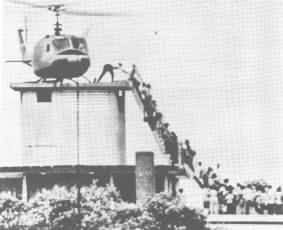 For the record, this famous photo isn't of the US embassy in Saigon, but of an apartment house where CIA types lived. They took as many of their Vietnamese allies with them as they could, but that wasn't many. What happened to the rest, we can only guess, but an informed guess isn't pretty.
Now, it's getting to be our perception that there are no good guys left among the Iraqis, so when we leave and our putative co-workers for peace and freedom are slaughtered, we shouldn't feel too bad about it.
Besides, the United States has a history of this sort of thing:
---In 1956, encouraged by John Foster Dulles, not to mention President Eisenhower and Radio Free Europe, the people of Hungary revolt against their Soviet masters. The CCCP's tanks roll in, 4000 die, and the US does nothing.
---In 1961, John F. Kennedy and the CIA send a band of Cuban exiles onto the beach of the Bay of Pigs to reverse Fidel Castro's revolution. Kennedy gets cold feet, the exiles are left on the beach, and they either die on the spot, get shipped off to Castro's prisons or are simply executed.
---American troops had actually been withdrawn from Vietnam by 1973. "Vietnamization," the people defending themselves, was actually a success for 2 years at least. It was the US Congress' (to this day inexplicable, except that we got bored and tired) cutoff of funds to South Vietnam that led to the events in the above photo in 1975. Then boat people, re-education camps, death.
---In 1979, Jimmy Carter not only withdrew support from the Iranian Shah Mohammad Reza Pahlavi, Carter threw him over the cliff, to the shock and awe of the West, including even France. The Shah was not only a US ally, he helped out in defeating Hitler back in the day. You could look it up.
Not only did Carter withdraw US military and political support, and forbid the Shah's forces from confronting his Khomeneist enemies, but the leftists who went along in the name of freedom got slaughtered by the new Islamicist regime, and you could look that one up, too.
---In 1991, the Bush41 administration gave nods, winks, and open encouragement to an uprising against the same Saddam Hussein whom the First Gulf War had left in place. The people rose up, the US did nothing, and slaughter ensued.
---We might also add that Ronald Reagan put US troops into Lebanon in 1983, 241 US troops got killed in a bombing, and the US withdrew 4 months later. Hezbollah, whether responsible or not, takes fortification to this day that they defeated the United States, and particularly Reagan, who is otherwise reputed to have never lost a tussle. And Bill Clinton sent a skeleton crew of US Army Rangers into Somalia in 1993, they were killed, and we promptly quit the country. Osama bin Laden crowed about our defeat and withdrawal often as a sign of our weakness, and the movie Black Hawk Down became one of Saddam's favorite flicks.
But never mind that last bit. The US quits all the time and leaves allies and other good people out to dry, so why not bail this time, too? It's in our character. I'm bored and tired with Iraq, who isn't, and what's one more betrayed ally among friends, or to our enemies?
Bin Laden is a student of history, and so is the entire Muslim world. They sussed out the paper tiger long ago, and that's what makes Islamism go. Their faith tells them that Islam must someday become the way of the world, but that could be in a 1000 or 10,000 years, sort of like Christianity's prophesized Second Coming Of Jesus. But the fecklessness of the west tells the Muslim world that that day, the end of times, might be right frigging now.
But, hey, the United States survived all those other regretful embraces of realpolitik, so one more won't make any difference, right? We still have our toasters and our TVs and our steel-belted radials, after all, so why should we say anything? Surely we can survive one more betrayal in the name of realism.
Iraq is boring, let's face it. To those Iraqis who actually believed we were liberating you and would get your back as you risked your lives for peace, freedom and human decency, sorry, you're on your own. You screwed up---you trusted us. You should have known who and what we are. Bin Laden understands us, far better than we do ourselves.
Bush’s State of the Union
I must confess that I had no desire to watch the president’s State of the Union address this evening. I am sick of hearing the carping and slamming of this man who has done noble work on the state of our union. Is he perfect? Has he done everything right? Of course not, but he is a man of conviction who has gotten an awful lot right, despite what his critics have claimed since he took office. One would think in light of the pressure and constant drip of negative that he would be bedraggled or show some of the wear and tear of the office. He has not.
I was impressed by his conviction that the war on terror, and in Iraq, is something we cannot simply turn away from and wish away. As he stated:
I am reminded of other statesmen in history who spoke truth about great ideological struggles and faced ridicule, including Winston Churchill and Ronald Reagan. The pacifists and isolationists were wrong then and they are wrong now. Thank God there are leaders of conviction who understand that leadership is not about following polls, but about standing on conviction. President Bush is one of those, and I believe history will prove him out.
I was impressed by his conviction that the war on terror, and in Iraq, is something we cannot simply turn away from and wish away. As he stated:
This war is more than a clash of arms -- it is a decisive ideological struggle, and the security of our nation is in the balance.
I am reminded of other statesmen in history who spoke truth about great ideological struggles and faced ridicule, including Winston Churchill and Ronald Reagan. The pacifists and isolationists were wrong then and they are wrong now. Thank God there are leaders of conviction who understand that leadership is not about following polls, but about standing on conviction. President Bush is one of those, and I believe history will prove him out.
Monday, January 22, 2007
The Free Lunch Party
Well, the beginning of the new Democrat congress, waggishly dubbed the 100 Hours of Terror and Irrelevance, is over. They started late because nobody can be expected to legislate on the Monday of the college football title game, and ended 14 days later, which adds up to 100 hours more or less. Most of us probably didn't even know the clock ran out, so I'm happy to be the bearer of good news. The accomplishments were considerable, and totally in character:
---Other people's money was given away, in this case a hike in the minimum wage. As Shaw noted, a government that robs Peter to pay Paul can always depend on the support of Paul. The Democrats gave Paul a raise. Peter was unavailable for comment, but there's not as many of him, so who cares?
---National security was ensured by declaring war (finally!) on the real enemy, those evil cargo containers. We can now bring the troops home and disband the military.
---Oil companies lost tax breaks that are available to most other US industries because, well, just because. Because oil is stinky and so are the cigars of rich, overpaid oil company executives.
With the money saved, we'll do more research on alternative energy sources. Seems you can put sunlight in one end of a black box and out the other comes cheap, unstinky and beautiful electricity. Is that cool or what?
---The taxpayers will also fund more scrambled eggs, in this case human ones, and in this case fertilized ones, in the form of more and better stem cell research. So far, embryonic stem cell therapy has proven invaluable in growing brain tumors, although, admittedly, not much else. But more money should result in even more and better brain tumors, so this one sounds like a winner, too.
---College students will get lower rates on student loans from the government, cut in half from the present 7% or so. The government will also jawbone lower prices from Big Pharma for Medicare-covered drugs. Students and old folks get a better deal, and absolutely nobody has to pay for either of these decreases, which is the really great part. You pass a law, things get better.
Republicans make things so complicated sometimes.
---Other people's money was given away, in this case a hike in the minimum wage. As Shaw noted, a government that robs Peter to pay Paul can always depend on the support of Paul. The Democrats gave Paul a raise. Peter was unavailable for comment, but there's not as many of him, so who cares?
---National security was ensured by declaring war (finally!) on the real enemy, those evil cargo containers. We can now bring the troops home and disband the military.
---Oil companies lost tax breaks that are available to most other US industries because, well, just because. Because oil is stinky and so are the cigars of rich, overpaid oil company executives.
With the money saved, we'll do more research on alternative energy sources. Seems you can put sunlight in one end of a black box and out the other comes cheap, unstinky and beautiful electricity. Is that cool or what?
---The taxpayers will also fund more scrambled eggs, in this case human ones, and in this case fertilized ones, in the form of more and better stem cell research. So far, embryonic stem cell therapy has proven invaluable in growing brain tumors, although, admittedly, not much else. But more money should result in even more and better brain tumors, so this one sounds like a winner, too.
---College students will get lower rates on student loans from the government, cut in half from the present 7% or so. The government will also jawbone lower prices from Big Pharma for Medicare-covered drugs. Students and old folks get a better deal, and absolutely nobody has to pay for either of these decreases, which is the really great part. You pass a law, things get better.
Republicans make things so complicated sometimes.
Bush Dodges Hurricane
Compliments of the Chicago Bears' 39-14 triumph on Sunday, the New Orleans Saints won't be going to the Super Bowl after all. The president and the nation will be spared two weeks of 24/7 reports on how the administration screwed up on Katrina, and instead SuperHype™ will be the usual stuff on how somebody got raised by their grandmother or that the 4th-string wide receiver was working as a chicken castrator until a month ago.
The president hasn't had a lot of luck lately, but this was his biggest win of the season. Win or lose, Da Bears should get an invite to the White House.
The president hasn't had a lot of luck lately, but this was his biggest win of the season. Win or lose, Da Bears should get an invite to the White House.
Saturday, January 20, 2007
"The Curse of the Golden Flower" and Two Ideas of Tragedy
 The Curse of the Golden Flower, Zhang Yimou's latest film to be released in America, is a brilliant motion picture that interestingly exemplifies important differences between East and West.
Following on the heels of two superb, epic dramas released in the United States in 2004—Hero (Ying xiong) and House of Flying Daggers—the Chinese director manages to top those films. The Curse of the Golden Flower is even more visually gorgeous than its recent predecessors, which is saying a lot. Zhang has been making brilliant, critically acclaimed films since his 1987 debut with Red Sorghum.
In Curse, the visual themes are even more cohesive than in the beautifully photographed Hero and Flying Daggers. Red and gold dominate, and the symbolism is carried through thematically, with red characteristically representing blood and life, and gold suggesting both riches and the power and beauty of nature, in its evocation of the sun. Black intrudes as the specter of death. Though these visual cues are truisms nearly to the point of being cliched, Zhang's intelligent use of them, and the astounding beauty of the compositions, enable the visuals to add meaning to the narrative without being annoyingly assertive about it.
As in Zhang's other recent dramas, the interiors of buildings are puzzling mazes, in which the viewer often becomes as lost in the architecture as the characters are in the complex plot.
The plot is indeed complex but told with great clarity and coherence. Gong Li plays Empress Phoenix, who is being slowly poisoned by her husband, the Emperor Ping, played by Chow Yun-Fat. Phoenix is aware of the poisoning but cannot openly disobey the emperor and must continue to take her deadly daily dose of fungus-laced medicine. However, she is plotting to take the kingdom away by conspiring with her elder son, the emperor's second son. (He has a son by a previous wife who is identified later in the film.) On the night of the Chrysanthemum Festival, an army of ten thousand will storm the palace under the command of Prince Jay.
Of course, things don't work out as planned, and the plot twists are truly Shakespearean in character, with the tawdriness of the characters' schemes making a great contrast with the grandeur of the settings and the importance of the events to the empire's future.
And there's the rub. In the end—without giving away any plot secrets—much happens, but nothing changes. And that is so very Eastern, with the cyclical sense of history common in the East. Ultimately, nothing changes. Yin and yang go out of balance, and in the end, they are back in balance. But that is all. Things don't get appreciably better for anybody, and the great irony of The Curse of the Golden Flower is that after all the effort to change who will sit on the throne, none of it changes anything—and, more importantly, it's clear that things wouldn't be noticeably different in the realm if Prince Jay had the throne. The individuals' loves, hatreds, and ambitions put things out of balance, and once the conflicts are resolved, balance is restored. But that's all.
American critics seem to sense this but not understand it at all. For example, Boston Globe critic Wesley Morris claims, "once it's all over, 'Golden Flower,' like 'Hero' and 'Flying Daggers,' leaves a flat taste." Other critics have had the same complaint.
But it's only a flat taste if you're expecting a Chinese director to make Western-style dramas. Which is, of course, a silly thing to ask.
Things are very different in Western drama of the past two millenia. One could surely argue that Greek tragedies exhibit a cyclical sense of history, driven as they are by the idea of fate. In the Christian era, however, Western tragedies have often been driven by a sense of progress. In Shakespeare, for example, there is frequently a great sense of a malign presence being driven out of society. By the end of Hamlet, for example, the stage is littered with the corpses of schemers, miscreants, the indecisive, and the weak, yet the playwright conveys a powerful sense of optimism about the future for the Danish kingdom. At the end of Macbeth, both tyrant and his evil muse are gone. The same is often true of the history plays.
In contemporary times, consider former Hong Kong and now American director John Woo, whose films tend to reflect a belief in the possibility (indeed the necessity) of personal and social transformation. (One of his Hong King films is even named A Better Tomorrow in English translation.) Woo, though born and raised in Hong Kong, was educated in a conservative Lutheran missionary school. His ideas are thus quite Western.
The Curse of the Golden Flower comes from a very different tradition. As in Hamlet, the stage is littered with corpses at the end, but the vision for the future is altogether different. Understanding that difference makes the film a richer and more rewarding experience.
From Karnick on Culture.
Subscribe to:
Posts (Atom)