Although the proximate stimulus for this article was the Dubai port situation, I speak about the general role of secrets in contemporary governance and the larger issue of how tolerant we should be of Presidential taciturnity.
As in:
In World War II, it is only a small exaggeration to say that the fate of the world hung on secret activities. Would our secret atom bomb program be completed before the German equivalent? And could it be kept secret from the Soviets? Would our cryptographers succeed in breaking the secret codes that the enemy used to issue military instructions over their radios? Later, when we did break the code, everything depended on keeping the enemy unsuspecting. We managed to fool them and they did not switch codes, gaining us an untold advantage.
With secrecy at such a premium, we learned to be satisfied knowing less. In return, public servants were more conscientious about earning our trust. For the most part, whenever we discover today the filed-away secrets of yesterday, we find that our leaders of then acted upon them wisely. Those days are long gone. Nixon's perfidy and Carter's incompetence, Reagan's occasional distractedness and Clinton's pathological duplicity, have all taught us to regard their caveats as emptier than their predecessors. Nine times out of ten, daylight is better. And the secrets tend not to be so darned big anyway.
Tuesday, February 28, 2006


Iran's Nuclear Weapon and What To Do About It
Recently Ahmadinejad, Iran’s outspoken leader, said, “Life is shaped by art and the highest form of art is martyrdom.” This is the statement of a man possessed. If taken along with his Holocaust denial claims and threats to wipe Israel off the map, this is a person who at the very least cannot be trusted.
It is therefore critical that he is denied the nuclear weapons he craves. His uranium enrichment program is well on the way to conclusion and in months, perhaps a year, Iran will be in possession of the knowledge necessary to produce a nuclear weapon.
The central question that must be considered is whether he can be stopped and whether the West has the will to do it.
President George W. Bush has made it abundantly clear that he will not tolerate a nuclear bomb in Iran. Yet even a determined president has limitations. Can the Air Force destroy the Iran facilities? Will there be retaliation? How will the Muslim world react to such an action? And will there be collateral damage that unites Iran and makes it an even more formidable threat than is the case at the moment?
As I see it the “cascading effect” needed to produce high grade uranium is probably in one major site even though ancillary activities may be dispersed. Therefore sortees carefully directed using bunker buster bombs could probably do the job against a reinforced underground facility.
While the Iranians have missiles that can reach Tel Aviv, they probably don’t have nuclear weapons yet. Therefore, they might deploy missiles tipped with chemical and biological weapons. While the prospect of such deployment is horrible to imagine, these weapons are unreliable. On the conventional front Iran is simply no match for Israeli forces much less U.S. military operations.
Although it is impossible to determine how the Muslim world will respond to such an attack, it is noteworthy that the much vaunted Arab street did not rise in unity against the liberation of Iraq and one might reasonably expect that will be the case in an attack on Iran.
Collateral damage is always a possibility even in the age of smart bombs. But the targets are limited and the precision bombs are increasingly more refined and accurate. Therefore it is probable that casualties will be limited. In fact, rather than unify Iran, such destruction of the nuclear facility might be the occasion for dissident groups to rise up against the ruling mullahs.
Recently there has been a lot of chatter about funding for public diplomacy that might encourage regime change. On this score, I remain skeptical. There have been many opportunities for rebellion against the repressive regime, but thusfar the secret police have been able to control the outbursts.
While regime change would be a desirable outcome, and a measure worth trying, we are running out of time. The clock is ticking on the prospective acquisition of a nuclear weapon. I would make the same claim about the European initiative to halt the Iranian program. Thusfar, the negotiations have merely served as a cover for the continued development of the program. Of course this diplomatic exercise is a necessary prerequisite for consensus on military action.
Security Council resolutions that lead to an embargo might be effective if the embargo on oil holds and if this isn’t interpreted by Iranian leaders as an act of war. Of course, getting unanimity in the Security Council is a long shot with the Russians poised to veto an embargo and China, sitting on the sidelines, bemused by the prospect of the U.S. groveling for support.
Any way you cut it, military force seems like the most likely stratagem for success. Will Bush do it? As I see it, he cannot afford not to do it. His legacy cannot be a nuclear armed Iran prepared to destabilize all of the Middle East and possibly Europe.
This is yet another test of American will. While the Democrats, in large part, will criticize the decision, there is little doubt the American people will support the president especially if he runs out the string on other options and points out that force is the only realistic alternative.
Herbert London is president of Hudson Institute and professor emeritus of New York University. He is the author of Decade of Denial (Lanham, Maryland: Lexington Books, 2001). London maintains a website, www.herblondon.org.
Faith and Learning
Sorry to be silent for so long, but I've been traveling a great deal. I just thought I'd note for those interested that if you're a student and thinking about grad school and interested in studying religion's intersection with just about anything, you should look seriously at Notre Dame. The history department just hired Mark Noll away from Wheaton and now the sociology department has hired Christian Smith away from UNC. So you have probably the best historian of American evangelicals (and probably the best historian of American Catholics in John McGreevy) and the best young sociologist of religion, some outstanding political scientists, great law faculty, and very good philosophers to work with. Just a thought...
Monday, February 27, 2006
Dog Days
The Disney live-action sled dog adventure 8 Below was the top grossing film the weekend it opened, and it is still sitting number two, having made over $45 million in two weeks. Meanwhile, John Grogan's tale of his yellow lab with a brain of cast iron but a heart of gold is #1 on Amazon, heads the NYT hardcover nonfiction list, has sold nearly a million copies, and the film rights have just been bought by Fox 2000.
I saw 8 Below last night with my husband and eleven-year-old daughter. If anyone is reluctant to see the movie because they are disgusted with the descent of Disney into previously uncharted regions of stupidity and bad taste, consider giving this one a try anyway. 8 Below is not great cinema, but it is something just as rare: a movie one can enjoy, without embarassment and without boredom, in the presence of one's children. The action, characterization, and plot are straightforward but believable; the cinematography is gorgeous, and the animals are memorable and engaging.

Surprisingly, the eight dogs are not overly anthropomorphized cartoons. With one exception, none of the dogs does anything I have not seen echoed in my own Siberian. I don't believe female huskies have the ability to coordinate six males, via short barks and apparent telepathy, to execute a cunning plan to capture seabirds -- with the subtlety of Navy Seals taking an enemy outpost on a moonless night -- but other than that every action is pack behavior familiar to anyone who's ever owned a working dog.
[Spoilers below]
The story is simple, and simply told: as the result of natural forces beyond anyone’s control, Jerry Shepherd, a guide employed by the National Science Foundation Antarctic Research Station, is forced to leave behind his team of eight sled dogs when the station is evacuated. It is impossible to travel to the continent until the following Southern hemisphere summer, and he returns to the States unable to shake off his sense of responsibility for abandoning his dogs. Everyone tells him it is not his fault, he should “let himself off the hook” and forgive himself, but he can’t. Juxtaposed against Jerry's efforts to first forget and then rejoin his pack, are scenes of the dogs' struggles to survive on their own, from the aforementioned seabirds escapade to raiding the Russian station's pantry. Eventually Jerry's stubborn devotion to his dogs snares three others, who were on the station when the disaster happened, into assisting him in gaining the continent to either rescue the team or face the reality of their deaths.
(An aside: to a former NSF staffer, the idea of using an unreconciled surplus in a research grant account as deus ex machina is pretty, well....imaginative.)
 I have not read Marley and Me, but I predict that before long this book will have sold 25 million copies. After all, there are 50 million dog-owning households in the US, and at least half of them will be curious about the intriguing, if improbable, notion that the World’s Worst Dog is not the one sitting on the professionally-clean-only sofa in the next room gutting a hand embroidered silk throw pillow or tearing the cap off a bottle of truffle oil.

In my house The World’s Worst Dog is named Jeeves, he’s a saluki, he crossed my threshold in September 1996, and whatever Marley might have done in his thirteen years, Jeeves has done him one better. The dog has eaten through plaster walls, air conditioners, feather beds, and seat belts. He has stolen and devoured enough meat, bread, chocolate, honey, and peanut butter to eradicate starvation in a smallish African country. He barks at my daughter’s little girlfriends just because it frightens them, and pees on the floor whenever he feels like it. He has awakened me every night for nine years so I can move over and let him get under the covers.
And if he were abandoned and lost somewhere, I would move heaven and earth to get him back, for the same reason that motivates the fictional Jerry Shepherd to cadge a helicopter, ice breaker, Italian Snow Cat and the services of three other science professionals to go after eight dogs that are probably dead anyway. And it's not sentimentality, misplaced anthropomorphism, or the overrefined sensitivity of wealthy, coddled people who have the luxury of treating their pets as if they were children. It is because Jeeves and I, like Jerry and his sled team, have forged a bond based on the pursuit of a common objective. The very qualities that make Jeeves annoying -- his barking, his suspicious reserve with strangers, his hyperactive scanning of the horizon for any perceived threat, from a squirrel to a serial killer -- make him a trusted aide for a woman who spends hours alone each day in an isolated house.
This is not a strict utilitarianism. It is, rather, more like the ties that used to bind families together, in the days when households were centers of independent economic activity, instead of places to sit in separate rooms wired to separate pieces of electronic gear to blow off the stresses of living parallel but separate lives in the global economy. How much of the alienation wives feel from their husbands and vice versa, how many arguments over work schedules, money, child rearing responsibilites, are caused by an economy that pits spouses at odds against each other, instead of harnessing them together like a sled team? I don't know, but I haven't had an argument with either one of my dogs in ages.
I saw 8 Below last night with my husband and eleven-year-old daughter. If anyone is reluctant to see the movie because they are disgusted with the descent of Disney into previously uncharted regions of stupidity and bad taste, consider giving this one a try anyway. 8 Below is not great cinema, but it is something just as rare: a movie one can enjoy, without embarassment and without boredom, in the presence of one's children. The action, characterization, and plot are straightforward but believable; the cinematography is gorgeous, and the animals are memorable and engaging.

Surprisingly, the eight dogs are not overly anthropomorphized cartoons. With one exception, none of the dogs does anything I have not seen echoed in my own Siberian. I don't believe female huskies have the ability to coordinate six males, via short barks and apparent telepathy, to execute a cunning plan to capture seabirds -- with the subtlety of Navy Seals taking an enemy outpost on a moonless night -- but other than that every action is pack behavior familiar to anyone who's ever owned a working dog.
[Spoilers below]
The story is simple, and simply told: as the result of natural forces beyond anyone’s control, Jerry Shepherd, a guide employed by the National Science Foundation Antarctic Research Station, is forced to leave behind his team of eight sled dogs when the station is evacuated. It is impossible to travel to the continent until the following Southern hemisphere summer, and he returns to the States unable to shake off his sense of responsibility for abandoning his dogs. Everyone tells him it is not his fault, he should “let himself off the hook” and forgive himself, but he can’t. Juxtaposed against Jerry's efforts to first forget and then rejoin his pack, are scenes of the dogs' struggles to survive on their own, from the aforementioned seabirds escapade to raiding the Russian station's pantry. Eventually Jerry's stubborn devotion to his dogs snares three others, who were on the station when the disaster happened, into assisting him in gaining the continent to either rescue the team or face the reality of their deaths.
(An aside: to a former NSF staffer, the idea of using an unreconciled surplus in a research grant account as deus ex machina is pretty, well....imaginative.)
 I have not read Marley and Me, but I predict that before long this book will have sold 25 million copies. After all, there are 50 million dog-owning households in the US, and at least half of them will be curious about the intriguing, if improbable, notion that the World’s Worst Dog is not the one sitting on the professionally-clean-only sofa in the next room gutting a hand embroidered silk throw pillow or tearing the cap off a bottle of truffle oil.

In my house The World’s Worst Dog is named Jeeves, he’s a saluki, he crossed my threshold in September 1996, and whatever Marley might have done in his thirteen years, Jeeves has done him one better. The dog has eaten through plaster walls, air conditioners, feather beds, and seat belts. He has stolen and devoured enough meat, bread, chocolate, honey, and peanut butter to eradicate starvation in a smallish African country. He barks at my daughter’s little girlfriends just because it frightens them, and pees on the floor whenever he feels like it. He has awakened me every night for nine years so I can move over and let him get under the covers.
And if he were abandoned and lost somewhere, I would move heaven and earth to get him back, for the same reason that motivates the fictional Jerry Shepherd to cadge a helicopter, ice breaker, Italian Snow Cat and the services of three other science professionals to go after eight dogs that are probably dead anyway. And it's not sentimentality, misplaced anthropomorphism, or the overrefined sensitivity of wealthy, coddled people who have the luxury of treating their pets as if they were children. It is because Jeeves and I, like Jerry and his sled team, have forged a bond based on the pursuit of a common objective. The very qualities that make Jeeves annoying -- his barking, his suspicious reserve with strangers, his hyperactive scanning of the horizon for any perceived threat, from a squirrel to a serial killer -- make him a trusted aide for a woman who spends hours alone each day in an isolated house.
This is not a strict utilitarianism. It is, rather, more like the ties that used to bind families together, in the days when households were centers of independent economic activity, instead of places to sit in separate rooms wired to separate pieces of electronic gear to blow off the stresses of living parallel but separate lives in the global economy. How much of the alienation wives feel from their husbands and vice versa, how many arguments over work schedules, money, child rearing responsibilites, are caused by an economy that pits spouses at odds against each other, instead of harnessing them together like a sled team? I don't know, but I haven't had an argument with either one of my dogs in ages.
Much Ado About Con-Cons
Rod Dreher of the Dallas Morning-News has developed a sideline as the promoter of "crunchy conservatism." This mainly involves the old Southern agrarianism except that we get rid of some of the unpleasant social hierarchism that was packaged in that old deal.
The bottom line on crunchy-con is that it is a trendy sensibility with a Catholic edge. Not Kroger -- Whole Foods. Not Milton Friedman -- G.K. Chesterton. Bye-bye Hummer -- Hello Toyota Hybrid. You get the idea. It's the whole earth mother thing if it had developed a stronger conservative element.
Though I may write with an edge of skepticism, I think crunchy con is a good thing. Not everybody is cut out for the bland navy sport coat-red tie world of the eighties GOP brought to maturity by Reagan. This group expands the tent and provides a firmer link to Christian thought in politics.
National Review has gone a little crazy with blogs. I can remember when I was excited to read the online version every day because of the great articles. The prepared content has suffered neglect as the blogs have become more and more prominent on the magazine's website. Unsurprisingly, Crunchy Conservatism (which originated with Dreher at NRO) now joins the legions as a featured blog at NRO. For a post from that blog that captures the ambiguous spirit of the enterprise (crunchy con, not blogging), I recommend this one from Ross Douthat.
In any case, it will be interesting to observe whether Dreher has really put his finger on a going concern. We've always known Christian conservatives didn't boil down to a composite of the viewers of the 700 Club. Crunchy cons may help fill out the picture.
Trying to Fuss
A new Dreyfus affair seems possible, this time featuring Richard Dreyfuss as the prosecutor. He publicly orated and opined that President Bush should be impeached.
Now have a look at Dreyfus the defendant and Dreyfuss the plaintiff.
Separated at birth?
Now have a look at Dreyfus the defendant and Dreyfuss the plaintiff.


Separated at birth?
Sunday, February 26, 2006
Times Were Verse
Just ran across this quatrain that I scribbled in 1997 to recite at the funeral of a relative who was an Air Force navigator, flying in bombing raids over Germany in WWII. It was an amazing feeling to read this to a hundred or so mourners before a flag-draped coffin.
Off to defend brothers with love
I flew missions in German air
Looked up, saw Heaven just above
But beneath me, Hell was there.
Off to defend brothers with love
I flew missions in German air
Looked up, saw Heaven just above
But beneath me, Hell was there.
Saturday, February 25, 2006
Another Brick in the Wall

From Why Mommy is a Democrat by Jeremy Zilber. (HT: InstaP.) Cool. I think I could turn a few bucks off this.

From Why Daddy Left Us and Now He Wants to Kill Us (in progress)
Friday, February 24, 2006
Chilling Out Andrew Sullivan's Newest Smoking Gun
I feel for Andrew Sullivan. Really do. As an unapologetically---on both counts---gay Iraq War hawk, he found himself in bed or at least in a shotgun marriage with President Bush, whose religious-right allies are opposed to the Love That Dare Not Speak Its Name doing any bedding or wedding.
What a pickle.
It seems he's been edging back to the fold of late, toward any weltanschauung that doesn't include supporting FOFs (Friends of Falwell). The life of a heretic is a lonely one, and doubly worse when you're thought to be a quisling.
So, ultramegaleftyliberal Matthew Yglasias makes great hay of Mr. Sullivan's confession of a loss of faith in the foundations of the Bush/Iraq enterprise. Turns out another ultramegaleftyliberal got a Freedom of Information Act release of notorious Department of Defense underling Steven Carbone's notes from meetings with Donald Rumsfeld.
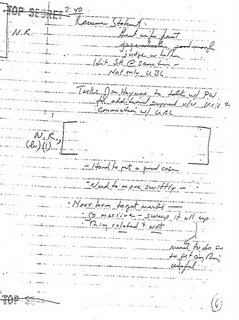
Mr. Sullivan writes:
I dunno if Mr. Sullivan actually looked at the document he posted, or just skimmed the FOIA blogger's account of it, but the keen eye reveals the smoking gun, "sweep it all up...relevant and not" is appended with an arrow saying "need to do to get anything useful."
The non-Bush Derangement Syndrome interpretation of that would be, "Dear Lower Level Guy and His Even Lower Staff: We know more than you do, and are in a better position to evaluate the intelligence and connect the dots. Get it all. Love, Rummy."
The section of the documents that reads "judge whether good enough [to] hit S.H. at same time" should come as no surprise to anyone who knew that the Bushies were determined to enforce Congress' 1998 resolution for regime change and reverse years of President Clinton's sometimes malign neglect of Saddam Hussein's violation of his peace treaty that included the withdrawal of WMD inspectors, attacking Baghdad with cruise missile or two, and most importantly, starving out the Iraqi people through "bloodless" sanctions.
No doubt, Dubya and the Bushies fixed the Saddam problem for good. No doubt.

In the aftermath, the Iraqi populace has already turned against al-Qaeda's indiscriminate murder. And we have cleared the road to self-determination. If the Shias and Sunnis want to descend into fratricide yet again, like the Iran-Iraq war, we cannot and should not stop them. Goodbye. But I believe they will step back from civil war. As their latest provocation in blowing up a mosque/shrine proves, it is the al-Qaedaers who are humanity's enemy, crusader and Muslim alike.
There is hope for us all yet, Mr. Sullivan, and your instincts were right in the first place: Saddam was a boil on humanity's butt that needed to be lanced. And we've done our moral duty in protecting the weak from the strong in the vacuum that inevitably ensues when the temporary stability of a butchering dictator evaporates. Nihil desperandum, sir. My admiration for your courage in a difficult spot endures.
Businessman/poet Tom Van Dyke writes from an undisclosed location beneath Southern California.
What a pickle.
It seems he's been edging back to the fold of late, toward any weltanschauung that doesn't include supporting FOFs (Friends of Falwell). The life of a heretic is a lonely one, and doubly worse when you're thought to be a quisling.
So, ultramegaleftyliberal Matthew Yglasias makes great hay of Mr. Sullivan's confession of a loss of faith in the foundations of the Bush/Iraq enterprise. Turns out another ultramegaleftyliberal got a Freedom of Information Act release of notorious Department of Defense underling Steven Carbone's notes from meetings with Donald Rumsfeld.

Mr. Sullivan writes:
"Go massive ... Sweep it all up. Things related and not." (My italics). My confidence that there was no deliberate misleading of the American people after 9/11 just slipped a notch.
I dunno if Mr. Sullivan actually looked at the document he posted, or just skimmed the FOIA blogger's account of it, but the keen eye reveals the smoking gun, "sweep it all up...relevant and not" is appended with an arrow saying "need to do to get anything useful."
The non-Bush Derangement Syndrome interpretation of that would be, "Dear Lower Level Guy and His Even Lower Staff: We know more than you do, and are in a better position to evaluate the intelligence and connect the dots. Get it all. Love, Rummy."
The section of the documents that reads "judge whether good enough [to] hit S.H. at same time" should come as no surprise to anyone who knew that the Bushies were determined to enforce Congress' 1998 resolution for regime change and reverse years of President Clinton's sometimes malign neglect of Saddam Hussein's violation of his peace treaty that included the withdrawal of WMD inspectors, attacking Baghdad with cruise missile or two, and most importantly, starving out the Iraqi people through "bloodless" sanctions.
No doubt, Dubya and the Bushies fixed the Saddam problem for good. No doubt.

In the aftermath, the Iraqi populace has already turned against al-Qaeda's indiscriminate murder. And we have cleared the road to self-determination. If the Shias and Sunnis want to descend into fratricide yet again, like the Iran-Iraq war, we cannot and should not stop them. Goodbye. But I believe they will step back from civil war. As their latest provocation in blowing up a mosque/shrine proves, it is the al-Qaedaers who are humanity's enemy, crusader and Muslim alike.
There is hope for us all yet, Mr. Sullivan, and your instincts were right in the first place: Saddam was a boil on humanity's butt that needed to be lanced. And we've done our moral duty in protecting the weak from the strong in the vacuum that inevitably ensues when the temporary stability of a butchering dictator evaporates. Nihil desperandum, sir. My admiration for your courage in a difficult spot endures.
Businessman/poet Tom Van Dyke writes from an undisclosed location beneath Southern California.
The Case for Dissolving FEMA
In response to my post titled "Federalizing Everything," a commenter asked, "You are saying you don't mind federal involvement [in disaster management] but you don't want them to be the ones coordinating it?"
That is not quite correct, so I'll explain further. First, I believe that the federal government should take the lead role in protecting the nation against attacks by foreign forces and any homegrown forces that venture across state borders. That is a given. It is when we get into the area of natural disasters that the problems arise.
I definitely don't want the federal government implementing responses to natural disasters. There is absolutely no need for it. Coordination is the farthest I should like them to go, and even that much involvement is in fact unnecessary. There is nothing on earth stopping states from cooperating in relief efforts and in preparing for disasters before they happen. Numerous states sent help to the Gulf Coast in the wake of Katrina, and countless private relief efforts contributed as well. States can work out agreements with each other to handle cross-border environmental problems and disaster-relief scenarios. Certainly there will be disagreements at times among states regarding which should take responsibilty for what (meaning whose taxpayers will pay how much for it), but federal "coordination" only moves the argument further up the line and results in greater stasis and failure of coordination and implementation.
In fact, the very existence of a federal agency devoted to disaster management (FEMA), and the existence (and meddling) of other agencies such as the Army Corps of Engineers, has helped take the pressure off of state and local governments to make the investments necessary to ensure that they can handle natural disasters. Any failures will ultimately be blamed on the federal government, which is exactly what happened after Katrina.
That is an excellent example of the concept economists call moral hazard.
If the state of Louisiana and city of New Orleans, in particular, have elected governments so inept and negligent that they failed to prepare for a catastrophe that everyone has known for countless years would eventually arrive, that is a matter for the voters of Louisiana and New Orleans to deal with. It is not a matter that requires a huge stratum of federal mandates to be laid on people in Seattle, Iowa City, and Charlotte.
The state of Louisiana could have prepared for this. The city of New Orleans could have been ready to deal with the problem. But they weren't. So now, because of the stupidity and cupidity of two state and local goverments, we will all have to climb under an even greater yoke of federal-government management of our lives. That is not sound policy; it is idiocy.
States would undoubtedly prepare for potential problems more effectively without federal "guidance," and especially without a huge new federal bureaucracy and a crushing new layer of laws, regulations, commissions, and greatly increased taxes to finance it all.
All of this is entirely unnecessary, including any federal role in planning and coordination. The creation of a large federal bureaucracy to coordinate and implement disaster management is an unnecessary and counterproductive boondoggle.
The best course at this time would be to dissolve FEMA and other such agencies and send the authority and responsibility back to the states, where it belongs.
Thursday, February 23, 2006
Dubai: Don't Sell
In case you thought that Laura Ingraham's on-line poll showing 90 percent opposition to the port sale was skewed by the well-known predilections of her listenership, I thought I should pass along that the MSNBC poll, not encumbered with rightward leanings, is at 88 percent against and holding.
Federalizing Everything
It's just a coincidence, I'm sure, but every major event that happens in the United States seems to be read as showing that we need more intervention from the federal government.
The Katrina disaster is an excellent case in point. As soon as it happened and people in the region had to put up with the consequences of having chosen to live in an area long known to be vulnerable to just such a catastrophe, the complaints rang through the press regarding the alleged slowness of the federal government in responding. Relatively little attention was paid to the disgracefully slow and inept response by the governments of New Orleans and Louisiana, and likewise to the fact that the federal government stepped in as soon as was legally permitted.
No, the federal government was responsible for everything, including the weather and the choice of people to live in places sure to be inundated at some point or other. And of course the blustering, handwring, and investigations followed. The White House report on the federal response to Katrina, released today, predictably calls for more federal control over such matters. As the New York Times reports:
The federal government, the report said, failed to sufficiently appreciate that there are certain types of disasters, like Hurricane Katrina, where local and state governments will be so overwhelmed that they will largely be unable to help themselves.
Perhaps, but in this case the state and local governments were not competent and overwhelmed; they were overwhelmed because they were grotesquely inept, disorganized, and unprepared. The way for that to be handled is for the voters to replace their inept leaders with competent ones. If they refuse to do that, that's their choice, and they should have to accept the consequences.
The federal report proceeds from this faulty premise to the expected conclusion. The Times continues:
The Department of Defense, as was proposed by President Bush and Homeland Security Secretary Michael Chertoff in the immediate aftermath of Katrina, would play a more active role in major disasters, the report suggests, perhaps leading the federal response to help accelerate search and rescue, evacuation and the delivery of supplies.
The report does not detail exactly when such a takeover might be appropriate, or how it would happen, suggesting only that the Departments of Homeland Security and Defense study the matter and come up with a plan. But it does offer examples of the types of incidents that would merit such a step, including perhaps a nuclear attack or "multiple simultaneous terrorist attacks causing a breakdown in civil society."
The latter certainly merit a central role for the federal government, as they would come under that government's responsibility for protecting us from foreign threats. When it comes to natural disasters, however, it is decidedly unclear when the federal government would have to be the main responder and when states and local governments should. What makes a disaster "federal"?—we should have to ask. But we will not do that, you can be sure, because the answer is that what really makes a disaster federal is the reaction of the media.
What will most certainly happen, then, is that the federal government will become the default option for management of the response to any significant disasters, natural or otherwise, occurring within the U.S. borders. That, of course, will require a huge, permanent bureaucracy to be established at the Department of Homeland Security, a bureaucracy that will inevitably become much bigger and vastly more expensive over time, as is the norm for federal departments and programs.
Subscribe to:
Posts (Atom)