My op-ed in today's Los Angeles Times, in opposition to the various proposals for disinvestment by public pension funds in firms doing business with the Iranian mullahs, can be found here. It was butchered a bit due to space constraints---in particular, the explanation of why sanctions against South Africa had the effect of strengthening apartheid was essentially dropped---but I think that the central argument still gets through. Comments welcome.
Tuesday, June 19, 2007


Monday, June 18, 2007
Wither the Episcopal Church?
Via Mark Steyn at NRO, an Episcopalian priest has decided she's also a Muslim.
"Exciting" is one way to put it. Unknown at this time is how a Muslim can take Communion when there's wine involved, since Muslims don't do alcohol. But if the Catholics are correct and the wine is transubstantiated into the Blood of Christ, I guess it's not wine anymore, so that's cool. But head Protestant honcho Martin Luther thought that although it's the Blood of Christ, it's still also wine (consubstantiation). As near as I can tell, the Episcopalian Church is firmly on the fence. Looks like they might have to finally sort that one out after all these years, unless they just start using grape juice.
Then again, Muslims don't believe in the Eucharist at all, so when a Muslim Episcopal priest consecrates the Eucharist, well, I remember the nuns telling us that if a fake priest said Mass but you took Communion in good faith, it was still Communion.
At least I think that's what they said. I never thought about it much because there wasn't much likelihood of running into a fake priest. Until now...
________________________________________
[Rev. Ann Holmes] Redding's bishop, the Rt. Rev. Vincent Warner, says he accepts Redding as an Episcopal priest and a Muslim, and that he finds the interfaith possibilities exciting.
"Exciting" is one way to put it. Unknown at this time is how a Muslim can take Communion when there's wine involved, since Muslims don't do alcohol. But if the Catholics are correct and the wine is transubstantiated into the Blood of Christ, I guess it's not wine anymore, so that's cool. But head Protestant honcho Martin Luther thought that although it's the Blood of Christ, it's still also wine (consubstantiation). As near as I can tell, the Episcopalian Church is firmly on the fence. Looks like they might have to finally sort that one out after all these years, unless they just start using grape juice.
Then again, Muslims don't believe in the Eucharist at all, so when a Muslim Episcopal priest consecrates the Eucharist, well, I remember the nuns telling us that if a fake priest said Mass but you took Communion in good faith, it was still Communion.
At least I think that's what they said. I never thought about it much because there wasn't much likelihood of running into a fake priest. Until now...
________________________________________
Sunday, June 17, 2007
Stupid Little Leftists
As Christopher Hitchens sagely noted, denigrating President Bush's intelligence is the sort of thing that stupid people find funny. Comedy Central has a new show for such folks.
It's predictably infantile enough, based on the clip I saw. It takes place while Bush 41 is president, and Lil' (sic) Bush and Lil' (sic) Cheney, et lil' al. won the softball game for Team Halliburton by getting revved up on crack. 41 says that cheating is fine if it wins back the trophy (apparently a reference to the 2000 election), and a knowing evil laugh is had by all. Dubya is portrayed as diabolical, but still an ignoramus, natch.

The correct contraction for "little" is li'l, of course, not lil'. This incorrectly punctuated graphic passed before literally hundreds of people at Comedy Central who apparently find the show funny.
Not a single one of them caught it. Irony knows no measure these days.
_______________________________________
It's predictably infantile enough, based on the clip I saw. It takes place while Bush 41 is president, and Lil' (sic) Bush and Lil' (sic) Cheney, et lil' al. won the softball game for Team Halliburton by getting revved up on crack. 41 says that cheating is fine if it wins back the trophy (apparently a reference to the 2000 election), and a knowing evil laugh is had by all. Dubya is portrayed as diabolical, but still an ignoramus, natch.

The correct contraction for "little" is li'l, of course, not lil'. This incorrectly punctuated graphic passed before literally hundreds of people at Comedy Central who apparently find the show funny.
Not a single one of them caught it. Irony knows no measure these days.
_______________________________________
Thursday, June 14, 2007
The Bigotry of the Journalists... and the UN
Well, there's quite a party going on in Gaza, don't you think? Fatah thrown off buildings here, shot in the head there, people cowering around the corner. Quite a show. Of course, were it the Israelis wreaking such havoc upon Fatah terrorists, the mainstream press and the UN bureaucrats would be having a field day: front-page denunciations, resolutions, calls for sanctions and boycotts. The possibilities are familiar and endless.
But because it is one group of Arab terrorists killing another, well, what do you expect from such people anyway? They are simply incapable of adhering to civilized standards of conduct, obviously, and so why waste precious ink and time on it? From the news bureaus to Turtle Bay: Let's go have a drink.
But because it is one group of Arab terrorists killing another, well, what do you expect from such people anyway? They are simply incapable of adhering to civilized standards of conduct, obviously, and so why waste precious ink and time on it? From the news bureaus to Turtle Bay: Let's go have a drink.
Wednesday, June 13, 2007
What is the South?
There are a lot of ways of distinguishing our cultural differences and especially of what has been that most distinct of areas, the South. Here is one take, dividing things up by the availability of sweet tea. Pretty cool.
(HT: Evangelical Outpost)
(HT: Evangelical Outpost)
"a wonderful young lady..."
Apparently, out in La-La land, they have a pretty wide view of what counts as wonderful . Even if the young woman in question didn't murder her newborn child, anyone leaving a baby in a dumpster is far from "wonderful."
Tuesday, June 12, 2007
Strict Constructionists, The Bible, Democracy and the Natural Law
When Rudy Giuliani says his appointees will be like Justices Antonin Scalia and Clarence Thomas, as if they're peas in a pod, I don't think he has any idea of what he's talking about. True, they often arrive at the same place, but it's by completely different paths, as we shall see.
Scalia is certainly not the ideologue he's made out to be. He believes in a natural law and believes he can discern it, but his position is that the Court (since Erie RR v. Tompkins [304 US 64, 78 (1938)]) is not free to use its own determination of natural law to override legislation. His judicial philosophy is that we have no choice but to achieve a provisional morality (or truth, I imagine) by consensus.
This rides on a kinda Rawlsian acknowledgement of what Aquinas, et al., admitted—-that there is a natural law, but interpretations will vary. Natural law, in all their views, of course must guide legislation. Unless one believes that questions of right and wrong are not germane to how a society orders itself.
These things get abstract to the point of nonsense in a hurry, because some believe the language of "rights" or tradition supersedes right and wrong. Justice Thomas disagrees, in that he would never subordinate his moral conscience to novel but reasonable legal theories or even to stare decisis. This is why John Locke wanted to drum the Catholics out of public life, as their allegience is to something higher than man's law. Scalia, however, would be quite acceptable to Locke, as he appears to have become a "reasonable" man, and stare comes with the performance of his duties.
Surely, using the Bible as “proof” to someone who rejects it is foolish if not tautological. It certainly stands to reason to use the language of the Other while trying to sway him to your position. Natural law was rehabilitated by Catholics in the past century as a lingua franca, and is achieving increasing acceptance by other philosophically-minded Christians as well.
But on the other hand, sometimes a “reasonable” theory of law is inadequate to the task, or the locutor is. That’s why Justice Thomas boldly holds to the asserting natural law, as simple as the statement “slavery is wrong.” Many reasonable men tried to make the reasonable case against slavery over the centuries, but with only a non-foundational view of human rights (i.e., absent the endowed by their Creator part), it was a tough go.
And so, because we are all citizen-rulers in this here democracy, sometimes, joining that Rawlsian consensus that x is wrong is all that remains, regardless of whether the minority thinks the way the judgment was reached is “reasonable.” This is Scalia’s pro-democracy, non-ideological view of law. However, since the Constitution, as a social contract, permitted slavery, Scalia's legal philosophy would be powerless to overturn something like Dred Scott.
Dang. Such are the limits are reason and of law.
To illustrate, we as a society have decided that cruelty to animals is wrong, and have codified that sentiment into law. The abstract “neutral” theories of law that have been bandied about of late cannot reasonably accomodate that sentiment. A bland, neutral reading of property rights yields that animals are property that we can dispose of as we see fit and nobody can say boo.
But that is not society, it is not the law, it is not “rights,” and it’s not reality. Cruelty to animals is wrong because it’s wrong. Sometimes we cannot transcend such tautologies; words and abstractions fail us, yet we ban it anyway. And if Peter Singer and PETA can convince a sufficient number of Americans that meat is murder, so shall it be.
It is often proposed that the Bible must be left at the door when we decide how we should legislate. But it must be noted here that Christians believe revelation is real. If the Constitution is truly neutral on religion, it must be agnostic, not atheistic. If one votes in this here democracy that x is wrong because God said so, that will have to do. Agnosticism must leave the room to answer, maybe He did.
On this, Scalia and Thomas would agree, but for very different reasons. They are not pod people. I find Rudy to be a thorough Lockean; he should adore Scalia, but Thomas should scare the bejesus out of him. Once you get into questions of right or wrong, the sky's the limit.
________________________________________
Scalia is certainly not the ideologue he's made out to be. He believes in a natural law and believes he can discern it, but his position is that the Court (since Erie RR v. Tompkins [304 US 64, 78 (1938)]) is not free to use its own determination of natural law to override legislation. His judicial philosophy is that we have no choice but to achieve a provisional morality (or truth, I imagine) by consensus.
This rides on a kinda Rawlsian acknowledgement of what Aquinas, et al., admitted—-that there is a natural law, but interpretations will vary. Natural law, in all their views, of course must guide legislation. Unless one believes that questions of right and wrong are not germane to how a society orders itself.
These things get abstract to the point of nonsense in a hurry, because some believe the language of "rights" or tradition supersedes right and wrong. Justice Thomas disagrees, in that he would never subordinate his moral conscience to novel but reasonable legal theories or even to stare decisis. This is why John Locke wanted to drum the Catholics out of public life, as their allegience is to something higher than man's law. Scalia, however, would be quite acceptable to Locke, as he appears to have become a "reasonable" man, and stare comes with the performance of his duties.
Surely, using the Bible as “proof” to someone who rejects it is foolish if not tautological. It certainly stands to reason to use the language of the Other while trying to sway him to your position. Natural law was rehabilitated by Catholics in the past century as a lingua franca, and is achieving increasing acceptance by other philosophically-minded Christians as well.
But on the other hand, sometimes a “reasonable” theory of law is inadequate to the task, or the locutor is. That’s why Justice Thomas boldly holds to the asserting natural law, as simple as the statement “slavery is wrong.” Many reasonable men tried to make the reasonable case against slavery over the centuries, but with only a non-foundational view of human rights (i.e., absent the endowed by their Creator part), it was a tough go.
And so, because we are all citizen-rulers in this here democracy, sometimes, joining that Rawlsian consensus that x is wrong is all that remains, regardless of whether the minority thinks the way the judgment was reached is “reasonable.” This is Scalia’s pro-democracy, non-ideological view of law. However, since the Constitution, as a social contract, permitted slavery, Scalia's legal philosophy would be powerless to overturn something like Dred Scott.
Dang. Such are the limits are reason and of law.
To illustrate, we as a society have decided that cruelty to animals is wrong, and have codified that sentiment into law. The abstract “neutral” theories of law that have been bandied about of late cannot reasonably accomodate that sentiment. A bland, neutral reading of property rights yields that animals are property that we can dispose of as we see fit and nobody can say boo.
But that is not society, it is not the law, it is not “rights,” and it’s not reality. Cruelty to animals is wrong because it’s wrong. Sometimes we cannot transcend such tautologies; words and abstractions fail us, yet we ban it anyway. And if Peter Singer and PETA can convince a sufficient number of Americans that meat is murder, so shall it be.
It is often proposed that the Bible must be left at the door when we decide how we should legislate. But it must be noted here that Christians believe revelation is real. If the Constitution is truly neutral on religion, it must be agnostic, not atheistic. If one votes in this here democracy that x is wrong because God said so, that will have to do. Agnosticism must leave the room to answer, maybe He did.
On this, Scalia and Thomas would agree, but for very different reasons. They are not pod people. I find Rudy to be a thorough Lockean; he should adore Scalia, but Thomas should scare the bejesus out of him. Once you get into questions of right or wrong, the sky's the limit.
________________________________________
Saturday, June 09, 2007
Eat the Rich
I don't pretend that the observation I'm about to make is particularly original, nor do I have a great deal of wonky social science data to back me up (there are others here more qualified than I to speak of that). But within the last few years I've noticed a significant divide in how certain people approach the problem of poverty and the oft-heard and decried increasing gap between rich and poor.
I suppose it was the Sojourners forum on June 4th that really got me thinking about this, though it's something I've also noticed in my corner of the academy (political theory, law, politics etc.). The observation is as follows.
On the one hand you have people concerned with poverty as such, that is, making sure that as many people as possible have enough to eat, clean water to drink, and a roof over their head. For these people inequality is a problem to the extent that some people are so poor that they do not enjoy a basic standard of living (for how this might apply to the American situation and the "poverty line", see here). These people may disagree as to the best means with which to address the truly disadvantaged, but they agree that the real problem is something tangible as are the solutions (more calories, rooftops, innoculations, etc.).
On the other hand are folks who think inequality as such is unjust and something to be remedied. To be sure, these people are also concerned about the sort of poverty mentioned in the previous paragraph, but these folks would not be satisfied with raising everyone to a basic level of economic prosperity. Even if everyone had enough to eat and a roof over their heads, and we can throw in even health care and cable television, these folks would still think that there is a serious injustice in any inequality, as if the creation and maintenance of wealth is a zero-sum game.
In the many graduate seminars I've sat in, the truly disreputable thing to do was not to hold a religious or pro-life position (though those were not necessarily welcomed), but to question this second premise about inequality and the sacrosanct role of government to redistribute wealth.
This brings to mind a few things. First, the first concern about inequality is one that can realistically be addressed and real gains can be made whereas the second approach to inequality will never succeed. This is because the second sort of concern, let's call it the concern of the levellers, finds an enduring harm in a psychological principle that feeds off the thought, "They have more than I do."
Second, this psychology is precisely the one JJ Rousseau diagnosed brilliantly (I'm afraid his solutions were not so brilliant) as being infected with amour-propre, the condition in which when I think of others I think only of myself, and when I consider my own value I frame it entirely with regard to others. Or as Pierre Manent has put it, "Man lives for the gaze of others, whom he hates."
Third, the solution to amour-propre as put forth by the levellers is, well, to level, as opposed to encouraging people not to define success entirely in terms of material prosperity ("entirely" is a key word there, as the truly poor would have to be saints to flourish in abject poverty).
Finally, this distinction helps us, or at least has helped me, understand some of the politics of poverty and the proposals put forth to approach it. People in both groups can agree on policies, both governmental and market-based, to help the truly poor. What people in the first group don't often realize is that some (most?) policies are tailor-made not merely to lift up folks at the very bottom but bring down a lot of folks at the top.
And while I'm not the most economics-savvy person on the planet, this seems to lead not only to bringing folks down at the top, but keeping a lot of folks dependent and strapped at the bottom.
I suppose it was the Sojourners forum on June 4th that really got me thinking about this, though it's something I've also noticed in my corner of the academy (political theory, law, politics etc.). The observation is as follows.
On the one hand you have people concerned with poverty as such, that is, making sure that as many people as possible have enough to eat, clean water to drink, and a roof over their head. For these people inequality is a problem to the extent that some people are so poor that they do not enjoy a basic standard of living (for how this might apply to the American situation and the "poverty line", see here). These people may disagree as to the best means with which to address the truly disadvantaged, but they agree that the real problem is something tangible as are the solutions (more calories, rooftops, innoculations, etc.).
On the other hand are folks who think inequality as such is unjust and something to be remedied. To be sure, these people are also concerned about the sort of poverty mentioned in the previous paragraph, but these folks would not be satisfied with raising everyone to a basic level of economic prosperity. Even if everyone had enough to eat and a roof over their heads, and we can throw in even health care and cable television, these folks would still think that there is a serious injustice in any inequality, as if the creation and maintenance of wealth is a zero-sum game.
In the many graduate seminars I've sat in, the truly disreputable thing to do was not to hold a religious or pro-life position (though those were not necessarily welcomed), but to question this second premise about inequality and the sacrosanct role of government to redistribute wealth.
This brings to mind a few things. First, the first concern about inequality is one that can realistically be addressed and real gains can be made whereas the second approach to inequality will never succeed. This is because the second sort of concern, let's call it the concern of the levellers, finds an enduring harm in a psychological principle that feeds off the thought, "They have more than I do."
Second, this psychology is precisely the one JJ Rousseau diagnosed brilliantly (I'm afraid his solutions were not so brilliant) as being infected with amour-propre, the condition in which when I think of others I think only of myself, and when I consider my own value I frame it entirely with regard to others. Or as Pierre Manent has put it, "Man lives for the gaze of others, whom he hates."
Third, the solution to amour-propre as put forth by the levellers is, well, to level, as opposed to encouraging people not to define success entirely in terms of material prosperity ("entirely" is a key word there, as the truly poor would have to be saints to flourish in abject poverty).
Finally, this distinction helps us, or at least has helped me, understand some of the politics of poverty and the proposals put forth to approach it. People in both groups can agree on policies, both governmental and market-based, to help the truly poor. What people in the first group don't often realize is that some (most?) policies are tailor-made not merely to lift up folks at the very bottom but bring down a lot of folks at the top.
And while I'm not the most economics-savvy person on the planet, this seems to lead not only to bringing folks down at the top, but keeping a lot of folks dependent and strapped at the bottom.
Wednesday, June 06, 2007
The Scum of the Scum of the Earth
I noted awhile back in a post that Colin Powell and Richard Armitage, then respectively Secretary and Deputy Secretary of State, had allowed Scooter Libby to twist in the wind even as they knew perfectly well that it was Armitage who had leaked the (trivial) details of Valerie Plame's CIA career. And they did so as part of an everyday manifestation of Beltway insider hardball over the Bush Iraq policy.
It turns out, as detailed in Paul Wolfowitz' letter to Judge Walton urging sentencing leniency for Libby, that Libby, while an attorney in private practice, had "helped a public official defend himself successfully against libelous accusations, something that is extremely difficult to do for anyone in public office. The official in question was Richard Armitage..."
So: Is there anyone out there prepared to defend the proposition that Armitage is not the scum of the scum of the earth? In the words of Ben Stein in Ferris Bueller's Day Off: "Anyone? Anyone?"
It turns out, as detailed in Paul Wolfowitz' letter to Judge Walton urging sentencing leniency for Libby, that Libby, while an attorney in private practice, had "helped a public official defend himself successfully against libelous accusations, something that is extremely difficult to do for anyone in public office. The official in question was Richard Armitage..."
So: Is there anyone out there prepared to defend the proposition that Armitage is not the scum of the scum of the earth? In the words of Ben Stein in Ferris Bueller's Day Off: "Anyone? Anyone?"
Through the Night with the Light from Above?
According to DRUDGE, O'Reilly got more viewers than the Republican debate, and a Fred Thompson interview an hour later on Hannity & Colmes got nearly as many.
And when RudyG was asked about the criticism of his pro-choice position from Catholic bishops, a lighting bolt momentarily cut off his response.
I dunno what, but something's going on...
________________________________________
And when RudyG was asked about the criticism of his pro-choice position from Catholic bishops, a lighting bolt momentarily cut off his response.
I dunno what, but something's going on...
________________________________________
Monday, June 04, 2007
Just Among Friends
The recent to-do around here about definitions got me thinking about "social justice." If Wade Connerly were to use the term, I'd know he was advocating a color-blind society. When a lefty uses it, I check my wallet.
The great humanist Hugo Chavez is currently distributing some social justice in Venezuela, initiating yet another round of Latin American land reform. He's also building socially just housing:
Until those without such pretty houses come knocking at your door demanding their social justice. So it goes, Señora Colmenares, round and round. Why should you have two shoes when I have none?
________________________________________
The great humanist Hugo Chavez is currently distributing some social justice in Venezuela, initiating yet another round of Latin American land reform. He's also building socially just housing:
Bella Vista is one of 12 “communal towns” that Mr. Chávez plans to build this year. It has neat rows of identical three-bedroom homes for 83 families, a reading room, a radio station, a building with free high-speed Internet service, a school and a plaza with a bust of Simón Bolívar, Venezuela’s national hero.
With financing from state banks, the cooperative plants crops like manioc, corn and beans, which officials in Caracas say are better suited to soils here than sugar cane. By burning the cane during land seizures, the squatters prepare the land for other crops and give owners less incentive to fight for control. The state and federal government holds Bella Vista as an example of the ideological fervor Mr. Chávez is trying to instill in the countryside.
Lisbeth Colmenares, 22, was radiant as she showed a visitor her new home here, where she and her family live rent-free.
“Before Chávez, the government would have been happy to let us starve,” said Ms. Colmenares, holding her 6-month-old daughter, Luzelis. “We’ll never let what we have now be taken from us.”
Until those without such pretty houses come knocking at your door demanding their social justice. So it goes, Señora Colmenares, round and round. Why should you have two shoes when I have none?
________________________________________
Saturday, June 02, 2007
Declaration of Principles
(Since the subject has been tradition lately, please permit a recap of the tradition of this particular URL:
The original Reform Club, (pictured on the sidebar to the right) was conceived as a place where worthy gentlepersons of all persuasions could convene in the spirit of inquiry into the human condition, and exchange their views before a wider audience, for the benefit and edification of all.
This blog, thenewswalk.com, is the successor to that tradition and to The Reform Club blog, founded by ST Karnick and Hunter Baker (see links to them on the sidebar at right as well).
A reposting of the below was requested by a certain Dr. Watson, and the request is timely. Here it is with minor updating:
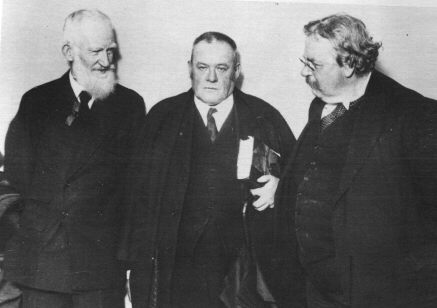
(L to R) George Bernard Shaw, Hilaire Belloc, GK Chesterton, 1928.
It will not do to paper over the fundamentals.
Every society reaches a point where it must examine its principles and choose whether to recommit to them or toss 'em out for new ones. Although it gets clearer every day that Western Civilization has reached that point, the question of the Crisis of the West was brought into exquisite focus nearly 100 years ago by a group of British gentlemen who called themselves The Reform Club.
Orthodoxy or modernity? That's the tension lying behind almost every issue of our times, and to recognize that is the first step to understanding not only our times, but our society, our own lives, and the human condition.
Current events are a logical starting point, because we share some commonality with the particulars. But to seek genuine understanding, they must only be our starting point. To duplicate the babble (perhaps the most deeply rooted etymology in the English language: the Tower of Babel, where no one is intelligible to the other) that passes for intelligent discussion elsewhere and everywhere is insufficient to the purpose of this blog, which like that club of visionaries in the past century is dedicated to the search for foundational, not ephemeral, truths.
In 1928, the orthodox GK Chesterton debated his existential enemy, the modernist George Bernard Shaw (with Catholic radical Hilaire Belloc as moderator), on how a society should order itself economically. The transcript can be found here, and reading it is good for the soul.
The discussion was playfully and wisely entitled "Do We Agree?" To understand what they were after, presenting unique and foundational views peppered with not a little bit of wit, is to understand our aspirations for this blog.
To parrot the prevailing arguments from elsewhere serves no purpose: it's a waste of time and cyberink. We must do our homework on what's already been said elsewhere---especially on the side opposite our own---commencing with an understanding of Square One so we can move together toward Square Two.
Square Two (in the least) is our goal, if this blog is to be more than a pale copy of the rest of the internet. Quality over quantity, inquiry over debate, original voices over echo chambers.
This blog recommits itself to its principles, and that is non-negotiable. We will not and cannot gear ourselves to the lowest common denominator. It's for others to preach to the masses: Like the original Reform Club, we shall preach to those who themselves preach to the masses---to arm them not so much with answers, but with the proper fundamental questions that must be asked again and again.
The rest of our principles we shall leave open to examination, as honest inquirers and seekers of truth are honor-bound to do. We leave the doors of our modest club open to those of like mind and spirit, and rely on them to help us preserve what we are, and to help us toward what we aspire to be.
The original Reform Club, (pictured on the sidebar to the right) was conceived as a place where worthy gentlepersons of all persuasions could convene in the spirit of inquiry into the human condition, and exchange their views before a wider audience, for the benefit and edification of all.
This blog, thenewswalk.com, is the successor to that tradition and to The Reform Club blog, founded by ST Karnick and Hunter Baker (see links to them on the sidebar at right as well).
A reposting of the below was requested by a certain Dr. Watson, and the request is timely. Here it is with minor updating:

(L to R) George Bernard Shaw, Hilaire Belloc, GK Chesterton, 1928.
It will not do to paper over the fundamentals.
Every society reaches a point where it must examine its principles and choose whether to recommit to them or toss 'em out for new ones. Although it gets clearer every day that Western Civilization has reached that point, the question of the Crisis of the West was brought into exquisite focus nearly 100 years ago by a group of British gentlemen who called themselves The Reform Club.
Orthodoxy or modernity? That's the tension lying behind almost every issue of our times, and to recognize that is the first step to understanding not only our times, but our society, our own lives, and the human condition.
Current events are a logical starting point, because we share some commonality with the particulars. But to seek genuine understanding, they must only be our starting point. To duplicate the babble (perhaps the most deeply rooted etymology in the English language: the Tower of Babel, where no one is intelligible to the other) that passes for intelligent discussion elsewhere and everywhere is insufficient to the purpose of this blog, which like that club of visionaries in the past century is dedicated to the search for foundational, not ephemeral, truths.
In 1928, the orthodox GK Chesterton debated his existential enemy, the modernist George Bernard Shaw (with Catholic radical Hilaire Belloc as moderator), on how a society should order itself economically. The transcript can be found here, and reading it is good for the soul.
The discussion was playfully and wisely entitled "Do We Agree?" To understand what they were after, presenting unique and foundational views peppered with not a little bit of wit, is to understand our aspirations for this blog.
To parrot the prevailing arguments from elsewhere serves no purpose: it's a waste of time and cyberink. We must do our homework on what's already been said elsewhere---especially on the side opposite our own---commencing with an understanding of Square One so we can move together toward Square Two.
Square Two (in the least) is our goal, if this blog is to be more than a pale copy of the rest of the internet. Quality over quantity, inquiry over debate, original voices over echo chambers.
This blog recommits itself to its principles, and that is non-negotiable. We will not and cannot gear ourselves to the lowest common denominator. It's for others to preach to the masses: Like the original Reform Club, we shall preach to those who themselves preach to the masses---to arm them not so much with answers, but with the proper fundamental questions that must be asked again and again.
The rest of our principles we shall leave open to examination, as honest inquirers and seekers of truth are honor-bound to do. We leave the doors of our modest club open to those of like mind and spirit, and rely on them to help us preserve what we are, and to help us toward what we aspire to be.
Subscribe to:
Posts (Atom)