Tradition is not the worship of ashes, but the preservation of fire.—Gustav Mahler

Monday, April 17, 2017

When Historians Attack: Mark Noll, Part Deux

Mark A. Noll, who started as a professor at conservative evangelical gold standard Wheaton College and achieved his largest notoriety for his acidic takedown of his co-religionists, The Scandal of the Evangelical Mind [“The scandal of the evangelical mind is that there is not much of an evangelical mind”], has now become ensconced as the gold standard on early American religious history on his throne at putatively Catholic University of Notre Dame.

I registered my own objection to Noll's approach here, that he may conflate his historian hat with his theological one--with his left-liberal sentiments coloring both--but this broadside on similar grounds from one Glenn Moots of tiny Northwood University makes me look like a pussycat.


In the Beginning was the Word: The Bible in American Public Life, 1492-1783 by Mark A. Noll, Oxford University Press, 448 pages, $29.95
Notre Dame historian Mark Noll recently released the first of three promised volumes chronicling the use of the Bible in American public life. In the Beginning Was the WordThe Bible in American Public Life, 1492-1783 follows cultural and theological movement over three centuries: from the “Bible under Christendom,” to the “Bible over Christendom,” and finally to the “Bible against Christendom.” Unfortunately, Noll’s reliance on a reductive caricature of Protestant political theology causes him to give a false impression of how most colonial American Protestants deployed sacred and secular sources in their political thought. The result is a work of history whose questionable methods and underlying assumptions are every bit as telling—perhaps more so—than the historical chronicle itself.
...
But more pertinent to Noll’s charge against Allen, Biblical exegesis in favor of resistance and republicanism existed in America and Britain long before supposedly corrupting influences of “Whiggism” or “the Enlightenment” came on the scene. British Protestant arguments for resistance and revolution were advanced first by Marian exiles (who took some cues from the Lutheran Torgau and Magdeburg Declarations) and then by Noll’s ideal biblicists—the Puritans! (It must also be noted that all Protestant political arguments owed a debt to medieval precedent, too.)

When Massachusetts Bay colonists faced invasion from England in 1634, an invasion they feared was intent on taking their charter and imposing an Anglican establishment, their justification for armed resistance included both scriptural and legal arguments. There was not yet an “Enlightenment” to corrupt the supposedly “proper” reading of Romans 13 as unconditional obedience—just as there had been no Enlightenment to inspire the Roman Catholic conciliarists, the Marian exiles, or Cromwell’s New Model Army. Why, therefore, does Noll so readily charge these “Whigs” or “patriots” with using “Scripture to clothe what opposition politics created”? Noll’s insistence on the American Revolution as a departure from Protestant biblicism also implies a preference for pacifism. Noll writes, “Among the authors who did seek direct biblical guidance, Christian pacifists stood out by invoking the sacred page to defend positions that had been derived originally from Scripture.” However, wasn’t classical just war theory largely owed to Christendom?
We want Professor Noll to keep his historical studies coming, but one wonders how he can insist on dividing wheat from chaff in the Bible’s proper use. Will Noll cast abolitionists as biblicists, given that many of their polemics resemble the politicized ravings of the Revolution’s patriot ministers, whom Noll scorns? Will every war be condemned if its proponents used the Bible to justify it? What will Noll make of the civil rights era? Shouldn’t its wedding of political ideology (the Declaration of Independence or nonviolent direct-action) to the Bible—particularly in the work of Martin Luther King, for example—be due the same criticism he levels at the Whigs of the mid-eighteenth century who defended British rights and liberties?
Ideally, Noll will settle into simply telling this long and difficult story of America’s relationship with the Bible, and not seek to impose ahistorical categories on its use in public life.

Friday, April 14, 2017

On the corruption of the social sciences

Writer James DC Walker limns the current crisis in his recent essay Conservatives Aren’t the Only Voices Silenced by Academia’s Intellectual Orthodoxy--it's not just that ideologically conservative voices are being suppressed by the scholarly academy [although that's certainly true]. No, it's the hermeneutics that are the problem. It's one thing that the prevailing conclusions may be ideologically biased, quite another that the method of pursuing them makes it impossible to come to any other conclusions.

The new way of "doing history" isn't just questionable in the validity of its new horizons, its biggest crime is that it closes off all the other ones.

This revolution has been political. Entire disciplines—Literature, Anthropology, Sociology, and the various interdisciplinary programs that end in the word “Studies” – have all become more strongly associated with a particular species of left-wing interpretation that now influences the broader discourse in journalism and on social media. In some departments, the social categories of analysis—race, class, and gender—have attained complete hegemony. The most recent convention of the Modern Language Association, the most prominent organization associated with the study of language and literature, hosted three times as many panels on post-colonialism as it did on Shakespeare. Like so many other areas of study, a consensus has been reached in English and Comparative Literature that the aims of one’s research should be about more than a body of knowledge or a disciplinary canon. Critique, as it is understood, is ultimately a criticism of the society (not the author) that produced a given text; all literary criticism reduces to social criticism. The contemporary literature professor need not even be an expert on any particular author or literary figure, but can be expected to be a master at applying a particular interpretive lens such as Queer Theory or Critical Race Theory.
The reality that the humanities and social sciences seem to be increasingly attracting one particular kind of person with one, very distinct, understanding of the world can be seen in other disciplines as well. Entire fields and subfields such as Diplomatic History and Military History are on the precipice of extinction, as more and more current and aspiring historians ignore or abandon these fields for the sexier (and more explicitly ideological) fields in Cultural and Social History.
What has happened in Literature and History departments as well as in other disciplines draws attention to something rarely considered in discussions concerning intellectual diversity in higher education. Conservatives will point to statistics such as the imbalance in the ratio between registered Democrats and Republicans as evidence of a political imbalance. Students it is argued are only getting one side of the story. While this sentiment is certainly understandable, it ignores an element of the current phenomena that might be even more deleterious to student learning and thus all the more intractable. The problem isn’t simply one of political imbalance, an absence of parity between Left and Right voices, but the extent to which humanities departments have become politicized.
The possibility that one might read a manuscript or approach a cultural or philosophical question from a perspective that isn’t explicitly political is now often dismissed as either naive or not worthwhile. In this way, the humanities have constructed a sort of ideological prison house for themselves. One of the most compelling features of humanistic study is the inexhaustibility of interpretations—the capacity to engage a text, a cultural practice, or an age-old philosophical question and derive new meanings and new possibilities from it. As the humanities have become subsumed into a larger political project, the possible interpretations that one may entertain have become narrowed to explicitly politicized readings. An education in the humanities risks becoming nothing more than a political education—that is to say, an education that isn’t worth pursuing for anyone other than the already-converted activist.

Friday, April 07, 2017

Jacob Henry, Religious Freedom, and Eisen & Painter’s Lawsuit Against President Donald Trump (with UPDATE)


Like many of the post-revolutionary constitutions of the newly independent states, the 1776 Constitution of North Carolina limited eligibility in regard to (some) positions in the state government. Only Protestants were eligible. Specifically, Article XXXII provided:

That no person, who shall deny the being of God or the truth of the Protestant religion, or the divine authority either of the Old or New Testaments, or who shall hold religious principles incompatible with the freedom and safety of the State, shall be capable of holding any office or place of trust or profit in the civil department within this State.[1]

In 1809, while the 1776 North Carolina Constitution was still in force, Jacob Henry was elected (actually reelected) to the House of Commons, i.e., the lower house of the North Carolina legislature. Henry was Jewish.[2] His qualifications were contested, and the members of the Commons acted as judges of the election.[3] A celebrated debate about religious freedom was to take place. “Mr. Henry boldly and successfully defended his rights, though a most curious construction of Article XXXII was adopted in order to enable him to retain his seat.”[4]

Interestingly, there is no record (of which I am aware) indicating that wide ranging concerns about religious freedom or religious establishments swung the members. It appears that what interested the members was not abstract norms, fairness, or even the purposes of Article XXXII; rather, what swung the members’ decision was their understanding of the state constitution’s actual language.[5] As Professor Orth has explained: “The house…refused to exclude him, apparently on the ground that a seat in the General Assembly was not an ‘Office…of Trust or Profit’ within the meaning of the North Carolina Constitution ….”[6] To put it another way:

Despite all this, however, the victory [for freedom of religion in North Carolina] was one in form only, not in substance. As a matter of fact, the [Article XXXII Religious] [T]est was more firmly implanted than ever. The House of Commons in permitting Henry to retain his seat…emphasized rather than weakened its prohibition. The decision was based on the fact that the Constitution prohibited non-Protestants from holding office in any civil department of the State. This was interpreted not to exclude such persons from serving in the legislature. The legislative office, it was said, was above all civil offices.[7]

Now this is all interesting. But what does it have to with President Trump?

A lawsuit has been brought against President Trump alleging that his business transactions with foreign state-owned commercial entities amount to violations of the United States Constitution’s Foreign Emoluments Clause. The Foreign Emoluments Clause provides: “[N]o Person holding any Office of Profit or Trust under them [i.e., the United States], shall, without the Consent of the Congress, accept of any present, Emolument, Office, or Title, of any kind whatever, from any King, Prince, or foreign State.”[8]

This lawsuit has been brought by, among others, Ambassador Eisen, Professor Painter, and Professor Teachout. Teachout has argued that the Foreign Emoluments Clause’s office-language extends to elected federal officials, including members of Congress and the presidency.[9] Eisen and Painter have stated: “The [Foreign] Emoluments Clause applies to all persons holding an office of trust or profit with the United States government—no exceptions. It applies to the president, the vice president, and the members of Congress. No one is above the law.”[10]

Now I think the language of the North Carolina Constitution of 1776 closely tracks the language in the United States Constitution’s Foreign Emoluments Clause. If anything the North Carolina provision, using office or place of trust or profit-language, would seem to be broader than the Foreign Emoluments Clause’s more limited language, which merely extends to office of profit or trust. If that is correct, and if one credits the decision of the North Carolina House of Commons, it would seem to follow that the Foreign Emoluments Clause does not reach members of Congress.

Now Teachout, Eisen, and Painter have argued that the Foreign Emoluments Clause’s office-language extends to members of Congress. If they are wrong about that (as I think they are), perhaps they are also wrong in asserting that the Foreign Emoluments Clause extends to the presidency? If the Constitution’s office-language does not reach members of Congress, it is not because members are “above the law,”[11] but because the Constitution itself uses language which was, is, remains inapplicable to such positions. Once one acknowledges that some government positions, including important positions such as Representative and Senator, fall beyond the scope of the Constitution’s office of profit or trust-language, then one can no longer rely on legal intuitions, such as no one is above the law. Rather, here, we must ask, given the language and purposes of the Foreign Emoluments Clause, is a person elected to the office of President more like a person elected to Congress (to whom the Foreign Emoluments Clause does not apply) or more like a subordinate appointed Executive Branch officer (to whom the clause does apply)?

It would be good to have that scholarly discussion. But when we have discussion, let us start from the baseline that the Foreign Emoluments Clause does not and cannot apply to members of Congress. And let us also start from the baseline that if Teachout’s, Eisen’s, and Painter’s legal intuitions have been wrong about so significant an issue (i.e., the applicability of the Foreign Emoluments Clause to members of Congress), then their intuitions—rooted in modern English usage related to “office” and modern norms related to good governance—cannot possibly inform our understanding of the Constitution’s Foreign Emoluments Clause.

Seth

Citation: Seth Barrett Tillman, Jacob Henry, Religious Freedom, and Eisen & Painter’s Lawsuit Against President Donald Trump, New Reform Club (April 7, 2017), http://tinyurl.com/lboqrgz


UPDATE: Seth Barrett Tillman, New Sources on the 1809 Motion to Vacate Jacob Henry’s North Carolina State Legislative Seat (posted Nov. 25, 2019) <https://ssrn.com/abstract=3498217>.


[1] Article XXXII in Constitution of North Carolina: December 18, 1776, The Avalon Project (last visited Apr. 7, 2017), http://avalon.law.yale.edu/18th_century/nc07.asp#b5 (emphasis added).
[2] See Jacob Henry may have been Michael Gratz’s brother. See generally Leon Hühner, The Struggle for Religious Liberty in North Carolina, with Special Reference to the Jews, 16 Publications of the American Jewish Historical Society 37, 46–47 (1907); id. at 47 n.31 (“A famous [Philadelphia] merchant in Revolutionary days; the father of Rebecca Gratz, who was the friend of Washington Irving.”).
[3] See Article X (“That the Senate and House of Commons, when met, shall each have power to choose a speaker and other their officers; be judges of the qualifications and elections of their members; sit upon their own adjournments from day to day, and prepare bills, to be passed into laws.” (emphasis added)), in Constitution of North Carolina, supra note 1.
[4] Supra note 2, at 47-48.
[5] See id. at 52 (“Despite all this, however, the victory was one in form only, not in substance. As a matter of fact, the test was more firmly implanted than ever.”).
[6] Jacob V. Orth & Paul Martin Newby, The North Carolina State Constitution 8 (2d ed. 2013) (footnote omitted) (emphasis added).
[7] Supra note 2, at 52 (footnotes omitted) (emphasis in the original).
[8] U.S. CONST. art. I, § 9, cl. 8 (emphasis added).
[9] See, e.g., Zephyr Teachout, The Anti-Corruption Principle, 94 Cornell L. Rev. 341, 354, 361–62 (2009) (arguing that the Foreign Emoluments Clause applies to members of Congress); id. at 366 (arguing that the Foreign Emoluments Clause applies to the presidency).
[10] Norman L. Eisen & Richard W. Painter, Trump Could Be in Violation of the Constitution His First Day in Office, The Atlantic (Dec. 7, 2016), http://tinyurl.com/zlgrh6u (emphasis added).
[11] Id

Gorsuch Succeeds Scalia

Tuesday, April 04, 2017

Podcast: Ian J. Drake Interviewing Seth Barrett Tillman on Ex Parte Merryman

James Kates, Ian J. Drake Interviewing Seth Barrett Tillman: Ex Parte Merryman: Myth, History, and Scholarship, New Books Network (Apr. 4, 2017), http://tinyurl.com/kaldoda

The above is a link to my New Books Network podcast on Ex parte Merryman. I did not write a book, but they made an exception for my lengthy article.

Seth 


Seth Barrett Tillman, Podcast: Ian J. Drake Interviewing Seth Barrett Tillman on Ex Parte Merryman, New Reform Club (Apr. 4, 2017, 1:47 PM), tinyurl.com/lssgrwn 

Wednesday, March 29, 2017

Why I Remain Unimpressed by Academic Presses


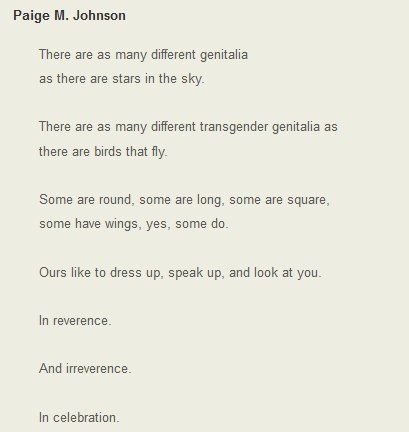
Hot off the Duke University Press:


They Look Back

The Animalization and Self-Articulation of Trans Genitalia


Duke University Press is "peer-reviewed," whatever that means in this day and age. One academic fraud gives cover to the other.

Buyer beware. Bigly.

Monday, March 27, 2017

Novel Questions of Pure Law and Discovery


The Constitution’s Domestic Emoluments Clause*** states:

The President shall, at stated Times, receive for his Services, a Compensation, which shall neither be increased nor diminished during the Period for which he shall have been elected, and he shall not receive within that Period any other Emolument from the United States, or any of them.[1]

The Constitution’s Foreign Emoluments Clause states:

[N]o Person holding any Office of Profit or Trust under them [i.e., the United States], shall, without the Consent of the Congress, accept of any present, Emolument, Office, or Title, of any kind whatever, from any King, Prince, or foreign State.[2]

In regard to the Domestic Emoluments Clause, where the federal government or a state government engages in a business transaction with a private commercial entity owned (in whole or in significant part) or controlled (in whole or in significant part) by the President of the United States (in his private capacity), but not with the President, it is not clear that such a transaction falls under the aegis of the Domestic Emoluments Clause. Indeed, no court of the United States (of which the Author is aware) has had occasion to resolve this novel threshold question of pure law. This issue must be resolved in any litigation seeking to assert that the Domestic Emoluments Clause applies to such business transactions with the President. As a question of pure law, this issue ought to be judicially resolved prior to any court ordered discovery.

Much the same can be said in regard to the Foreign Emoluments Clause. No court of the United States (of which the Author is aware) has had occasion to determine whether a foreign state owned or foreign state controlled commercial entity is a “foreign state” for the purposes of the Foreign Emoluments Clause. This is a novel threshold question of pure law which must be resolved in any litigation seeking to assert that the Foreign Emoluments Clause applies to business transactions between a constitutionally proscribed federal officeholder (i.e., an “officer … under the United States”) and a foreign state owned or foreign state controlled commercial entity. As a question of pure law, this issue ought to be judicially resolved prior to any court ordered discovery.

Similarly, where a foreign state engages in a business transaction with a private commercial entity owned (in whole or in significant part) or controlled (in whole or in significant part) by a constitutionally proscribed federal officeholder (in his private capacity), but not with the officeholder, it is not clear that such a transaction falls under the aegis of the Foreign Emoluments Clause. Indeed, no court of the United States (of which the Author is aware) has had occasion to resolve this novel threshold question of pure law. This issue, too, must be resolved in any litigation seeking to assert that the Foreign Emoluments Clause applies to business transactions between private commercial entities owned or controlled by a constitutionally proscribed federal officeholder and a foreign state. And, here too, as a question of pure law, this issue ought to be judicially resolved prior to any court ordered discovery.

Where a transaction has a commercial entity on both sides, as opposed to an actual foreign state and an actual constitutionally proscribed federal officeholder, the policy concerns animating the Foreign Emoluments Clause must be much attenuated.


Seth


Seth Barrett Tillman, Novel Questions of Pure Law and Discovery, The New Reform Club (Mar. 27, 2017, 6:58 AM), http://tinyurl.com/lpjudfk

*** I am following the odd naming convention for the clause used by the Plaintiff in CREW v. President Trump, Civ. A. No. 1:17-cv-00458-RA (S.D.N.Y. Jan. 23, 2017) (Abrams, J.). See note [1].


[1] U.S. Const. art. II, § 1. cl. 7 (the so-called Domestic Emoluments Clause, a/k/a Presidential Compensation (or Emoluments) Clause) (emphasis added).
[2] U.S. Const. art. I, § 9, cl. 8 (the Foreign Emoluments Clause, a/k/a Foreign Gifts (or Titles) Clause, or Emoluments Clause) (emphasis added). 

Sunday, March 19, 2017

Business Transactions for Value Are Not “Emoluments”

Addendum: Accepted Paper: Seth Barrett Tillman, Essay, Business Transactions and President Trump’s “Emoluments” Problem, 40(3) Harv. J.L. & Pub. Pol’y (forthcoming circa 2017–2018), https://ssrn.com/abstract=2957162

Recently, it has been argued that the term “emoluments” (as used in the Constitution’s Foreign Emoluments Clause[1] and Domestic Emoluments Clause[2]**) reaches any pecuniary advantage, benefit, or profit arising in connection with business transactions for value.[3] This position is incorrect. The Domestic Emoluments Clause states:

The President shall, at stated Times, receive for his Services, a Compensation, which shall neither be increased nor diminished during the Period for which he shall have been elected, and he shall not receive within that Period any other Emolument from the United States, or any of them.[4]

If the emoluments-are-any-pecuniary-advantage position were correct, if “emoluments” as used in the Constitution extended to any pecuniary advantage, then presidents are and would have been precluded from doing business with the United States government.

However, George Washington (who had previously been president of the Federal Convention which drafted the Constitution[5]), while he was President of the United States, did business on more than one occasion with the Federal Government. He purchased several lots of land in the new federal capital at public auction. One such set of purchases took place on or about September 18, 1793.[6] Three commissioners ran the public auction: David Stuart, Daniel Carroll, and Thomas Johnson. Who were they?

·    David Stuart was a member of the Virginia convention which ratified the Federal Constitution.[7]
·  Daniel Carroll was a member of the Federal Convention which drafted the Constitution and later a member of the First Congress.[8]
·   Thomas Johnson was the first Governor of Maryland following independence, a member of the Maryland convention which ratified the Federal Constitution, and afterwards he served as a Justice of the Supreme Court of the United States.[9]

So among the four participants (i.e., Washington and the three commissioners) were:


  •       three members of the Continental Congress;[10]
  •       two members of state ratification conventions;
  •       two members of the Federal Convention (including the Convention’s president);
  •       a member of the First Congress;
  •       a Justice of the Supreme Court of the United States;
  •       a Governor; and,
  •       our first President.
An undoubtedly accomplished group. Are we really to believe that not only did all four participants willingly, openly, and notoriously participate in a conspiracy to aid and abet the President in violating the Constitution’s Domestic Emoluments Clause, but that they also left—for themselves and their posterity—a complete and signed documentary trail of their wrongdoing?[11]

The emoluments-are-any-pecuniary-advantage position amounts to: (1) President Washington was at best an idiot, if not a crook; (2) Washington’s allies openly supported obvious and profound constitutional lawlessness; and (3) Washington’s political opponents[12] were altogether and unaccountably silent—silent in Congress, silent in newspapers, and silent in their private correspondence. The emoluments-are-any-pecuniary-advantage position amounts to a naked assertion by twenty-first century legal academics that they understand the Constitution’s original public meaning better than those who drafted it, and better than those who ratified it, and better than those who put it into effect in the First Congress.

The alternative view is that linguistic and historical humility compel reasonable minds to recognize that much of the language within our more than two-century old Constitution is opaque. It follows that—in order for twenty-first century citizens to understand what the Constitution’s opaque language meant when ratified (and what it continues to mean now) in regard to a specific (but otherwise wholly obscure) legal term (e.g., “emoluments”)—reasonable persons must look to the actual conduct of the Framers, the Ratifiers, and the original practice of the three branches when they were squarely confronted with the need to determine the meaning of a particular legal term on concrete facts.

It is incontrovertible that President George Washington, in a private capacity, engaged in business transactions with the Federal Government, notwithstanding that he received or intended to receive a pecuniary advantage. Given Washington’s very public conduct,[13] a modern interpreter should be reluctant to conclude that such advantages, benefits, and profits amount to a constitutionally proscribed “emolument.” It stands to reason that if the benefits flowing from business transactions for value (with the Federal Government) are not constitutionally proscribed “emoluments” for the purposes of the Domestic Emoluments Clause, then the benefits flowing from similar transactions for value—with foreign states or foreign state owned or controlled commercial entities[14]—are not constitutionally proscribed “emoluments” for the purposes of any other clause, including the Foreign Emoluments Clause. Both the Domestic Emoluments Clause and the Foreign Emoluments Clause use the same “emoluments” language.[15]

Indeed, from the perspective of modern (as opposed to eighteenth century) governance norms, President Washington’s business transactions posed a nonfrivolous risk of moral hazard, conflicts, and corruption. Unlike bargains struck between genuinely adverse parties, President Washington was speculating on land in public auctions—that is, public auctions managed by commissioners whom he personally appointed.[16] As a result, Washington was on both sides of each and every one of these transactions;[17] yet, no one then or since has ever impugned the propriety of his conduct, much less the legal validity or constitutionality of his purchases.

Second, as the President’s lawyers, at Morgan, Lewis & Bockius LLP (“MLB”), explained the presents-language and the emoluments-language in the original Constitution’s Foreign Emoluments Clause were imported into a proposed federal constitutional amendment in 1810, the so-called Titles of Nobility Amendment.

In 1810, Congress voted by overwhelming margins to extend the Foreign Emoluments Clause to all citizens, not just federal officials. The proposed amendment would have prohibited private citizens’ acceptance of “any present, pension, office, or emolument, of any kind whatever, from any Emperor, King, Prince, or foreign Power,” stripping violators of their citizenship and barring them from state or federal office. The amendment came within two states of ratification—indeed, because of a publishing mistake, several generations believed it was part of the Constitution.

Yet there is no evidence anyone at the time thought the proposed amendment restricted citizens’ ability to engage in commerce with foreign nations, their governments, their representatives, or their [commercial] instrumentalities [or agents]. That suggests that the public did not understand the prohibition on accepting [foreign presents or] foreign emoluments to prohibit commerce with foreign states or their representatives through fair-market-value exchanges—and, by implication, that the Foreign Emoluments Clause does not reach these transactions.[18]

MLB’s argument remains wholly unrebutted by those suggesting that the Constitution’s presents-language and emoluments-language extend to business transactions for value.[19]

Finally, if there were any doubt that business transactions for value are not “emoluments” for the purposes of the Domestic Emoluments Clause and the Foreign Emoluments Clause, the Supreme Court laid that issue to rest in 1840. In Hoyt v. United States, the Court explained:

These terms [“fees” and “commissions”] denote a compensation for a particular kind of service to be performed by the officer, and are distinguishable from each other … they are also distinguishable from the term emoluments, that [term] being more comprehensive, and embracing every species of compensation or pecuniary profit derived from a discharge of the duties of the office.[20]

President Washington may very well have derived pecuniary advantages, benefits, and profits from his business transactions with the Federal Government, but the benefits flowing from those transactions were not “derived from [his] discharg[ing] the duties of [his] office.”[21] Hence, no constitutionally proscribed “emoluments” were involved.[22]

For all the reasons elaborated above, one must conclude that business transactions for value are not encompassed by the term “emoluments” as used in the Constitution.

Seth Barrett Tillman***


Seth Barrett Tillman, Business Transactions for Value Are Not “Emoluments”, The New Reform Club (Mar. 19, 2017, 3:15 AM), http://tinyurl.com/kos696z 

Addendum: Accepted Paper: Seth Barrett Tillman, Essay, Business Transactions and President Trump’s “Emoluments” Problem, 40(3) Harv. J.L. & Pub. Pol’y (forthcoming circa 2017–2018), https://ssrn.com/abstract=2957162


** I am following the odd naming convention for the clause used by the Plaintiff in CREW v. President Trump, Civ. A. No. 1:17-cv-00458-RA (S.D.N.Y. Jan. 23, 2017) (Abrams, J.). See note [2].
  

*** Maynooth University Department of Law, New House (#53), Maynooth University, Maynooth, County Kildare, Ireland. sbarretttillman(at)yahoo.com. I received helpful comments, particularly in regard to finding sources, from several legal academics, historians (in academia and elsewhere), and listserv participants while developing this short paper. I thank them all; all errors remain mine. This short paper is cross-posted. See Seth Barrett Tillman, Business Transactions For Value Are Not “Emoluments” (Mar. 19, 2017), https://ssrn.com/abstract=2937186; Seth Barrett Tillman, Business Transactions For Value Are Not “Emoluments,” The New Reform Club (Mar. 19, 2017, 3:15 AM), http://tinyurl.com/lxash3w; see also Seth Barrett Tillman, Novel Questions of Pure Law and Discovery, The New Reform Club (Mar. 27, 2017, 6:58 AM), http://tinyurl.com/lpjudfk

[1] U.S. Const. art. I, § 9, cl. 8 (the Foreign Emoluments Clause, a/k/a Foreign Gifts (or Titles) Clause, or Emoluments Clause) (“[N]o Person holding any Office of Profit or Trust under the[] [United States], shall, without the Consent of the Congress, accept of any present, Emolument, Office, or Title, of any kind whatever, from any King, Prince, or foreign State.”).
[2] U.S. Const. art. II, § 1. cl. 7 (the so-called Domestic Emoluments Clause, a/k/a Presidential Compensation (or Emoluments) Clause).
[3] If the subject matter of our inquiry were something other than an exchange for value, we would be discussing either: (1) a present, or (2) a bribe. Textually, the Domestic Emoluments Clause does not extend to presents. Likewise, bribery is expressly dealt with by the Impeachment Clause, U.S. Const. art. II, § 4, not by either the Foreign Emoluments Clause or the Domestic Emoluments Clause.
[4] U.S. Const. art. II, § 1. cl. 7 (emphasis added).
[5] See Washington, George (1732–1799), Biographical Directory of the United States Congress (last visited Feb. 14, 2017), http://tinyurl.com/l5vpnzk (also reporting that Washington was a member of the Continental Congress).
[6] See Certificate for Lots Purchased in the District of Columbia, 18 September 1793, Founders Online (last visited Feb. 14, 2017), http://tinyurl.com/gtpw5mm.
[7] See 3 The Debates in the Several State Conventions on the Adoption of the Federal Constitution as Recommended by the General Convention at Philadelphia in 1787, at 654 & 662 (Jonathan Elliot ed., Washington 2d ed. 1836) (recording Stuart’s votes on June 25 and 27, 1788), http://tinyurl.com/l6ypss2. Stuart was also a federal elector for Virginia in the first federal election. See 3 The Documentary History of the First Federal Elections 1788–1790, at xvi (Gordon DenBoer ed., 1986), http://tinyurl.com/kvbwrou.
[8] See Carroll, Daniel (1730–1796), Biographical Directory of the United States Congress (last visited Feb. 14, 2017), http://tinyurl.com/hxf9dyx (also reporting that Carroll was a member of the Continental Congress and signed the Articles of Confederation).
[9] See Johnson, Thomas (1732–1819), Biographical Directory of the United States Congress (last visited Feb. 14, 2017), http://tinyurl.com/lwxw22r (also reporting that Johnson was a member of the Continental Congress and first Governor of Maryland following independence).
[10] See supra notes 5, 8–9.
[11] See, e.g., Certificate for Lots Purchased in the District of Columbia, 18 September 1793, Founders Online (last visited Feb. 14, 2017) (reproducing a certificate of purchase signed by Commissioners David Stuart and Daniel Carroll which stated: “At a Public Sale of Lots in the City of Washington, George Washington, President of the United States of America became purchaser of Lots No. twelve, No. thirteen & No. fourteen in Square No. six hundred & sixty seven . . . .” (emphasis added)), http://tinyurl.com/gtpw5mm. In addition to lots nos. 12, 13, and 14, Washington also purchased lot no. 5, and he received a separate certificate confirming this additional purchase. See id. (editors’ notes). See generally, e.g., Letter from President George Washington to the Commissioners (Mar. 14, 1794), in The Writings of George Washington Relating to the National Capital, 17 Records of the Columbia Hist. Soc. 3, 97 (1914) (indicating that Washington believed and intended that his purchases of public land were known to the public), http://www.jstor.org.jproxy.nuim.ie/stable/pdf/40067048.pdf.
[12] In 1793, during the Third Congress, the year President Washington made these land purchases at public auctions, there were some 13 anti-administration Senators and some 40 anti-administration Representatives. See Biographical Directory of the United States Congress (last visited Feb. 14, 2017), http://bioguide.congress.gov/biosearch/biosearch.asp (enter “Representative” or “Senator” for “Position:” and enter “1793” for “Year or Congress:”); see also, e.g., Letter from President George Washington to Bushrod Washington (July 27, 1789), in 30 The Papers of George Washington 366, 366 (John C. Fitzpatrick ed., 1939) (“My political conduct . . . must be exceedingly circumspect and proof against just criticism, for the Eyes of Argus are upon me, and no slip will pass unnoticed that can be improved into a supposed partiality for friends or relatives.”), https://www.loc.gov/resource/mgw2.017/?sp=26; infra note 13.
[13] See Akhil Reed Amar, America’s Unwritten Constitution: The Precedents and Principles We Live By 309 (2012) (“Over the centuries, the constitutional understandings that crystallized during the Washington administration have enjoyed special authority on a wide range of issues . . . .”); see also Seth Barrett Tillman, Who Can Be President of the United States?: Candidate Hillary Clinton and the Problem of Statutory Qualifications, 5(1) Br. J. Am. Leg. Studies 95 (2016) (peer reviewed), https://ssrn.com/abstract=2679512:

Evidence arising in connection with the Washington administration is generally considered superior to that of later administrations. Why? First, Washington’s administration was contemporaneous with the Constitution’s ratification. Second, the President was a Framer and his cabinet (and administration) contained other prominent Framers and ratifiers. Indeed, between the President and his nine cabinet members (over the course of two terms), half of the group were either Framers or ratifiers or both. Third, the President saw himself above party or faction; indeed, active partisan federal electoral politics did not arise until after Washington announced that he would not run for a third term. Fourth, Washington both valued his reputation for probity and acted under the assumption that his conduct was closely monitored by political opponents and opportunists. Fifth, Washington understood that his personal and his administration’s conduct were precedent-setting in regard not only to significant deeds, but even in regard to what might appear to be minor events and conduct.

Id. at 105–08 (emphasis added) (footnotes with supporting sources omitted); supra note 12.
[14] In regard to the Domestic Emoluments Clause, where the federal government or a state government engages in a business transaction with a private commercial entity owned (in whole or in significant part) or controlled (in whole or in significant part) by the President of the United States (in his private capacity), but not with the President, it is not clear that such a transaction falls under the aegis of the Domestic Emoluments Clause. See supra note 2. Indeed, no court of the United States (of which the Author is aware) has had occasion to resolve this novel threshold question of pure law. This issue must be resolved in any litigation seeking to assert that the Domestic Emoluments Clause applies to such business transactions with the President. As a question of pure law, this issue ought to be judicially resolved prior to any court ordered discovery.
Much the same can be said in regard to the Foreign Emoluments Clause. No court of the United States (of which the Author is aware) has had occasion to determine whether a foreign state owned or foreign state controlled commercial entity is a “foreign state” for the purposes of the Foreign Emoluments Clause. See supra note 1. This is a novel threshold question of pure law which must be resolved in any litigation seeking to assert that the Foreign Emoluments Clause applies to business transactions between a constitutionally proscribed federal officeholder (i.e., an “officer … under the United States”) and a foreign state owned or foreign state controlled commercial entity. As a question of pure law, this issue ought to be judicially resolved prior to any court ordered discovery. Similarly, where a foreign state engages in a business transaction with a private commercial entity owned (in whole or in significant part) or controlled (in whole or in significant part) by a constitutionally proscribed federal officeholder (in his private capacity), but not with the officeholder, it is not clear that such a transaction falls under the aegis of the Foreign Emoluments Clause. Indeed, no court of the United States (of which the Author is aware) has had occasion to resolve this novel threshold question of pure law. This issue, too, must be resolved in any litigation seeking to assert that the Foreign Emoluments Clause applies to business transactions between private commercial entities owned or controlled by a constitutionally proscribed federal officeholder and a foreign state. And, here too, as a question of pure law, this issue ought to be judicially resolved prior to any court ordered discovery. Where a transaction has a commercial entity on both sides, as opposed to an actual foreign state and an actual constitutionally proscribed federal officeholder, the policy concerns animating the Foreign Emoluments Clause must be much attenuated.
[15] See supra notes 1–2 and accompanying text; Akhil Reed Amar, Intratextualism, 112 Harv. L. Rev. 747, 748 (1999).
[16] See Letter from George Washington, President of the United States of America, to All Who Shall See These Presents (Jan. 22, 1791), in The Writings of George Washington Relating to the National Capital, supra note 11, at 3 (appointing Johnson, Carroll, and Stuart commissioners), http://www.jstor.org.jproxy.nuim.ie/stable/pdf/40067048.pdf.
[17] Oliver Evans held U.S. Patent #3: a patent for an automated grain milling system. This patent was issued by Executive Branch officers responsible to President Washington during his first term in office. Indeed, President Washington personally reviewed and signed the patent application. See George Washington upgraded his milling operation by installing improvements invented by Oliver Evans, George Washington’s Mount Vernon (last visited Mar. 20, 2017), http://www.mountvernon.org/the-estate-gardens/gristmill/oliver-evans/. Subsequently, in 1791, “Washington purchased a license for the patent and had the milling system installed in his [Mount Vernon] gristmill.” See George Washington constructed a large, extremely profitable gristmill at Mount Vernon using cutting-edge technology of the time, George Washington’s Mount Vernon (last visited Mar. 20, 2017), http://www.mountvernon.org/the-estate-gardens/gristmill/. Here too, President Washington was on both sides of the transaction at issue. This another good example indicating that modern fiduciary governance standards are wholly unrelated to the original public meaning of the Constitution’s Domestic Emoluments Clause and Foreign Emoluments Clause. See, e.g., Martin H. Redish & Elana Nightingale Dawson, “Worse than the Disease”: The Anti-Corruption Principle, Free Expression, and the Democratic Process, 20 Wm. & Mary Bill Rts. J. 1053, 1068 (2012) (distinguishing the “Framers’ limited prophylactic approach” from Professor Teachout’s position); Adrian Vermeule, The Constitutional Law of Official Compensation, 102 Colum. L. Rev. 501, 510 (2001) (denominating the Domestic Emoluments Clause and the Foreign Emoluments Clause “limited anticorruption provisions”). See generally Marbury v. Madison, 5 U.S. (1 Cranch) 137 (1803) (issuing a decision by Chief Justice Marshall, notwithstanding his having previously been a key federal official who was in part responsible for the facts giving rise to the litigation).
[18] Sheri Dillon et al., Moran, Lewis & Bockius LLP White Paper, Conflicts of Interest and the President, 4–5 (Jan. 11, 2017), https://assets.documentcloud.org/documents/3280261/MLB-White-Paper-1-10-Pm.pdf (footnotes omitted).
[19] Id.
[20] 51 U.S. (10 How.) 109, 135 (1850) (Nelson, J.) (emphasis added). Justice Nelson’s definition of “emolument” has been cited approvingly by the Executive Branch. See, e.g., Memorandum from Samuel A. Alito, Jr., Dep’y Asst. Att’y Gen., Office of Legal Counsel, for H. Gerald Staub, Office of Chief Counsel, National Aeronautics and Space Administration, Re: Emoluments Clause Questions Raised by NASA Scientist’s Proposed Consulting Arrangement with the University of New South Wales, 1986 WL 1239553, at *1 n.4 (May 23, 1986), https://www.justice.gov/olc/page/file/936146/download.
[21] Hoyt, 51 U.S. (10 How.) at 135.
[22] See generally Andy Grewal, The Foreign Emoluments Clause and the Chief Executive, 102 Minn. L. Rev. (forthcoming 2017), https://ssrn.com/abstract=2902391; Robert G. Natelson, The Original Meaning of ‘Emoluments’ in the Constitution (Feb. 21, 2017), https://ssrn.com/abstract=2911871