
Wednesday, March 15, 2017


Chief Justice Taney on the Take Care Clause
The only power, therefore, which the president
possesses, where the “life, liberty or property” of a private citizen is
concerned, is the power and duty prescribed in the third section of the second
article, which requires “that he shall take care that the laws shall be
faithfully executed.” He is not authorized to execute them himself,
or through agents or officers, civil or military, appointed by himself,
but he is to take care that they be faithfully carried into execution, as they
are expounded and adjudged by the co-ordinate branch of the government to which
that duty is assigned by the constitution. It is thus made his
duty to come in aid of the judicial authority, if it shall be resisted by a
force too strong to be overcome without the assistance of the executive arm;
but in exercising this power he acts in subordination to judicial authority,
assisting it to execute its process and enforce its judgments.
Ex parte Merryman, 17 F. Cas. 144, 149 (C.C.D. Md. 1861) (No. 9487) (Taney, C.J.) (bold & underscore added).
Citation: Seth Barrett Tillman, Chief Justice Taney on the Take Care Clause, New Reform Club (Mar. 15, 2017, 12:35 PM). [here]
Citation: Seth Barrett Tillman, Chief Justice Taney on the Take Care Clause, New Reform Club (Mar. 15, 2017, 12:35 PM). [here]
Sunday, March 12, 2017
NPR's Planet Money, President Trump, and the Foreign Emoluments Clause
Noel King & Robert Smith, NPR Podcast #758, Can Trump Take the Money, NPR: Planet
Money (Mar. 10, 2017), http://tinyurl.com/zg6cgte.
Noel King: Presidents and other elected officials have been so
paranoid that they might seem to be in violation of [the Foreign Emoluments
Clause] that they do everything they can to avoid it. In fact, in the handful
of times it does come up it sounds ridiculous.
…
Noel King: Or if Presidents or other U.S. officials do accept
gifts, they do what the [Foreign Emoluments] [C]lause says they got to do, they
ask Congress for permission.
Dear Noel,
I listened to your full podcast. In fact,
I listened to it twice. And then I delayed two days before writing you.
In your podcast (at 10:20ff), you state
that Presidents have done “everything they can to avoid” application of the Foreign
Emoluments Clause “or … they ask Congress for permission [to keep the gift].”
I find your willingness to make this claim
more than a little troubling. You interviewed me for well over an hour, and you
and I discussed in detail President George Washington’s diplomatic gifts: gifts
which he received, acknowledged, and kept, absent any request for congressional
consent.
You say that Presidents have been paranoid.
You say that Presidents have done everything to avoid application of
the clause. But that is simply not true. President Washington did not do anything.
Washington just kept the gifts, including, a full length framed portrait of
Louis XVI, which remains on display to this day at his Mt Vernon estate. This
was diplomatic gift sent to President Washington at the direction of the French
government through the French ambassador. Your podcast is over 20 minutes long,
and yet, you could not even find a few seconds to let your listeners know that presidential
practice is not uniform and also that there are academics who disagree with the
merits of the legal arguments which form the basis of CREW’s lawsuit against
President Trump. That result is more than disappointing; it is an unfair
result. It is unfair because there are two sides to this story, and you chose
to present only one, and you did so after reaching out to me, after asking me for
an interview, and after taking a good deal of my time.
Why is it reasonable for you to spend all your
airtime considering Ambassador Franklin and President Martin Van Buren, but not
President George Washington and Secretary Alexander Hamilton—except that you
chose to present only evidence supporting only one point of view?
What happens if CREW’s lawsuit fails, and fails on the merits, unrelated to standing? What happens if the federal court
disagrees with the positions you put forth in your podcast, e.g., your asserting
that emoluments means profits (as opposed to alternative and
more limited definitions suggested by other academics, e.g., Professors Grewal and Natelson), and, e.g., your asserting that the Foreign Emoluments Clause
applies to the President? If that should happen, then your listeners might
begin to wonder: Why should they listen to NPR?, Why should they donate to
public radio?, and, finally, Why should public radio receive taxpayer funded
subsidies?—if public radio is determined to present only one side of issues
that quite clearly have two sides (as even The NY Times has managed to
acknowledge and report on multiple occasions). Now you might say that such a
result, as I suggest here, i.e., CREW’s losing on the merits, would be wholly
unexpected. But lately, unexpected things have been happening with some unexpected
regularity: e.g., Brexit and the election of President Trump. Perhaps that is
something you might want to consider when you next consider exercising
editorial discretion to report only one side of an issue with two sides.
Seth
Citation: Seth Barrett Tillman, NPR’s Planet Money, President Trump, and the
Foreign Emoluments Clause, New Reform
Club (Mar. 12, 2017). [here]
Friday, March 10, 2017
Purim & My Bangladeshi Friend: A Short Story
Seth Barrett Tillman, Purim & My Bangladeshi Friend, Gadfly: Culture that Matters, [Here] and [Here].
Sunday is Purim.
I wrote and published this 8-page short story—Purim & My Bangladeshi Friend—a little while back. My story is once again, timely, and sadly, once again, all too relevant to life in our shared West, in our shared modernity.
My short story was reviewed (or linked to) on several blogs:
T. Greer, Notes From All Over (3/02/2014): Ghosts, Empire, and Tribal Honor, The Scholar’s Stage (Feb. 3, 2014) (favourable review, but the reviewer gives away a key plot point);
Lexington Green, Seth Barrett Tillman, “Purim & My Bangladeshi Friend,” Chicago Boyz (Jan. 9, 2014) (favourable review);
Fri. Eve. Linkage (abbreviated), Howl at Pluto: History and Theory of International Politics, Etc. (Feb. 7, 2014, 6:38 PM) (with comments) (mixed to unfavourable reviews);
C. R. Krieger, Purim 2015–A Meditation, Right-Side-Of-Lowell (Mar. 6, 2015, 5:10 AM) (favourable review);
Jonathan Rowe, Seth Barrett Tillman, Purim & My Bangladeshi Friend, Gadfly: Culture that Matters, American Creation (Jan. 6, 2014, 12:14 PM) (neutral); and,
Glenn Reynolds, FOR PURIM: Seth Tillman: Purim & My Bangladeshi Friend, Instapundit (Mar. 5, 2015, 8:07 PM) (neutral ... but see comments).
After reading my short story, you might consider—or reconsider—the meaning of the sad events in Cologne (and across Europe) in a new way. You might also consider or reconsider the meaning of the authorities’ immediate, disgraceful response, or to be more accurate, non-response.
Seth
Twitter: https://twitter.com/SethBTillman ( @SethBTillman )
Citation: Seth Barrett Tillman, Purim & My Bangladeshi Friend: A Short Story, New Reform Club (Mar. 10, 2017, 12:27 PM). [here]
Citation: Seth Barrett Tillman, Purim & My Bangladeshi Friend: A Short Story, New Reform Club (Mar. 10, 2017, 12:27 PM). [here]
Sunday, March 05, 2017
Some Thoughts on the 2016 Presidential Election
You
may remember that late in the evening on election night, the electoral college
vote was 268-Trump, and 215-Clinton. At that juncture, the 5 outstanding states were: (i) Maine (4
electoral votes, which could be split); (ii) New Hampshire (4 electoral votes); (iii) Pennsylvania (20 electoral votes); (iv) Michigan (16 electoral votes); and (v) Minnesota (10 electoral votes). Additionally, 1
unawarded electoral vote for Nebraska remained because only 4 of Nebraska's 5 electoral votes had
already been awarded. See CNN, https://www.youtube.com/watch?v=YwvW85AyIO4 (at 3:45ff); see also PBS, https://www.youtube.com/watch?v=lL-gicgoCAY (at 8:13:30ff, with a slightly different configuration of states: 269-Trump, Clinton-218, with Arizona (11), New Hampshire (4), Michigan (16), Wisconsin (10), and Minnesota (10) yet to be called, and if all had gone to Clinton, then a 269-to-269 Clinton-Trump tie).
At that point, had Clinton carried all the remaining
states (including all 4 of Maine’s electoral votes), worth 54 electoral votes, Clinton
would have won 269 electoral votes, and had Trump only carried either the remaining 1 unawarded electoral vote in Nebraska (which he, in fact, ultimately won) or a single electoral vote in Maine (which he, in fact, ultimately won), then the final
tally would have been an electoral vote tie: 269-to-269 Clinton-Trump tie. A tie would
have thrown the election into the House of Representatives,** where Trump would
have been (likely) to prevail given the new House's strong Republican configuration (in terms of number of Republican members and in terms of the number of state delegations with a Republican majority). In other words, Trump could have become President without Pennsylvania and without Michigan and without any of Maine's electoral votes. At that juncture, Trump only needed
A
269 to 269 tie would have come about in those circumstances because of the 2
electoral vote bonus awarded to each state. Trump carried 30 states (each
bringing a bump of 2 electoral votes), but Clinton only carried 20 states and the
District of Columbia. It appears that Republicans go into presidential elections with about a 10 state or 20
electoral vote bonus.
**N/B: In the event of an electoral college vote tie (as determined at the general popular election), even faithless Trump electors would not have cost Trump the presidency unless those faithless Trump electors would have switched their votes from Trump to Clinton. To prevail in the electoral college, and thereby avoid election by the House, a candidate in the general popular election needs a majority of all electors who were appointed: half (i.e., 269 electors of 538 appointed electors) or a mere plurality of appointed electors will not do. In fact, the two faithless Trump electors voted for Governor Kasich and (former) Congressman Ron Paul. Thus, faithless Trump electors (only) risked transferring the election to the House, where (as explained) Trump was likely to prevail.
Seth
Twitter: https://twitter.com/SethBTillman ( @SethBTillman )
Cite this post: Seth Barrett Tillman, Some Thoughts on the 2016 Presidential Election, New Reform Club (Mar. 5, 2017, 7:39 PM), http://tinyurl.com/j7oy3vq
Seth
Twitter: https://twitter.com/SethBTillman ( @SethBTillman )
Cite this post: Seth Barrett Tillman, Some Thoughts on the 2016 Presidential Election, New Reform Club (Mar. 5, 2017, 7:39 PM), http://tinyurl.com/j7oy3vq
My most recent post: Seth Barrett Tillman, Tillman on Irish Television and Radio, New Reform Club (Feb. 2, 2017, 2:17 PM). [here]
Saturday, February 18, 2017
Fake news? Fake scholarship.
¿𝐻𝑢ℎ?

It's only the 3rd such poll; none was held after 2004 and 2012. Still, in 2001, what made them think they could put Clinton's presidency into a historical context so soon? Why at that moment in history, when Clinton left office high in the polls but leaving his Democratic Party an electoral wreck, did someone decide to conduct this survey before the smoke had even cleared?
That is politics, not history. If one judged Harry Truman or LBJ positively at the close of their presidencies--each so wretchedly unpopular and besieged by events they declined to run for re-election--he would be laughed at. But now LBJ's Top 10. Harry Truman's 6th!
For those two examples alone, this survey is exposed as worthless as serious history. It's simply too soon, especially if the lion's share of these experts most likely voted for those they're presumably judging impartially--and would vote for them again!
Further, this is not a rating of presidents or presidencies as advertised or at least understood by the general public: It's a subjective set of criteria with even more subjective 1-10 ratings of "ten qualities of presidential leadership." Thus 2 1/2 years of Jack Kennedy's inspirational bumbling can somehow be rated above Ronald Reagan's greatly significant two terms. We expect such silly outcomes from Gallup, but not social "scientists."
I find the historiography far more interesting. Who watches the watchers? See PARTISANSHIP AS A SOURCE OF PRESIDENTIAL RANKINGS, Joseph E. Uscinski and Arthur Simon.
This study looks for evidence of a partisan bias in the ranking polls.
Concentrating on the modern presidency, we find that
presidential partisanship is a potent predictor of rank; academic raters consistently rank Democratic presidents ten places higher on average than Republican presidents. We also compare the rankings from academics to rankings from non-academics and show that academic raters favor Democratic presidents more than non-academic raters. Our findings suggest, in accordance with previous literature, that partisan attachment affects the subjective judgments that presidential ranking polls inherently require.
This is what folks like me mean by fake news, and also why we Great Unwashed are so hostile to the academic powers that are, their opinion and bias passed off as fact and "science." This survey makes our nation more ignorant, not less. It should not exist, especially under C-SPAN's putatively neutral imprimatur.
Thursday, February 09, 2017
America's Christian Heritage: Dreisbach vs. Fea, 𝑒𝑡 𝑎𝑙.
Liberal historian/polemicist John Fea of Messiah College has made great and amusing hay fisking best-selling activist/amateur historians of the Right such as Eric Metaxas, Dinesh D'Sousa, and of course the left's favorite tomato can, the perennial David Barton.
John's own claim to pop history fame, Was America Founded as a Christian Nation?, explicitly attacks the unaccredited history writer/GOP operative Barton by name.
[Fea's answer to his own question
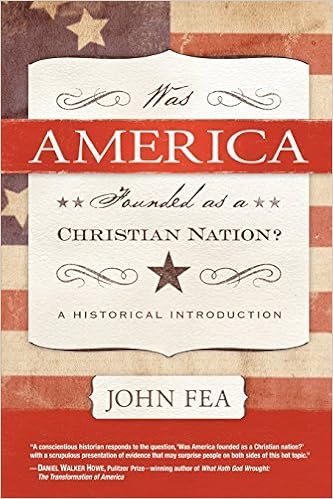 is, unsurprisingly, 'not really.']
Which brings us to Daniel Dreisbach of American University's new book, Reading the Bible with the Founding Fathers.
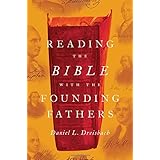
John Fea himself gets named by name and pulled into the docket, and although the highly accredited Dreisbach does not share Fea's taste for polemics or baldly partisan "scholarly" politics [such as "Historians Against Trump"] and the culture war, Dr. Fea, et al., are definitely in his sights.
Can you tell the story of America only via economics, Greek democracy, Roman law, and the Enlightenment?
It's the view of those not in the left-leaning in-crowd that the strict secularism of the 20th century tended to whitewash America's religious foundations, and Dreisbach [no easy pickins like the uncredentialed Barton with a doctorate from Oxford and a law degree from the prestigious University of Virginia] shows himself an able ally of that view.
Dreisbach is one major-leaguer who can't be waved away for lack of academic credentials, or be delegitimized by the death of a thousand cuts that amateur historians often suffer for sloppy [albeit usually inconsequential] errors. The modern academy may not be dishonest in its prevailing view, but Dreisbach argues that they're staring directly at the primary documents but due to a lack of familiarity with Christian scripture and theo-political thought, they are losing the thread.
In Dr. Dreisbach, the "aristorian" club finds itself forced onto a level playing field with worthy opposition. We can only hope that this debate becomes a debate once again, instead of the current scholarly shooting gallery at laughably outgunned sitting ducks like David Barton.
To business:
"Many scholars have described the founding era, sandwiched
between the momentous religious revivals known as the first and
second Great Awakenings, as an age of Enlightenment and
rationalism, in which “the founding generation,” according to political
theorist Wilson Carey McWilliams, “rejected or deemphasized the
Bible and biblical rhetoric.” Writing more specifically about the
arguments and rhetoric Americans used as they contemplated
resistance to British colonial rule and, eventually, independence,
historian John Fea asserted that, “when one examines the specific
arguments made by colonial political leaders in the years leading up to
1776, one is hard-pressed to find any Christian or biblical language
apart from a few passing references to God.” Rather, the “most
important documents” produced by Americans “focused more on
Enlightenment political theory about the constitutional and natural
rights of British subjects than on any Christian or biblical reason why
resistance to the Crown was necessary.”
Historian Mark A. Noll observed “that the nation’s founders were conversant with scripture,”which “should not be surprising for they lived at a time when to be an educated member of the Atlantic community was to know the Bible.” He further contended, however, that explicit references to Scripture or Christian themes “are conspicuously absent in the political discussions of the nation’s early history. In short,” Noll concluded, “the political figures who read the Bible in private rarely, if ever, betrayed that acquaintance in public. [T]he Bible’s direct political influence was extremely limited, the occasions when leaders turned to it for assistance in political reasoning extremely rare.”
Did the founders avoid or repudiate biblical influences on their
politics? Reports of the Bible’s demise in the founding era are
controverted by Professor [Donald S.] Lutz’s study and ample illustrations in this
volume. The Bible continued to permeate both the private expressions
and public pronouncements of those who shaped the new nation and
its civic institutions. Compared to an earlier age dominated by
Puritan divines, biblical language in the founding generation’s
political rhetoric may seem muted. Nonetheless, late eighteenth-
century Americans remained biblically literate and, contrary to the
claims of modern scholarship, the Bible continued to inform public
culture. Biblical language pervaded the discourse of not only pious
founders, such as Samuel Adams, Patrick Henry, John Jay, Roger
Sherman, and John Witherspoon, but also those figures most
influenced by the Enlightenment, including Benjamin Franklin and
Thomas Paine.
No less a founding figure than George Washington
opined in 1783 that Americans were fortunate that “[t]he foundation of
our Empire was not laid in the gloomy age of Ignorance and
Superstition, but at an Epocha when[,] above all, the pure and
benign light of Revelation, have had a meliorating influence on
mankind and increased the blessings of Society.” There is little
doubt that by “Revelation” he meant the Bible.
Why, then, has modem scholarship missed or dismissed the Bible’s
place in the political discourse of the founders? Often the most
important things in life, like the air we breathe, do not receive the
attention they merit because they are so pervasive and so much a part
of our very existence that they are taken for granted. This may account
for the historians’ inattention to the Bible’s place in the American
founding. Biblical illiteracy, especially a lack of familiarity with the
distinct phrases and cadences of the King James Bible, may explain
the failure of some scholars to recognize the biblical language in this
literature.
The founders often quoted the Bible without the use of
quotation marks or citations, which were not necessary for a biblically
literate society but the absence of which fail to alert a biblically
illiterate modem audience to the Bible’s invocation. Also, scholars
trained in the modern academy, with its emphasis on the strictly
rational and the secular, may discount biblical themes because they
find them less noteworthy or sophisticated than the intellectual
contributions of the Enlightenment.
There may even be a discomfort with or, perhaps, hostility toward
explicitly religious material and themes.
Some fear that mere acknowledgment of Christianity’s and the
Bible’s influence on the American founding will diminish the
Enlightenment’s influence and buttress the alleged theocratic impulses
of some twenty-first-century citizens. Moreover, some scholars find a
focus on the God of the Bible and biblical religion divisive or even
offensive to twenty-first-century, secular sensibilities. In an
admonition seldom mentioned in the scholarly literature, for example,
George Washington warned in his Farewell Address of September
1796 that one who labors to subvert a public role for religion and
morality cannot call oneself a patriot.” Such rhetoric, unexceptional
in its time, is discordant with the secular ethos of our time. Other
founders held views similarly out of step with secular academic and
popular sentiments of the twentieth and twenty-first centuries, such as
advocating state support for Protestant denominations and restricting
the civil and religious rights of Catholics, Unitarians, atheists, and
Jews.
In any case, this book should put to rest the notion that the
founding generation ignored biblical language and themes in its
political discourse."
Indeed, as Dreisbach writes in a questionnaire-type "interview" at John Fea's blog,
Another question worth exploring, I believe, is did the Bible inform the founding generation’s political thought and influence their political and legal projects? I see evidence that the founders looked to Scripture for insights into human nature, civic virtue, social order, political authority and other concepts essential to the establishment of a political society. Many in the founding generation saw in the Bible political and legal models – such as republicanism, separation of powers, and due process of law – that they believed enjoyed divine favor and were worthy of emulation in their polities.
Then there is much more to the question of "Christian America" than "not really."
More generally, but no less significant to the founders’ political vision, many in the founding generation believed the Bible was an indispensable handbook for republican self-government. In a republican government, the founders believed, the people must be sufficiently virtuous that their personal responsibility and discipline would facilitate the social order and stability necessary for a regime of self-government. And the Bible was an ideal tool for developing civic virtue. Believing that “without national morality a republican government cannot be maintained” and that “[t]he Bible contains the most profound philosophy, the most perfect morality, and the most refined policy, that ever was conceived upon earth,” John Adams described the Bible as “the most republican book in the world.” In other words, the Bible nurtures the civic virtues that give citizens in a republic the capacity for self-government. Such sentiments were commonplace in the political discourse of the founding.
A study of the Bible in the political culture of the founding era gives us insights into one source of ideas that shaped the founders’ political thoughts and the political and legal systems they sought to establish. These insights, I hope, will enhance our understanding of ourselves as a people, our history, and the American experiment in republican self-government and liberty under law.
Monday, February 06, 2017
 Reagan Foundation
Thursday, February 02, 2017
Tillman on Irish Television and Radio
Sharon Ní Bheoláin
& Bryan Dobson, RTÉ News: Six One (Jan. 31, 2017, 6:00 PM) (interview), http://tinyurl.com/h2yatsx ; http://tinyurl.com/hx3ndjc ;
Cormac Ó hEadhra, The Late Debate, RTÉ Radio 1 (Jan. 31, 2017, 10:00 PM) (panellist), http://tinyurl.com/hfs62h2 ;
Pat Kenny, The Pat Kenny Show, Newstalk.com 106–108fm (Feb. 1, 2017, 9:00 AM), http://tinyurl.com/gvvqdnb ;
Seth
Twitter: https://twitter.com/SethBTillman ( @SethBTillman )
My most recent post: Seth Barrett Tillman, Three
Podscasts on the Foreign Emoluments Clause, with Seth Barrett Tillman, The New
Reform Club (Jan. 20, 2017, 5:37 AM). [here]
Friday, January 20, 2017
Three Podscasts on the Foreign Emoluments Clause, with Seth Barrett Tillman
Marc Johnson, Episode 8:
Article 1, Section 9, Clause 8, Many Things Considered
(Jan. 18, 2017), http://manythingsconsidered.com/podcast (at 28:15ff) ;
Andrew Torrez & Thomas Smith, OA36: The Emoluments (w/Seth Barrett Tillman), Part 2, Opening Arguments (Jan. 20, 2017), http://tinyurl.com/hxg9ruk (at 7:30ff) ; and,
Andrew Torrez & Thomas Smith, OA35: The Emoluments Clause (w/Seth Barrett Tillman), Part 1, Opening Arguments (Jan. 16, 2017), http://tinyurl.com/zsvebop (at 24:40 to 47:00).
I think the best of the 3 was Opening Arguments, Part 2.
Seth
My former post: Seth Barrett Tillman, Tillman’s
Poetry Corner: Flanders Fields, The New Reform
Club (Jan. 16, 2017, 10:54 AM) [here]
Friday, January 13, 2017
This is what balanced news reporting looks like ....
Winand Von Petersdorff, “A student would thus fail the exam,” Frankfurter Allgemeine (Jan. 13, 2017), http://tinyurl.com/jq5aeq3
Translated in part:
The renowned Harvard professor Laurence Tribe called the Trump-selected legal construction fraudulently and a "Potemkin village" via Twitter. A lawyer who presented such a construction would go through the constitutional examination. None of the ethical and legal problems is solved with the proposal. But lawyers are by no means in agreement as to whether Trump actually violates the law. The also in Harvard educated constitutional expert and professor in Ireland Seth [Barrett] Tillman argued that it is inconsistent with the American legal tradition to ask the President-elect to sell illiquid assets such as real estate. America's first president, George Washington, had extensive land ownership and continued to conduct ground [i.e., land] speculation as president. Democratic President Jimmy Carter had put his peanut farm in Georgia in a trust led by his brother.
Tillman also pointed out that many of the public service regulations were not valid for the purpose of preventing possible conflicts of interest for elected deputies [i.e., officials], judges and not least the presidents and vice-presidents. Tillman called [i.e., made reference to] the desired independence of the persons who hold such offices. If presidents had to submit their decisions to an ethics officer, in order to rule out possible conflicts of interest, the latter would gain a very powerful position, although he [i.e., the latter] was not legitimized by any choice [of the people]. Judges and elected representatives enjoy a trust advance.
No jurisprudence yet
Currently the question is discussed whether Trump specifically violates the so-called Emolument clause in the American Constitution. It forbids government officials to accept gifts, nobility titles or other donations from foreign governments. Specifically, the problem might arise when foreign diplomats stay in Trump's Hotel in Washington. Trump's lawyer Dillon argues that business transactions such as booking a hotel room are not gifts and therefore not subject to the Emolument clause. Nevertheless, Trump wants to donate profits from the overnight stays of foreign diplomats to the American Treasury.
Tillman believes that the entire clause is not applicable to presidents. It also confirms uncertainty on this issue. For there is no jurisprudence to date. So far, no President has been sued for breaching the clause. He also considers that an action for annulment [i.e., judicial review] is almost impossible because a plaintiff is bound to make a legal claim [i.e., one supported by statute]. Thus, according to Tillman's assessment of the violation of conflicts of interest, only Parliament's resignation [i.e., impeachment] proceedings remain.
[END]
An honest and balanced press is possible. It really is.
Seth
My prior post: Seth Barrett Tillman, Tillman
on Trump on RTE (Irish national television), The New
Reform Club (Jan. 13, 2017, 4:27 AM). [here]
Tillman on Trump on RTE (Irish national television)
Miriam O'Callaghan,
Prime Time: A Segment on Trump, RTÉ (Jan. 12, 2017, 9:00 PM), http://tinyurl.com/jjm38q6
(at 5:50ff) (appearing with Eric Walker for DNC)
Here I appear on RTÉ: Irish national (and state subsidized) television. Some have criticized my performance as "rude, bombastic and arrogant" and "ignorant, boorish & interrupting". Two very old law firms. Another person said, "Well, @SethBTillman just had that good looking @TheDemocrats chap for breakfast, lunch and dinner on #rtept there. Ouch."
Enjoy.
Seth
My prior post: Seth Barrett Tillman, “Nonsense,”
“Takedowns,” and “Giving Lawyers A Bad Name,” The New Reform
Club (Jan. 8, 2017, 9:02 AM). [here]
Subscribe to:
Posts (Atom)