Tradition is not the worship of ashes, but the preservation of fire.—Gustav Mahler
Showing posts with label judicial review. Show all posts

Saturday, October 24, 2015

The wisdom of St. George Tucker on judicial review

Introduction. The issue of judicial review was an active one in the early American Republic, with the leader of the first Republican Party, Thomas Jefferson. One of the structural constitutional problems in the early Republic revolved around the problem of enforcing the Constitution on the federal government itself. If the president or Congress decided to violate the Constitution's protections and requirements, how would their actions be restrained or reversed? The Constitution itself is silent on that direct question, although insisting via the Supremacy Clause that the federal Constitution was the "supreme law of the land." (US Const., art. VI, cl. 2.)

The Federalist solution: judicial review. Federalist constitutional theory posited that the Supreme Court had the power to judicially review legislation enacted by Congress and signed by the president in order to determine its constitutionality. 

In a nutshell, if the Court found that the legislation in question was not constitutional, the legislation would be regarded as null and void. This approach to judicial review was advocated by Alexander Hamilton in The Federalist Papers, specifically No. 78. It also is the theory that was embraced by Federalist Supreme Court Chief Justice John Marshall in the landmark Supreme Court case of Marbury v. Madison, 5 US 137 (1803). That case has long been considered the key Supreme Court case in the development of the doctrine of judicial review, although it built off earlier case law acknowledging the principle. One of those cases is the 1789 case of Ware v. Hylton. In that case, the Supreme Court struck down a state law under the Supremacy Clause because the state law violated the requirements of a treaty to which the United States was a party.
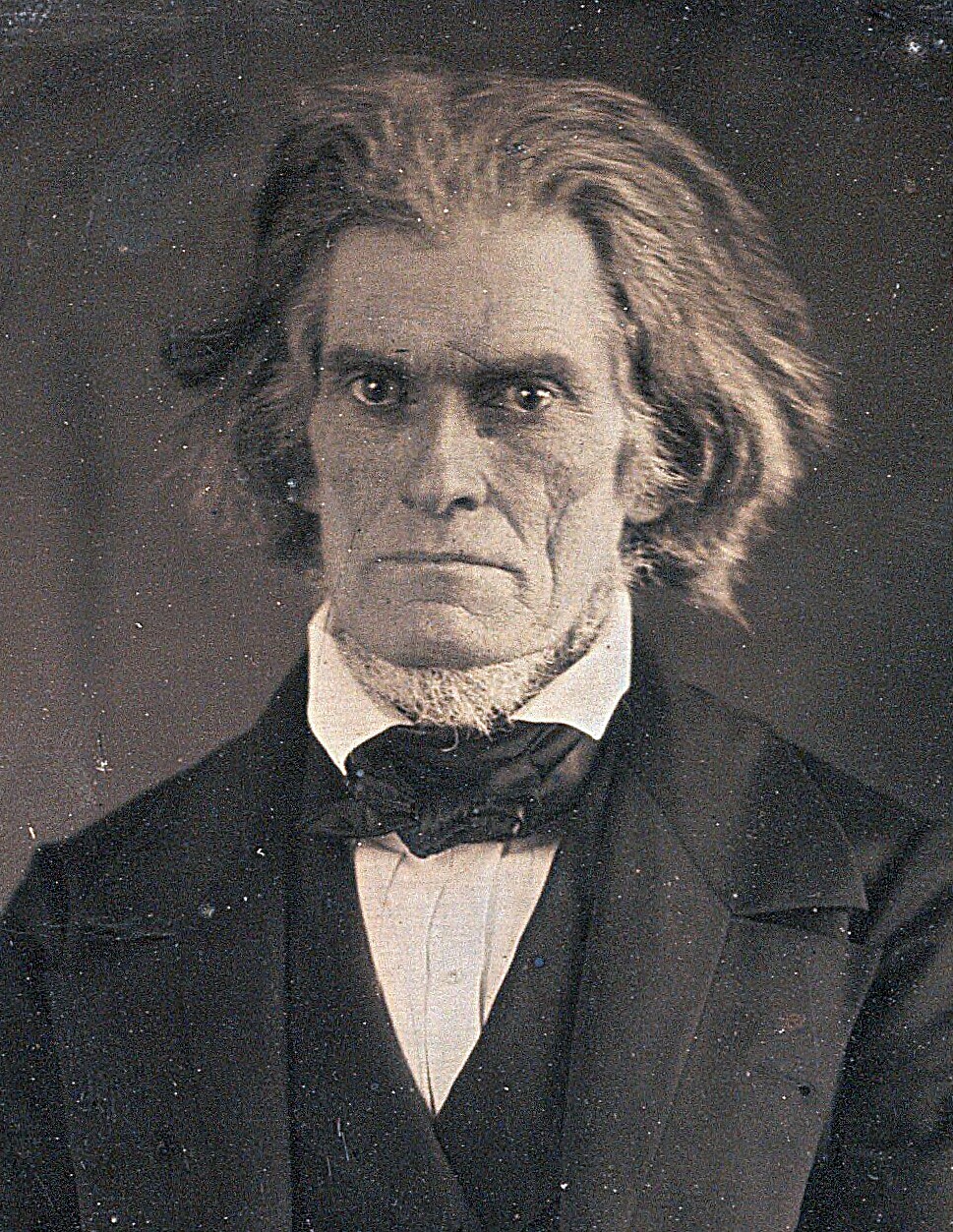
Jefferson's radicalism and nullification under Calhoun. Jefferson was highly skeptical of the idea of judicial review, and Madison, while originally supporting the idea at the Constitutional Convention, eventually grew skeptical of judicial review as well. During the controversy over the Alien and Sedition Acts, both Jefferson and Madison proposed a different mechanism by which the Constitution's protections could be vindicated in the face of possible abuse by the general government: the doctrine of nullification. Under that theory, a state could nullify constitutionally problematic federal legislation within that state's boundaries, effectively shielding its own state citizens from federal overreach. Sometimes referred to as interposition (from the idea that the state would position itself between its own citizens and the federal government), the Jeffersonian-Madisonian view lived on in American polity well into the 19th century.

As the Jeffersonian Republicans morphed into the Jacksonian Democrats, the new Democratic Party's southern wing's leader, John C. Calhoun, was an ardent proponent of the idea, and much of Southern constitutional theory, both prior to the Civil War and during the Confederate period, was dominated by the idea. Interestingly enough, prior to the emergence of the Jacksonian Democrats there was a strong view within the Jeffersonian Republican Party in support of the idea of judicial review, despite Jefferson and Madison's misgivings about the doctrine.

St. George Tucker's approach. One Republican proponent of judicial review was Virginia jurist St. George Tucker. Tucker, a federal judge, noted Republican and early proponent of the abolition of slavery, was a major legal theorist in the early Republic, and the author of the first major American edition of Blackstone to be published since Independence. Tucker published his edition of Blackstone in 1803, the same year the Supreme Court decided Marbury v. Madison. In Note D of the first volume of his edition of Blackstone, Tucker makes a strong appeal to the idea of judicial review as a bulwark of constitutional liberty:
The obligation which the constitution imposes upon the judiciary department to support the constitution of the United States, would be nugatory, if it were dependent upon either of the other branches of the government, or in any manner subject to their control, since such control might operate to the destruction, instead of the support, of the constitution. Nor can it escape observation, that to require such an oath on the part of the judges, on the one hand, and yet suppose them bound by acts of the legislature, which may violate the constitution which they have sworn to support, carries with it such a degree of impiety, as well as absurdity, as no man who pays any regard to the obligations of an oath can be supposed either to contend for, or to defend. 
Specifically taking aim at the constitutionality of the Alien and Sedition Acts, the very acts that led his Republican brethren Jefferson and Madison to propose the radical idea of nullification, St. George Tucker writes a robust defense of the principle of judicial review:
If we consider the nature of the judicial authority, and the manner in which it operates, we shall discover that it cannot, of itself, oppress any individual; for the executive authority must lend it's aid in every instance where oppression can ensue from it's decisions: whilst on the contrary, it's decisions in favour of the citizen are carried into instantaneous effect, by delivering him from the custody and restraint of the executive officer, the moment that an acquittal is pronounced. And herein consists one of the great excellencies of our constitution: that no individual can be oppressed whilst this branch of the government remains independent, and uncorrupted; it being a necessary check upon the encroachments, or usurpations of power, by either of the other. Thus, if the legislature should pass a law dangerous to the liberties of the people, the judiciary are bound to pronounce, not only whether the party accused hath been guilty of any violation of it, but whether such a law be permitted by the constitution. If, for example, a law be passed by congress, prohibiting the free exercise of religion, according to the dictates, or persuasions of a man's own conscience or abridging the freedom of speech, or of the press; or the right of the people to assemble peaceably, or to keep and bear arms; it would, in any of these cases, be the province of the judiciary to pronounce whether any such act were constitutional, or not; and if not, to acquit the accused from any penalty which might be annexed to the breach of such unconstitutional act. If an individual be persecuted by the executive authority, (as if any alien, the subject of a nation with whom the United States were at that time at peace, had been imprisoned by order of the president under the authority of the alien act, 5 Cong. c. 75) it is then the province of the judiciary to decide whether there be any law that authorises the proceedings against him, and if there be none, to acquit him, not only of the present, but of all future prosecutions for the same cause: or if there be, then to examine it's validity under the constitution, as before-mentioned. 
Liberty & Union. Why is this important historically? Tucker's work demonstrates the strong appeal during the early Republic of the idea of an independent federal judiciary as a block to constitutional abuses by the federal branches. As the premier defender of Southern Jeffersonianism Clyde Wilson has written of Tucker's views:
One of Tucker’s principal concerns as a legal and political thinker is to affirm the standing of the judiciary as an independent and coequal power with the legislature and executive. This is an American accomplishment to be supported in state and federal governments both. For him the judiciary is the realm where individuals may seek relief from the oppressions of the government. Its power and independence are thus essential. 
While some of the top-tier Founders within the Republican fold argued for a constitutional theory that would ultimately tear the Union apart, Tucker defended the idea of liberty under, rather than in opposition to, the Union of the States and the federalist system of government established by the Constitution.  While Tucker did support the right of States to secede from the Union, that power did not justify nullification or efforts to abandon the role of the federal judiciary as defender of constitutional order.

For Tucker, the Union was grounded in the supremacy of the Constitution and protected by the glory of Anglo-American government: a truly independent judiciary. Tucker's constitutional vision was thus broadly consonant with the Federalist vision enunciated by Marshall. Unlike Jefferson and Madison's proposed solution, which set the stage for a Southern jurisprudence that would eventually justify an illegal attempt at succession, St. George Tucker sought to preserve both liberty and the Union. And did so through the principle of constitutional government & the mechanism of judicial review.

Tuesday, October 13, 2015

Originalism and precedent at the trial court level

That's the topic addressed by Orin Kerr in this older post over at the Volokh Conspiracy. Kerr makes, I think, a very interesting point in analyzing an early decision by a federal district court judge finding ObamaCare unconstitutional:
The core problem, I think, is that Supreme Court doctrine has strayed far from the original meaning of the scope of federal power granted by the Constitution. Today’s constitutional doctrine permits a scope of federal power that is much broader than the original meaning of the Commerce Clause and Necessary and Proper clause would allow. When interpreting the scope of federal power, then, you need to decide what you will follow: The original meaning or case precedents. As I read Judge Vinson’s opinion, he mixes the two. Judge Vinson jumps back and forth between purporting to apply Supreme Court precedents and purporting to interpret the Commerce Clause and Necessary and Proper clause in light of its original meaning. Judge Vinson spends about half of the legal analysis on original meaning and about half of the legal analysis on precedent, and he seems to treat both as important.
Essentially, the judge balanced precedent alongside with the original intent behind the Constitution to reach the holding in the case, that the health care reform act exceeded the scope of Congress' powers under the Commerce Clause. And while that evaluation may be substantively correct, Kerr notes that there is a problem with a trial court judge making that kind of determination:
[T]here’s a technical problem here that I want to draw out: Judge Vinson is only a District Court judge. Under the principle of vertical stare decisis, he is bound by Supreme Court precedent. See, e.g, Winslow v. F.E.R.C., 587 F.3d 1133. 1135 (D.C. Cir. 2009) (Kavanaugh, J.) (“Vertical stare decisis — both in letter and in spirit — is a critical aspect of our hierarchical Judiciary headed by ‘one supreme Court.’”) (citing U.S. Const. art. III, § 1). And when Supreme Court precedent conflicts with original meaning, Judge Vinson is bound to follow the former. Of course, that doesn’t mean a District Court can’t discuss the original meaning of a constitutional provision in his opinion. But where the original meaning and case precedents conflict, the judge is stuck: Because he is bound by Supreme Court doctrine, the judge has to apply the doctrine established by the Supreme Court and has to ignore the original meaning.
I think Kerr is on to something here, as far as the practicalities of how trial courts are supposed to rule in light of precedent from appellate courts within the trial court's jurisdiction (and the Supreme Court's jurisdiction covers the entire country). The trial court judge is bound by those precedents and cannot disregard them, even if he or she thinks that the precedents are wrongly decided. So long as the precedents are on point to the relevant issues in the case, the judge is, as Kerr puts it, "stuck."  He or she has to follow those precedents. The judge is certainly at liberty to point out where he or she thinks the Supreme Court has gotten it wrong and why, but the trial court judge isn't free to decline to apply Supreme Court precedent. As long as that precedent stands, the trial court is bound to follow it.

Related item:  Clinical law professor William Jacobson over at Legal Insurrection provides an overview of Judge Vinson's ruling here. Well worth a read. A strong case can be made that the judge was substantively correct in his originalist analysis. The question is, was that the kind of analysis he should have been making in light of the relevant Supreme Court case law?

Wednesday, March 11, 2015

Originalism isn't an ideology, it's a methodology

Here's a good observation over at the Volokh Conspiracy law blog that originalism in legal theory is a method and not an ideology:  There's no originalist consensus, but that's okay. Originalism isn't about pat answers, it is an approach to thinking through issues of constitutional and legal meaning when direct guidance from the text of the law is lacking.

Judicial diligence in the defense of rights isn't the same thing as judicial activism

Libertarian legal scholar and law professor Randy Barnett makes that point in this op-ed over at The Washington Post: "Judicial engagement" is not the same as "judicial activism." Taking as his starting point an op-ed by George Will (discussed on this blog here), Barnett correctly identifies the real problem with modern liberal jurisprudence: its tendency to misinterpret the Constitution, leading to the courts striking down laws that are perfectly constitutional. Barnett then goes on to develop a distinctively libertarian approach to the role of the courts in limiting the powers of Congress and the state governments.

While I would not go nearly as far as Barnett in arguing for using vague and generalized constitutional provisions to strike down specific governmental actions under long-recognized powers to protect public health, safety and welfare, his point is well-worth consideration when evaluating various theories of judicial reasoning. There is always a risk that judges -- and politicians too, but that's another post -- will conflate their own ideas & policy preferences for the Constitution. It is precisely for that reason that judicial restraint is a key prudential aspect of judicial reasoning. However, restraint is a prudential principle -- when the clear text of the Constitution demands that the courts intervene to protect the people from the abuse of power, then the courts are duty-bound to move, and move rapidly, to protect individuals and institutions from governmental over-reach.