Rev. Wright has decided not to keep his head down until November. Instead, it's all about him - he sees just how the US govt is capable of "anything" (like infecting people with AIDS), that it's unfair to demand that he criticize Farrakhan (after all, Mandela didn't throw Castro under the bus!), that 9/11 occurred because we're terrorists ourselves, and so on and so on.
Hoo-buddy! We've all really wandered into the fever swamps now and Rev. Wright has decided, apparently, that he's not backing down an inch. No sir, he's got nothing to apologize for. And that Obama denunciation/disavowal? Just "politics," dude, can't you see that?
So Obama has a choice. He's certain to be asked about these sets of remarks; what does he do? If he continues to denounce Wright's views (as opposed to Wright himself), he's just setting himself up, isn't he? Isn't it clear that Wright just *loves* the attention and will play things up as much as he can? And eventually, he's going to have to start answering specific questions about specific claims - does *he* believe the AIDS stuff, etc.?
The problem is, though, that if he goes whole hog and gets serious about his denunciations, that is what will dominate the news for at least the next week, right up through the Indiana primary, and he'll be dealt another big loss. What's more, he's in danger of becoming *defined* by his association with the wackadoo fringe of American religion. But here's the real kicker: setting aside some of the more conspiratorial stuff (e.g. AIDS), what about Wright's views would the hard-core lefties that populate too much of American academia actually disagree with? America as structurally racist? Check. Islamic terrorism essentially "caused" by US foreign policy? Check. Israel as the "problem" in the Middle East? Check. How many of these folks will sit still if Obama goes after Wright's views - who will pen the first essay lamenting Obama's capitulation to monied Jewish interests? Or the lack of his "real" progressive politics?
I'd really be enjoying this more, though, if I didn't think that he wasn't still the odds-on favorite for the presidency. Gulp.
Monday, April 28, 2008


Why Barack Obama Shunned the Flag Pin
Via the often-elegant Don Surber---
Some of us---many of us---believe this country is already great, despite its flaws and its checkered history. The flag pin isn't just about the war in Iraq. You have to lose all sense of perspective to believe that.
We massacred each other over slavery, and could have sat out World Wars One and Two and gave Germany and Japan free rein over Europe and Asia since it didn’t affect us.
As to what proto-president Obama believes will make this country truly great at last, well, I’m willing to listen.
Perhaps he’s thought of something new.
_________
N.B.---The invaluable Mr. Surber also includes this quote:
Well, that's a perspective that every man in America who left his wallet on the dresser while hustling off to work could sympathize with, and that's every single one of us. You could vote for a guy who understands that.
Word up, Brother Barack. When all else fails, stick with the truth.
_____________________________________
Shortly after 9/11, particularly because as we’re talking about the Iraq War, that became a substitute for I think true patriotism, which is speaking out on issues that are of importance to our national security, I decided I won’t wear that pin on my chest. I’m going to try to tell the American people what I believe will make this country great, and hopefully that will be a testimony to my patriotism.”—B. Obama (D-IL)
Some of us---many of us---believe this country is already great, despite its flaws and its checkered history. The flag pin isn't just about the war in Iraq. You have to lose all sense of perspective to believe that.
We massacred each other over slavery, and could have sat out World Wars One and Two and gave Germany and Japan free rein over Europe and Asia since it didn’t affect us.
As to what proto-president Obama believes will make this country truly great at last, well, I’m willing to listen.
Perhaps he’s thought of something new.
_________
N.B.---The invaluable Mr. Surber also includes this quote:
The reason that I don’t always wear a flag pin is not that I disrespect the flag, it’s that when I started wearing a flag pin after 9/11, I gotta admit that sometimes I would misplace it and so I didn’t always put it on.
Well, that's a perspective that every man in America who left his wallet on the dresser while hustling off to work could sympathize with, and that's every single one of us. You could vote for a guy who understands that.
Word up, Brother Barack. When all else fails, stick with the truth.
_____________________________________
Friday, April 25, 2008
Decision 2008
From WLS over at Patterico, and just too delicious not to pass on:
A caller into the Dennis Miller Show this morning had a particularly insightful view into the coming general election choice that will be before the country:
The Dems offer a witch who is a lawyer and who is married to a lawyer, or a lawyer who is married to a witch who is a lawyer.
One of those will be matched up against a war hero who is married to a hot babe who owns a beer distributorship.
How hard is that choice?
A caller into the Dennis Miller Show this morning had a particularly insightful view into the coming general election choice that will be before the country:
The Dems offer a witch who is a lawyer and who is married to a lawyer, or a lawyer who is married to a witch who is a lawyer.
One of those will be matched up against a war hero who is married to a hot babe who owns a beer distributorship.
How hard is that choice?
Tuesday, April 22, 2008
War And Decision
Run---do not walk, do not wait for Amazon's SuperSaver delivery schedule---to your local bookstore and buy Douglas J. Feith's War and Decision. It is unlike any book that has come out of the Beltway in years, written by a member of that rare species, the objective insider seeking to set the record straight rather than settle scores or engage in desperate self-justification. It is, in a word, scholarly; with massive references to documents and the actual decisionmaking record, Feith sets out the evidence on how the decision to go to war in Iraq was made, on who and which institutions supported what courses of action, etc. If you want hard evidence to refute the various disinformation campaigns of the left---and others---this is the work in which to find it.
I will begin a series of blogs on this book next week.
I will begin a series of blogs on this book next week.
Thursday, April 17, 2008
You Just Don't Get It, Dude
They like stirring up controversy and they like playing gotcha games, getting us to attack each other. And I have to say Senator Clinton looked in her element...She was taking every opportunity to get a dig in there. You know, that's all right. That's her right. That's her right to kind of twist the knife a little bit.---Sen. Barack Obama (D-IL), alleged Next President of the United States of KKK-A
You mean like your dig when you casually put the knife right back where it came from, bringing up Bill Clinton's midnight pardon of the Weather Underground?
By the way, who's "they?" Hillary? Me? Seems like The Great Unifier has at least 2/3 of God Damn America on his spitlist. A whole lotta "they" coming out of the woodwork, and a shrinking "us."
That was the roll-out of the Republican campaign against me in November. That is what they will do...they will try to focus on all these issues that don't have anything to do with how you pay your bills at the end of the month.
Yeah, they just might. Unlike you, Sen. Obama, many in the GOP believe that when Americans enter the voting booth, they just don't cling to their checkbooks. They have more than their material well-being on their minds.
You call those things "distractions." Many of your fellow Americans prefer to think of them as "principles."
_____________________________________
Words Escape Me
And, believe me, that happens, well, rarely. With respect to how Obama's bitterness quote happened to become public, I quote Michael Barone:
Kit Seelye in the New York Times and Pajamas Media correspondent Bill Bradley (the California political writer, not the former New Jersey senator) fill us in on how the story got on the pro-Obama Huffington Post. It seems that Arianna Huffington approved it by cellphone while on David Geffen's 454-foot yacht in Tahiti. No, I'm not making this up.
Like I said: Words escape me.
Kit Seelye in the New York Times and Pajamas Media correspondent Bill Bradley (the California political writer, not the former New Jersey senator) fill us in on how the story got on the pro-Obama Huffington Post. It seems that Arianna Huffington approved it by cellphone while on David Geffen's 454-foot yacht in Tahiti. No, I'm not making this up.
Like I said: Words escape me.
Wednesday, April 16, 2008
Elitism, Judicial Activism---You Name It
Basically, the charges of Barack Obama's "elitism" stem from a perception that he believes he knows better than you, and that your disagreement comes from irrationality.
By a 7-2 vote, the Supreme Court just upheld lethal injection as constitutional. Justice John Paul Stevens dissented. Why? “I have relied on my own experience in reaching the conclusion that the imposition of the death penalty [is unconstitutional]."
Oh.
But Antonin Scalia rides to the rescue, and comes down on Justice Stevens bigtime. Justin Levine over at Patterico kindly types out this gem from the PDF of Scalia's opinion:
And that's elitism in a nutshell. Principled disagreement with the "Elect" is impossible; it's stupidity or irrationality or bitterness or just being downright lazy. Opposing views don't even rise to the level of being wrong---they're simply not valid.
Such arrogance rubs some people the wrong way, like me, tens of millions of other Americans, and the great Nino Scalia.
___________________________________
By a 7-2 vote, the Supreme Court just upheld lethal injection as constitutional. Justice John Paul Stevens dissented. Why? “I have relied on my own experience in reaching the conclusion that the imposition of the death penalty [is unconstitutional]."
Oh.
But Antonin Scalia rides to the rescue, and comes down on Justice Stevens bigtime. Justin Levine over at Patterico kindly types out this gem from the PDF of Scalia's opinion:
As JUSTICE STEVENS explains, ‘objective evidence, though of great importance, [does] not wholly determine the controversy, for the Constitution contemplates that in the end our own judgment will be brought to bear on the question of the acceptability of the death penalty under the Eighth Amendment.’
Purer expression cannot be found of the principle of rule by judicial fiat. In the face of JUSTICE STEVENS’ experience, the experience of all others is, it appears, of little consequence. The experience of the state legislatures and the Congress—--who retain the death penalty as a form of punishment—--is dismissed as “the product of habit and inattention rather than an acceptable deliberative process.”
The experience fellow citizens who support the death penalty is described, with only the most thinly veiled condemnation, as stemming from a “thirst for vengeance.” It is JUSTICE STEVENS’ experience that reigns over all.
And that's elitism in a nutshell. Principled disagreement with the "Elect" is impossible; it's stupidity or irrationality or bitterness or just being downright lazy. Opposing views don't even rise to the level of being wrong---they're simply not valid.
Such arrogance rubs some people the wrong way, like me, tens of millions of other Americans, and the great Nino Scalia.
___________________________________
The Trouble With Talking
So Nobel Peace Prize winner, former US President, and peanut farmer Jimmy Carter has spent his time in the Middle East laying a wreath at the tomb of Yasser Arafat and will now, reportedly, be meeting with leaders of Hamas, the Palestinian group that controls the Gaza strip and is officially committed to the destruction of Israel, the establishment of an Islamist state, and is on the State Department's terrorist list, among other highlights. Giving honor to Arafat, an unrepentant terrorist and scourge of his own people, is bad enough, but even Obama wouldn't meet with Hamas. (Though why, exactly, is unclear, since they're certainly not any nastier than Iran).
We're often told - and Carter seems to be operating under this premise - that it does no harm and possibly great good to talk to enemies. "You make peace with your enemies, not your friends," or so the saying goes. But in what way is that true - when exactly should one talk to your enemies? It seems to me that Carter's view - talk to everyone - betrays a dangerous and rather silly naivete, particularly because it lumps all of one's "enemies" together. Of course, you make peace with your enemies, but any reasonable understanding of history shows that you don't make peace with *all* of your enemies. Or, to put it a bit too bluntly, sometimes the only peace available is the peace of the dead - you get peace, but only because one of you is no longer on the scene.
But surely just talking to one's enemies couldn't do any harm, could it? Well,consider what talking might accomplish (and by "talking" I have in mind general diplomatic exchanges, to include everything from meet-and-greets to formal negotiations). Talking could very well clear up misunderstandings and provide greater transparencies, mitigating conflicts and solving problems before they get dangerous. Talking can also be a vehicle for getting one side to understand clearly that their position is untenable and finding ways for them to do a "climb-down" with minimal damage. Talking can also be a means for bargaining, where one side gives something up in exchange for something else.
But none of that covers the sort of "talking" Carter and others have in mind with respect to Hamas and, say, Iran. What seems to be at work in this sort of talking is the profoundly naive hope that simply by talking to them, both will come to see the unreasonableness of their views and will modify their behavior accordingly. But why, if one talks to them (and does so publicly) without preconditions, will they come to see the unreasonableness of their views and modify their behavior? It is precisely those views (and the actions they produce) that have pushed you (so they will think, perhaps rightly) to the talking table. With Hamas, if you are willing to talk to them, willing to "negotiate" with them, then haven't they already won half the battle? Haven't they pushed you to a position of "talking" precisely with the sort of behavior you hope they will give up? And if their most fundamental goals - say, the destruction of Israel - are precisely what you want them to give up, isn't the "talking" inevitably bound to fail, unless you allow them to maintain those fundamental goals? That is, Hamas (and a similarly constructed argument could be made with respect to Iran as well) is constituted fundamentally as an organization dedicated to the destruction of Israel. They will not give that up (whatever they may claim) except that they decide to close up shop and exit the stage of history; talking to them will not change that and will instead merely put you in a position of implicitly legitimating that goal, since it is something that can be negotiated over.
It's a shame ol' Jimmy wasn't satisfied with peanut farming.
We're often told - and Carter seems to be operating under this premise - that it does no harm and possibly great good to talk to enemies. "You make peace with your enemies, not your friends," or so the saying goes. But in what way is that true - when exactly should one talk to your enemies? It seems to me that Carter's view - talk to everyone - betrays a dangerous and rather silly naivete, particularly because it lumps all of one's "enemies" together. Of course, you make peace with your enemies, but any reasonable understanding of history shows that you don't make peace with *all* of your enemies. Or, to put it a bit too bluntly, sometimes the only peace available is the peace of the dead - you get peace, but only because one of you is no longer on the scene.
But surely just talking to one's enemies couldn't do any harm, could it? Well,consider what talking might accomplish (and by "talking" I have in mind general diplomatic exchanges, to include everything from meet-and-greets to formal negotiations). Talking could very well clear up misunderstandings and provide greater transparencies, mitigating conflicts and solving problems before they get dangerous. Talking can also be a vehicle for getting one side to understand clearly that their position is untenable and finding ways for them to do a "climb-down" with minimal damage. Talking can also be a means for bargaining, where one side gives something up in exchange for something else.
But none of that covers the sort of "talking" Carter and others have in mind with respect to Hamas and, say, Iran. What seems to be at work in this sort of talking is the profoundly naive hope that simply by talking to them, both will come to see the unreasonableness of their views and will modify their behavior accordingly. But why, if one talks to them (and does so publicly) without preconditions, will they come to see the unreasonableness of their views and modify their behavior? It is precisely those views (and the actions they produce) that have pushed you (so they will think, perhaps rightly) to the talking table. With Hamas, if you are willing to talk to them, willing to "negotiate" with them, then haven't they already won half the battle? Haven't they pushed you to a position of "talking" precisely with the sort of behavior you hope they will give up? And if their most fundamental goals - say, the destruction of Israel - are precisely what you want them to give up, isn't the "talking" inevitably bound to fail, unless you allow them to maintain those fundamental goals? That is, Hamas (and a similarly constructed argument could be made with respect to Iran as well) is constituted fundamentally as an organization dedicated to the destruction of Israel. They will not give that up (whatever they may claim) except that they decide to close up shop and exit the stage of history; talking to them will not change that and will instead merely put you in a position of implicitly legitimating that goal, since it is something that can be negotiated over.
It's a shame ol' Jimmy wasn't satisfied with peanut farming.
Tuesday, April 15, 2008
Just a Thought...
Wouldn't it be ironic if the first serious black presidential candidate in American history were undone in part because of a perception that he was "elitist"?
I mean, if Obama goes down - and who knows at this point what will happen - it will be because some portion of the Democratic or general electorate decided that his views were more representative of Harvard Law School than deepest, palest Pennsylvania. That's pretty remarkable, isn't it?
I mean, if Obama goes down - and who knows at this point what will happen - it will be because some portion of the Democratic or general electorate decided that his views were more representative of Harvard Law School than deepest, palest Pennsylvania. That's pretty remarkable, isn't it?
Monday, April 14, 2008
Giving Obama a Break, Sort Of
In fairness to Barack Obama, I sincerely believe that by "religion" he was explicitly referring to opposition to gay marriage, and politically, to the GOP's exploitation of the issue in Ohio '04. [Although it may not have made the difference, contrary to popular Democrat belief.]
From Barack's backtrack today:
The rest of his explanation was sophistic hogwash, but I think he was honest there. After a free pass from the chattering class, it's ironic that he's getting it both barrels [gun pun intended, sorry] for the wrong reason.
On the other hand, Obama falls into Thomas Frank's Marxist-friendly "What's the Matter with Kansas" view of the human condition, that the Great Unwashed should vote their pocketbooks instead of their social values about what kind of country they want to raise their kids in.
Hey, I live in a cosmopolitan area---I know lots of folks who are unsympathetic, if not hostile, to organized religion. I can take it. But this is why Frank doesn't get Kansas, why Obama doesn't get America and why the left doesn't get what all the hubbub's about:
It's the leftism, stupid.
____________________________________
From Barack's backtrack today:
So people end up, you know, voting on issues like guns, and are they going to have the right to bear arms. They vote on issues like gay marriage...
The rest of his explanation was sophistic hogwash, but I think he was honest there. After a free pass from the chattering class, it's ironic that he's getting it both barrels [gun pun intended, sorry] for the wrong reason.
On the other hand, Obama falls into Thomas Frank's Marxist-friendly "What's the Matter with Kansas" view of the human condition, that the Great Unwashed should vote their pocketbooks instead of their social values about what kind of country they want to raise their kids in.
Hey, I live in a cosmopolitan area---I know lots of folks who are unsympathetic, if not hostile, to organized religion. I can take it. But this is why Frank doesn't get Kansas, why Obama doesn't get America and why the left doesn't get what all the hubbub's about:
It's the leftism, stupid.
____________________________________
Other than Tibet, China's OK?
So here's what I don't get about the current contretemps regarding the Olympics and whether heads of state should boycott the opening ceremonies and all: it seems entirely framed in terms of the recent events in Tibet (where China has been behaving thuggishly for a good half-century). Soooo...if the crackdown hadn't happened in Tibet, would we be talking about this at all? Is the idea that the repression in Tibet means that China has crossed some line but that its continued repression of political opposition and religious liberty, forced abortions, support for genocidal regimes, and the like don't cross the line? Is the message that we want to send that you can throw Christian pastors in jail at your whim, lock up and torture people who merely ask for free speech, and act as a de facto sugar daddy to some of the world's ugliest regimes, but just don't act similarly toward the Tibetans?
I'm not especially impressed with calls for Olympic boycotts or whatever - they seem to me a sort of grandstanding that makes the protesters feel good, but has little actual effect. (It would be much better if each American athlete, for example, carried with them a picture or name of a Chinese dissident in jail or under house arrest - or even better if they decided to go meet with them and dare the Chinese to arrest them or get in their way). But what seems to me the rather weird way in which some events galvanize opposition and others are merely par for the course is troubling and doesn't speak well of us.
I'm not especially impressed with calls for Olympic boycotts or whatever - they seem to me a sort of grandstanding that makes the protesters feel good, but has little actual effect. (It would be much better if each American athlete, for example, carried with them a picture or name of a Chinese dissident in jail or under house arrest - or even better if they decided to go meet with them and dare the Chinese to arrest them or get in their way). But what seems to me the rather weird way in which some events galvanize opposition and others are merely par for the course is troubling and doesn't speak well of us.
Sunday, April 13, 2008
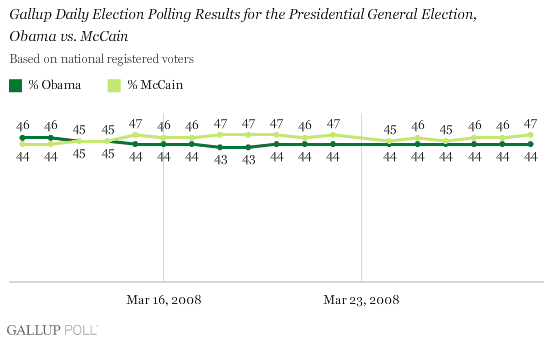
Religion, Government, and Obama
Has anyone else noticed that Obama seems to think that bitter people will abandon their descent into religious faith when they have a government that they can count on? Do I actually have that right? Well, OK then: In Obama's sophisticated view, religion is just the opiate of the masses!
I think that the McCain people ought to be sleeping just a bit easier these days.
I think that the McCain people ought to be sleeping just a bit easier these days.
Saturday, April 12, 2008
Statistically Proven: No Republicans Watch CNN!
Well, by now you've heard about Barack Obama calling the small-town people who aren't voting for him firearms-humpin' Jebus-lovin' xenophobes. Even worse than that, protectionists!
Most fascinating is CNNPolitics.com's report, with hundreds of comments---but not one from an apparent Republican, just a few Hillaryistas being gobbled up by a swarm of Obamans.
Now, a commenter at the righty blog The Ace of Spades says CNN is censoring his $0.02. Either way, censorship or 100% Democrat readership, CNN is toejam.
Equally fascinating---in over 800 comments at the Daily Kos, scarcely a whisper from the Hillary corner. Since the Obamans descended on them with all their savagery last month, Daily Kos, the jewel of the leftosphere, is a Hillary no-go zone.
I used to think when I got into a scrap with a lefty, it was all in the game. But after seeing how they treat each other, I'm thinking something more pathological is at work, if not downright eerie.
No more Republicans at CNN, no Hillary people left at Kos. The Disappeared. Soon all that'll be left is the Obamans, unified, hopeful, agents of change...
______________________________________
"And it's not surprising then they get bitter, they cling to guns or religion or antipathy to people who aren't like them or anti-immigrant sentiment or anti-trade sentiment as a way to explain their frustrations...
Most fascinating is CNNPolitics.com's report, with hundreds of comments---but not one from an apparent Republican, just a few Hillaryistas being gobbled up by a swarm of Obamans.
Now, a commenter at the righty blog The Ace of Spades says CNN is censoring his $0.02. Either way, censorship or 100% Democrat readership, CNN is toejam.
Equally fascinating---in over 800 comments at the Daily Kos, scarcely a whisper from the Hillary corner. Since the Obamans descended on them with all their savagery last month, Daily Kos, the jewel of the leftosphere, is a Hillary no-go zone.
I used to think when I got into a scrap with a lefty, it was all in the game. But after seeing how they treat each other, I'm thinking something more pathological is at work, if not downright eerie.
No more Republicans at CNN, no Hillary people left at Kos. The Disappeared. Soon all that'll be left is the Obamans, unified, hopeful, agents of change...
______________________________________
Thursday, April 10, 2008
Numbers Don't Lie! (Though sometimes people do bend them).
Larry Bartels, a political science professor at Princeton, has gotten a lot of play in "the internets" (as a friend of mine calls it) for his argument that Democratic presidents help create more economic growth and more egalitarian distributional effects than their GOP counterparts, at least since WWII. Jim Manzi's dismantling of at least the inequality claims over at NRO almost make me wish I had spent more time doing stats in grad school and less reading Plato or whoever. Well, almost.
What's remarkable about Manzi's analysis - and deadly for Bartels' claims - is that he makes clear that Bartels is playing a shell game with his numbers. When calculating presidential effects, Bartels gives himself a "lag year" and so Jimmy Carter gets credit for whatever happens economically for a year after he stopped being president. (That's 1980 for you young'uns). But as Manzi shows, if you get rid of the lag year or make it two years, all of Bartels' effects disappear. Poof! Now, maybe there's something robust about a year, but my guess is that Bartels fidgeted around a bit with the lag until he got what made sense to him.
What's remarkable about Manzi's analysis - and deadly for Bartels' claims - is that he makes clear that Bartels is playing a shell game with his numbers. When calculating presidential effects, Bartels gives himself a "lag year" and so Jimmy Carter gets credit for whatever happens economically for a year after he stopped being president. (That's 1980 for you young'uns). But as Manzi shows, if you get rid of the lag year or make it two years, all of Bartels' effects disappear. Poof! Now, maybe there's something robust about a year, but my guess is that Bartels fidgeted around a bit with the lag until he got what made sense to him.
Someone Ought to be Fired
Another example of university administrators not having a clue as to what the First Amendment requires of them: a state university has reprimanded a tenured professor because they've decided that the things he's posted on his door constitute "harassment", not "protected free speech." Nonsense upon nonsense. Administrators are not going to learn their lesson on these things - if you're working at a state university, you can't tell someone not to say something except under very limited circumstances - until people start losing their jobs. The professor and his legal team should do more than ding the school for some cash, they should demand firings.
Sunday, April 06, 2008
Condi for Veep?
Speculation abounds.
My first instinct is that she's too connected with the Current Occupant to be anything but a drag for McCain.
But according to the ABCNews blog, not only does she want the gig, but
I mean, if she could split the 15% "Don't Know" crowd, who right now are busy getting abducted by aliens and writing letters to Elvis, her favorables would be over 60%, even better than Barack ["I'll Unify Your Ass"] Obama's.
An interesting thought, anyway. If John ["I'll Unify Your Ass Even Better"] McCain finds himself in a poll hole come convention time, Condoleezza could be a helluva Hail Mary.
_______________________________________
My first instinct is that she's too connected with the Current Occupant to be anything but a drag for McCain.
But according to the ABCNews blog, not only does she want the gig, but
The survey by the Pew Research Center for the People & the Press, conducted during the last few days of March, found that the Secretary of State enjoys a solid favorability rating: 56% expressed a good opinion of her, compared to 29% who did not.
I mean, if she could split the 15% "Don't Know" crowd, who right now are busy getting abducted by aliens and writing letters to Elvis, her favorables would be over 60%, even better than Barack ["I'll Unify Your Ass"] Obama's.
An interesting thought, anyway. If John ["I'll Unify Your Ass Even Better"] McCain finds himself in a poll hole come convention time, Condoleezza could be a helluva Hail Mary.
_______________________________________
Friday, April 04, 2008
Alas
My friend Ashley Woodiwiss, who teaches political theory at Erskine College in South Carolina, has suffered what can only be considered the most grievous of tragedies: his daughter Anna has been killed in an accident while working in Afghanistan. Go read Alan Jacob's touching memorial. RIP.
Juan Williams on Obama and Wright
But when Barack Obama, arguably the best of this generation of black or white leaders, finds it easy to sit in Rev. Wright's pews and nod along with wacky and bitterly divisive racial rhetoric, it does call his judgment into question. And it reveals a continuing crisis in racial leadership.
What would Jesus do? There is no question he would have left that church.
Well said, sir.
______________________________________
Subscribe to:
Comments (Atom)