As earlier noted, I was privileged on Friday to behold the Liberty Bell. Although I was born in New York City (so were both my parents and my father's mother), I managed to reach the age of 47 before this very first visit.
What I found most fascinating was that when the original crack appeared it did not prevent the bell from ringing. In an effort to repair the crack, they tried some process that held only temporarily. When it rebroke, it was considerably more damaged and no longer functioned. Sometimes, if it ain't all that broke, it's still better not to fix it.
I was reminded of the Jewish law against repairing vessels that were used in the Holy Temple, because of the principle that "there can be no poverty in a place of wealth". However, this applies only if the original break caused it to be unusable. In that case, the item can be utilized only as the result of the repair, which renders it a specimen of "poverty" that is inappropriate in a place of generous munificence. This creates a counterintuitive premise: "If it is broke, don't fix it."
The Talmud adds a story that relates directly to the Liberty Bell. It reports that there was an oboe that had been crafted in the days of Moses and was preserved through all the generations, eventually being used in Solomon's Temple (built 440 years after the passing of Moses). Later, it developed a crack but still made nice music. They tried to repair the crack with some gluey substance but the music was not as sweet. So they just scraped it off and went back to using it, crack and all.
Sunday, July 31, 2005


As The Jay Flies (2)
Aah, depression: now there is a subject I would love to write about, if I could only lift my hand...
Actually, I plan to write an article on the subject soon. It would deal with different Biblical models of depression: Moses, Elijah and Jonah. Maybe if you guys would put in a good word for me, we could coax Karnick into publishing it in Crux.
In the meantime, I'm still busy recording the exciting doings of Washington, D.C. If perchance you overlooked my latest offering, perhaps this link will fill your appetite - that is, if you don't mind the nitrates.
As to my peregrinations, I have moved beyond Washington to Philadelphia and am sorry to report that the Liberty Bell is still cracked. About which, more on a separate post.
Actually, I plan to write an article on the subject soon. It would deal with different Biblical models of depression: Moses, Elijah and Jonah. Maybe if you guys would put in a good word for me, we could coax Karnick into publishing it in Crux.
In the meantime, I'm still busy recording the exciting doings of Washington, D.C. If perchance you overlooked my latest offering, perhaps this link will fill your appetite - that is, if you don't mind the nitrates.
As to my peregrinations, I have moved beyond Washington to Philadelphia and am sorry to report that the Liberty Bell is still cracked. About which, more on a separate post.
Saturday, July 30, 2005
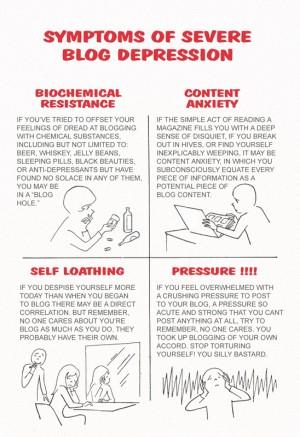
Blog Depression
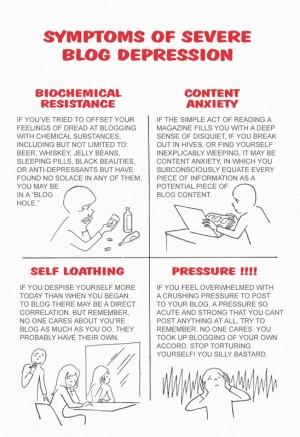
As a public service, we are releasing this image from The Nonist's helpful brochure on blog depression.
Please consider the dangers of blog depression before embarking upon your own electronic printing press project.
Blog depression can be staved off in many ways, one of which is to add think tank all-stars to the contributor list. Welcome, Herb London.
Friday, July 29, 2005
More Leadership From the Left Coast
I have a short essay today in Medical Progress Today on an initiative on the California ballot forthcoming this November. It essentially is a full-employment act for the lawyers, masquerading as pharmaceutical "compassion" for the middle class. If passed, upheld, and implemented, it would destroy the pharmaceutical sector nationwide. It can be found at
http://www.medicalprogresstoday.com/spotlight/spotlight.php.
Comments welcome.
http://www.medicalprogresstoday.com/spotlight/spotlight.php.
Comments welcome.
U.S. Economy Continues Growth
From AP: "The economy clocked in at a chipper 3.4 percent annual growth rate in the second quarter, fresh evidence the country's business climate is healthy despite surging energy costs." (See "Economy Grows Despite High Energy Costs.")
The story notes, "The solid increase in the gross domestic product for the April-to-June quarter, reported by the Commerce Department on Friday, came on the heels of a larger 3.8 percent growth rate in the opening quarter of this year."
Unemployment continues to fall: "With the economy on solid footing, the nation's job market continues to plug ahead. The unemployment rate dropped to 5 percent in June, a nearly four year low, as employers expanded payrolls modestly."
The AP story noted that growth has been slighly slower than expected: "Economic growth averaged 2.8 percent over the last three years, down from the 3.1 percent that originally had been reported for the period.
The story notes, "The solid increase in the gross domestic product for the April-to-June quarter, reported by the Commerce Department on Friday, came on the heels of a larger 3.8 percent growth rate in the opening quarter of this year."
Unemployment continues to fall: "With the economy on solid footing, the nation's job market continues to plug ahead. The unemployment rate dropped to 5 percent in June, a nearly four year low, as employers expanded payrolls modestly."
The AP story noted that growth has been slighly slower than expected: "Economic growth averaged 2.8 percent over the last three years, down from the 3.1 percent that originally had been reported for the period.
"For all of 2004, the new figures show the economy expanded by 4.2 percent, versus the old estimate of 4.4 percent." However, the story noted, "Even with the slightly lower growth, last year's performance was still the best since 1999."
The Bush economy began in 2002.
Columbo: Season One, Pilot
I am now in possession of the first season of the Columbo television movies. Last night I viewed the pilot for the first time. Very interesting. Peter Falk's Columbo is a little different in this version and so is the obligatory villain played by Gene Barry.
Barry is a psychiatrist who crafts the perfect murder of his wife who is threatening to ruin his medical practice with a scandalous divorce. His execution is picture perfect. Enough issues to keep Columbo on his tail, but no proof, not even circumstantial evidence. The scenes where Columbo and the murderous psychiatrist engage in conversational duels are outstanding, particularly when they begin to speak more frankly.
At one point, the two speak of a hypothetical murderer and Columbo asks the psychiatrist to construct a profile. They both know he will be speaking of himself. He states that the murderer is highly intelligent, a professional man, patient, strong nervous system, etc. Columbo interjects: "But wouldn't someone who takes a human life in cold blood be insane?" "No," the psychiatrist answers, "Morals are all relative and murder is simply one option among many. An intelligent man would use it if need be." Paraphrasing a bit here. This is the great part. Columbo says, "Well, that's interesting. I guess a fellow like that would figure he's very hard to catch, but there's a problem. The murderer gets one chance to commit the crime. One chance to learn. But a man like me sees a hundred crimes like this in a year. It's my business." Finally, the psychiatrist begins to pale a bit as he realizes he may be outgunned.
The Columbo of the pilot is a little bit different from the detective of the long-running series. He is younger, better groomed, and angrier, much angrier. Any fan of the series needs to see this episode, which is surely the least-aired of the bunch.
Barry is a psychiatrist who crafts the perfect murder of his wife who is threatening to ruin his medical practice with a scandalous divorce. His execution is picture perfect. Enough issues to keep Columbo on his tail, but no proof, not even circumstantial evidence. The scenes where Columbo and the murderous psychiatrist engage in conversational duels are outstanding, particularly when they begin to speak more frankly.
At one point, the two speak of a hypothetical murderer and Columbo asks the psychiatrist to construct a profile. They both know he will be speaking of himself. He states that the murderer is highly intelligent, a professional man, patient, strong nervous system, etc. Columbo interjects: "But wouldn't someone who takes a human life in cold blood be insane?" "No," the psychiatrist answers, "Morals are all relative and murder is simply one option among many. An intelligent man would use it if need be." Paraphrasing a bit here. This is the great part. Columbo says, "Well, that's interesting. I guess a fellow like that would figure he's very hard to catch, but there's a problem. The murderer gets one chance to commit the crime. One chance to learn. But a man like me sees a hundred crimes like this in a year. It's my business." Finally, the psychiatrist begins to pale a bit as he realizes he may be outgunned.
The Columbo of the pilot is a little bit different from the detective of the long-running series. He is younger, better groomed, and angrier, much angrier. Any fan of the series needs to see this episode, which is surely the least-aired of the bunch.
Thursday, July 28, 2005
And Now for Something Completely Different. . .
Click here to read the real story of how Supreme Court Justices finish their careers.
Fighting a War Against Fanatics
The jihadist attack on innocent London residents as they made their way to work during the morning rush hour two weeks ago, and the subsequent failed attack, illuminate the grim reality of this era. Despite all of the claims about assimilating radical Moslems or moderating their sentiments, it is clear that whatever Western motives may be, jihadist goals are unremitting: undiluted destruction and sanguinary nihilism.
With another 700 injured and at least 50 killed, it is time to face this truth. These fanatics are intent on killing and maiming as many people as they can. Negotiations are not possible. With whom would one negotiate in any case?
Difficult as it may be for well meaning liberals to accept, jihadists are different from those of us who share Judeo-Christian principles. They are at war with the West and it is a war in which civilization itself is at risk.
This is not merely a war for hearts and minds, it is a war of life and death. The West is at the crossroads. It is one thing to say, as Tony Blair has, that we will prevail. How we will prevail; what we must do to prevail? These need to be answered.
It is instructive that MI5 reports that “only 1 percent of Muslims in the U.K. are extremists.” However, that one percent translates into 16,000 potential terrorists. The “only” in the intelligence report speaks volumes about British political correctness.
A call for realism is in order. We can no longer tolerate sermons from mosques that justify slaughter or martyrdom. We can no longer allow foreign-born, noncitizen fanatics to live in our nation or any civilized nation where they plan attacks or marshal support for attacks. We can no longer simply assume that through Herculean effort radical Muslims will embrace the essential creed of our civilization. We can no longer allow our Constitution to be used against Americans. Freedom of religion is not freedom to promote carnage. The Constitution is not a suicide pact.
Even after 9/11 our Secretary of Transportation refused to consider “profiling.” From any perspective he was more intent on the maintenance of a liberal agenda than public safety. That decision is a metaphor for the war on terror. We cannot fight this war effectively with at least one hand tied behind our backs.
Now that body parts have been exploded on to London streets, the public may awaken from its tranquilized state. This war depends on an all-out effort to win. Half measures won’t do, nor will good-will. The time has come to remove our ideological shackles and fight this war with every once of strength we, as a people, can muster. Our destiny and the destiny of our civilization depend on it.
A longer version of this item appeared on FrontPage magazine.
New Member of Reform Club Blog
I am delighted to announce that Herb London has joined the Reform Club blog. Herb is president of the Hudson Institute, Professor Emeritus at New York University, and author of hundreds of articles and numerous books, the most recent of which is Decade of Denial (Lexington Books). Herb, as most reasonably well informed people know, is a brilliant and respected commentator on a wide variety of subjects, and we are extremely fortunate to have him on the team.
The Economics of Willy Wonka
Update: Welcome, Carnival of the Capitalists readers! Check out more great stuff on the Reform Club homepage.
The Viking Child and I saw Charlie and the Chocolate Factory this afternoon. I’ve liked Tim Burton for a long time, and this film is one of his best. Johnny Depp is certainly one of the most interesting, and most talented, actors of his generation. A Dahl purist might object to the invented backstory of Willy’s disturbed childhood as the son of Saruman the Dentist; it didn’t bother me, it was sufficiently Dahlian to fit, and it helped flesh out the persona of a man who looks like Anna Wintour on purpose.
But if I want to blog about a movie two weeks in the theaters already, I have to have some oddball schtick and here it is: Willy Wonka as a primer on economics.
When we first meet the Bucket family, they are mired in comically desparate penury: one breadwinner, five dependents, and cabbage soup every night. Mr. Bucket is an honest and industrious man, but he can’t earn much, because he puts caps on toothpaste tubes by hand. Since an employer can’t afford to pay him more than the value he adds to the product at the margin, he makes a peasant’s wage and eats a peasant’s diet.
There’s a massive, modern, efficient factory right next to the Bucket house – the Wonka works – but there are no employment opportunities there. Grandpa Joe once worked for Mr. Wonka, but that all ended with a rash of industrial espionage. Some of the Wonka workforce were bribed to steal secret recipes for his competitors, and in response Wonka fired everyone and closed the factory. Wonka’s competitive advantage at candymaking is his fertile creativity; if his intellectual property rights can’t be defended, he can’t afford to keep inventing things. And although this was bad for Wonka, it was worse for Grandpa Joe. Wonka eventually found an alternative source of labor that wasn’t so untrustworthy. Grandpa had to go lie in bed with three other old people and eat cabbage soup every day.
Keep that in mind the next time you feel like bashing Big Pharma when they defend their drug patents.
Although things are bad for the Buckets at the beginning of the film, they get worse. Mr. Bucket loses his job at the toothpaste factory, when the demand curve for toothpaste shifts east in response to an exogenous demand increase for candy caused by the Wonka Golden Ticket craze (since of course toothpaste and candy are complementary goods). You might think that what’s good for toothpaste is good for the Buckets, but paradoxically the firm’s increased revenues give them the cash position to enter the capital market and purchase a machine that screws caps on toothpaste tubes and makes Mr. Bucket redundant.
Then Charlie finds a 10 pound note (or maybe it was a 10 euro note, or some made up currency. Ten somethings, though) half buried in the snow, takes possession of it, buys a Wonka bar and gets the last Golden Ticket. You might cavil that Charlie should have taken the note to the police and reported it as lost. I say he mixed his labor with an abandoned physical good, all according to John Locke, and it became rightfully his.
Most of the time spent in the Chocolate Factory is microeconomics free, but afterwards the Bucket fortunes improve when the toothpaste makers hire Mr. Bucket back at a significant wage increase to fix the machine that screws the caps on the tubes. This illustrates that Mr. Bucket’s previous poverty was in part due to insufficient capital to mix with his labor. While in the short run the capital purchase seemed bad for Mr. Bucket, in the end it’s once again shown that workers are more productive and better compensated when they have more capital to work with.
Next week: Baseball’s Antitrust Exemption and The Bad News Bears
The Viking Child and I saw Charlie and the Chocolate Factory this afternoon. I’ve liked Tim Burton for a long time, and this film is one of his best. Johnny Depp is certainly one of the most interesting, and most talented, actors of his generation. A Dahl purist might object to the invented backstory of Willy’s disturbed childhood as the son of Saruman the Dentist; it didn’t bother me, it was sufficiently Dahlian to fit, and it helped flesh out the persona of a man who looks like Anna Wintour on purpose.
But if I want to blog about a movie two weeks in the theaters already, I have to have some oddball schtick and here it is: Willy Wonka as a primer on economics.
When we first meet the Bucket family, they are mired in comically desparate penury: one breadwinner, five dependents, and cabbage soup every night. Mr. Bucket is an honest and industrious man, but he can’t earn much, because he puts caps on toothpaste tubes by hand. Since an employer can’t afford to pay him more than the value he adds to the product at the margin, he makes a peasant’s wage and eats a peasant’s diet.
There’s a massive, modern, efficient factory right next to the Bucket house – the Wonka works – but there are no employment opportunities there. Grandpa Joe once worked for Mr. Wonka, but that all ended with a rash of industrial espionage. Some of the Wonka workforce were bribed to steal secret recipes for his competitors, and in response Wonka fired everyone and closed the factory. Wonka’s competitive advantage at candymaking is his fertile creativity; if his intellectual property rights can’t be defended, he can’t afford to keep inventing things. And although this was bad for Wonka, it was worse for Grandpa Joe. Wonka eventually found an alternative source of labor that wasn’t so untrustworthy. Grandpa had to go lie in bed with three other old people and eat cabbage soup every day.
Keep that in mind the next time you feel like bashing Big Pharma when they defend their drug patents.
Although things are bad for the Buckets at the beginning of the film, they get worse. Mr. Bucket loses his job at the toothpaste factory, when the demand curve for toothpaste shifts east in response to an exogenous demand increase for candy caused by the Wonka Golden Ticket craze (since of course toothpaste and candy are complementary goods). You might think that what’s good for toothpaste is good for the Buckets, but paradoxically the firm’s increased revenues give them the cash position to enter the capital market and purchase a machine that screws caps on toothpaste tubes and makes Mr. Bucket redundant.
Then Charlie finds a 10 pound note (or maybe it was a 10 euro note, or some made up currency. Ten somethings, though) half buried in the snow, takes possession of it, buys a Wonka bar and gets the last Golden Ticket. You might cavil that Charlie should have taken the note to the police and reported it as lost. I say he mixed his labor with an abandoned physical good, all according to John Locke, and it became rightfully his.
Most of the time spent in the Chocolate Factory is microeconomics free, but afterwards the Bucket fortunes improve when the toothpaste makers hire Mr. Bucket back at a significant wage increase to fix the machine that screws the caps on the tubes. This illustrates that Mr. Bucket’s previous poverty was in part due to insufficient capital to mix with his labor. While in the short run the capital purchase seemed bad for Mr. Bucket, in the end it’s once again shown that workers are more productive and better compensated when they have more capital to work with.
Next week: Baseball’s Antitrust Exemption and The Bad News Bears
Wednesday, July 27, 2005
The Philosopher's Dream
After yet another round of head meeting wall of denial in the comment room, I am reminded of a story about a philosopher who kept having the most interesting dream. In his dream, the philosopher saw himself meeting the greatest minds of history in debate. With a single remark, he sent each of them away despondent and defeated. No matter whether they were natural law theorists, Christians, atheists, agnostics, continental, analytic, Freudians, Marxists, behaviorists, nihilists, whatever, he sent them away with his awe-inspiring single remark.
The only problem was that he would wake up each morning completely unable to remember what his atomic statement was. The greatest piece of argumentation of all-time and he couldn't remember it!
After having the dream several more times he read that some dreamers could wake themselves long enough to take notes on their dreams before collapsing back into unconsciousness. He resolved to do so himself. He placed a pencil and notepad by his bed and spoke very sternly to himself about the need to wake up. Despite the tension caused by such rigorous concentration and self-talk, he finally managed to fall asleep.
The dream faithfully recurred. Amazingly, he managed to rise and scribble the deadly argument on the pad. As he finished his note unconsciousness descended and he immediately returned to slumber.
He awoke to the sound of his alarm clock with great expectation. He remembered having woken from his dream and having made a note. He could barely get his eyes to focus on the pad he held with shaking fingers. With great discipline he mastered himself and read the inscription only to go pale with disappointment as he read what it said:
"Well, that's what you say. . ."
The only problem was that he would wake up each morning completely unable to remember what his atomic statement was. The greatest piece of argumentation of all-time and he couldn't remember it!
After having the dream several more times he read that some dreamers could wake themselves long enough to take notes on their dreams before collapsing back into unconsciousness. He resolved to do so himself. He placed a pencil and notepad by his bed and spoke very sternly to himself about the need to wake up. Despite the tension caused by such rigorous concentration and self-talk, he finally managed to fall asleep.
The dream faithfully recurred. Amazingly, he managed to rise and scribble the deadly argument on the pad. As he finished his note unconsciousness descended and he immediately returned to slumber.
He awoke to the sound of his alarm clock with great expectation. He remembered having woken from his dream and having made a note. He could barely get his eyes to focus on the pad he held with shaking fingers. With great discipline he mastered himself and read the inscription only to go pale with disappointment as he read what it said:
"Well, that's what you say. . ."
Krauthammer on Gitmo
I'm linking to this column by Charles Krauthammer because it recapitulates my sense of what's happening in Guantanamo and how we should respond to it.
I'm open to a revised opinion based on hard fact, but for now I think Krauthammer has it about right.
Here's an excerpt:
The self-flagellation has gone far enough. We know that al Qaeda operatives are trained to charge torture when they are in detention, and specifically to charge abuse of the Koran to inflame fellow prisoners on the inside and potential sympathizers on the outside.
In March the Navy inspector general reported that, out of about 24,000 interrogations at Guantanamo, there were seven confirmed cases of abuse, "all of which were relatively minor." In the eyes of history, compared to any other camp in any other war, this is an astonishingly small number. Two of the documented offenses involved "female interrogators who, on their own initiative, touched and spoke to detainees in a sexually suggestive manner." Not exactly the gulag.
The most inflammatory allegations have been not about people but about mishandling the Koran. What do we know here? The Pentagon reports (Brig. Gen. Jay Hood, May 26) -- all these breathless "scoops" come from the U.S. government's own investigations of itself -- that of 13 allegations of Koran abuse, five were substantiated, of which two were most likely accidental.
Let's understand what mishandling means. Under the rules the Pentagon later instituted at Guantanamo, proper handling of the Koran means using two hands and wearing gloves when touching it. Which means that if any guard held the Koran with one hand or had neglected to put on gloves, this would be considered mishandling.
I'm open to a revised opinion based on hard fact, but for now I think Krauthammer has it about right.
Here's an excerpt:
The self-flagellation has gone far enough. We know that al Qaeda operatives are trained to charge torture when they are in detention, and specifically to charge abuse of the Koran to inflame fellow prisoners on the inside and potential sympathizers on the outside.
In March the Navy inspector general reported that, out of about 24,000 interrogations at Guantanamo, there were seven confirmed cases of abuse, "all of which were relatively minor." In the eyes of history, compared to any other camp in any other war, this is an astonishingly small number. Two of the documented offenses involved "female interrogators who, on their own initiative, touched and spoke to detainees in a sexually suggestive manner." Not exactly the gulag.
The most inflammatory allegations have been not about people but about mishandling the Koran. What do we know here? The Pentagon reports (Brig. Gen. Jay Hood, May 26) -- all these breathless "scoops" come from the U.S. government's own investigations of itself -- that of 13 allegations of Koran abuse, five were substantiated, of which two were most likely accidental.
Let's understand what mishandling means. Under the rules the Pentagon later instituted at Guantanamo, proper handling of the Koran means using two hands and wearing gloves when touching it. Which means that if any guard held the Koran with one hand or had neglected to put on gloves, this would be considered mishandling.
A False Claim We Hope Won't Stick
"I don't have to prove that it causes cancer," an attorney told the Associated Press. "I only have to prove that DuPont lied in a massive attempt to continue selling their product."
So reports Michael Fumento in this excellent report on the latest example of rich lawyers trawling for big corporate pockets to plunder. Fumento notes that two law firms have filed a class action lawsuit against Dupont, Inc., makers of Teflon, for $5 billion. Their claim: that a chemical called perfluorooctanoic acid, which is used in the production of Teflon, is dangerous to humans because it causes cancer in rats when administered in dosages just short of instantaneously poisonous levels.
The purpose of the tort system, of course, is to provide redress to individuals harmed by other persons within the society. And if anyone has truly been harmed by Teflon, they have a right to sue the persons responsible.
As the lawyer's comment above demonstrates, however, the nation's tort system has been perverted into a proxy for the criminal justice system: a means of punishing supposed wrongdoers through the use of a weaker standard of proof—preponderance of the evidence instead of proof beyond a reasonable doubt.
Frankly, abusing the tort system in this way is a crappy, cowardly thing to do.
Any decent judge in a reasonable system would throw such a suit out immediately. Unfortunately, that probably won't happen. Read Mike's account here.
So reports Michael Fumento in this excellent report on the latest example of rich lawyers trawling for big corporate pockets to plunder. Fumento notes that two law firms have filed a class action lawsuit against Dupont, Inc., makers of Teflon, for $5 billion. Their claim: that a chemical called perfluorooctanoic acid, which is used in the production of Teflon, is dangerous to humans because it causes cancer in rats when administered in dosages just short of instantaneously poisonous levels.
The purpose of the tort system, of course, is to provide redress to individuals harmed by other persons within the society. And if anyone has truly been harmed by Teflon, they have a right to sue the persons responsible.
As the lawyer's comment above demonstrates, however, the nation's tort system has been perverted into a proxy for the criminal justice system: a means of punishing supposed wrongdoers through the use of a weaker standard of proof—preponderance of the evidence instead of proof beyond a reasonable doubt.
Frankly, abusing the tort system in this way is a crappy, cowardly thing to do.
Any decent judge in a reasonable system would throw such a suit out immediately. Unfortunately, that probably won't happen. Read Mike's account here.
A Little Happening Christian Humor . . .

The ad copy contains this gem:
Running from the floodtide of internet filth? Plagued by the merchants of obscenity? Maligned by the mercenaries of smut? Stop the madness and insist on the product that protects my family from the lewd, lecherous portal known as the world wide web.
Get the best Internet filter available from Integrity Online. Now with S.P.I.F.T.™, Superior Pornographic Internet Filtering Technology.
We're also alerted to the fact that this filter "PROTECTS THE JOHNSONS!"
The Incredible Lightness of Howard Dean
His Airness (and that doesn't refer to his vertical leap) Howard Dean fired another shot into the alternate reality-based community in which he lives. By Dean's account:
"The president and his right-wing Supreme Court think it is 'okay' to have the government take your house if they feel like putting a hotel where your house is."
Dean perhaps missed out on the fact that the four dissenters to the Kelo eminent domain decision included the three most conservative justices: Rehnquist, Scalia, and Thomas. Get that man a newspaper, wouldja?
"The president and his right-wing Supreme Court think it is 'okay' to have the government take your house if they feel like putting a hotel where your house is."
Dean perhaps missed out on the fact that the four dissenters to the Kelo eminent domain decision included the three most conservative justices: Rehnquist, Scalia, and Thomas. Get that man a newspaper, wouldja?
Tuesday, July 26, 2005
Club G'itmo
I've stated before that I think Rush Limbaugh transformed talk radio as much or more because of his talent and humor than because of his ideology. Assuming Guantanamo is more a detainment facility and less the raging chamber of torture horrors the Daily Kos groupies think it is, I'm linking to the hilarious merchandise Rush has for sale in the Club G'itmo line.
Sample lines from mugs, t-shirts, etc.:
"What happens at Club G'itmo, stays at Club G'itmo."
"My mullah went to Club G'itmo and all I got was this lousy t-shirt."
"Your tropical retreat from the stress of Jihad."
I think the last is my favorite.
Sample lines from mugs, t-shirts, etc.:
"What happens at Club G'itmo, stays at Club G'itmo."
"My mullah went to Club G'itmo and all I got was this lousy t-shirt."
"Your tropical retreat from the stress of Jihad."
I think the last is my favorite.
Face Transplants and Face/Off
We've all seen the news accounts of the face transplants that will soon begin to take place. Interesting, hopeful stuff, particularly for those who have been severely disfigured. As I read, I began thinking of the highly implausible, but really entertaining film Face/Off which starred Nick Cage and John Travolta. What was hard to believe was that two men with really different bodies, hairlines, etc. could trade faces through surgery.
My wife, the doctor, pointed out a much better reason it would be implausible while I told her about the new transplants. She informed me (duh, why didn't I think of that) that face transplant recipients would not look like the donors because the bones of the face play a great part in defining the way the face looks. Interesting point.
My wife, the doctor, pointed out a much better reason it would be implausible while I told her about the new transplants. She informed me (duh, why didn't I think of that) that face transplant recipients would not look like the donors because the bones of the face play a great part in defining the way the face looks. Interesting point.
Can a (Yuk!!!!) Catholic Uphold the Constitution?
There seem to be increasing doubts, among many on the political left, that U.S. Catholics are sufficiently respectful of America's constitutional system to be able to serve on the U.S. Supreme Court. There are, of course, partisan reasons for this. The ongoing efforts to find something wrong with President Bush's current choice for the vacancy on the Court, John Roberts, have failed to uncover anything sufficiently damning to give Democrats a pretext for filibustering his nomination or turning moderate Republicans against him. Hence the focus has turned—rather desperately, I think—to his religious beliefs and the beliefs of his wife.
This past weekend, the New York Times reports, Illinois Senator Dick Durbin asked Judge Roberts directly whether he could uphold the Constitution.
"An opinion-page article in The Los Angeles Times on Monday by Jonathan Turley, a George Washington University law professor, included an account of Mr. Durbin's question. Professor Turley cited unnamed sources saying that Judge Roberts had told Mr. Durbin he would recuse himself from cases involving abortion, the death penalty or other subjects where Catholic teaching and civil law can clash.
"A spokesman for Mr. Durbin and Senator John Cornyn, Republican of Texas, who spoke to Judge Roberts on Monday about the meeting, said Professor Turley's account of a recusal statement was inaccurate.
"But in an interview last night, Professor Turley said Mr. Durbin himself had described the conversation to him on Sunday morning, including the statement about recusal. Whatever the conversation in the senator's office on Friday, Mr. Durbin's question hit the fault line between liberal anxiety about theocratic intolerance and conservative fears about hostility to religion."
Durbin, however, would not confirm Turley's claim, and an aide cast doubt on the professor's interpretation of his conversation with Sen. Durbin, according to the Times:
"Mr. Durbin declined to discuss the issue on Monday. A spokesman, Joe Shoemaker, said, 'What Judge Roberts did say clearly and repeatedly was that he would follow the rule of law, and beyond that we are going to leave it to Judge Roberts to offer his views.'"
What I find fascinating here is the readiness to believe that membership in a church that has 65 million members in this country is sufficient to cast doubt on a person's devotion to their nation's constitutional principles. The Times story reports, however, that at least one major political activist on the left finds that conclusion to be unfair:
"Ralph Neas, president of People for the American Way said, conservatives were 'laying a foundation or somehow setting up a dynamic that if you are against John Roberts you are somehow anti-Catholic, and that is just pure poppycock.'"
But if there's nothing else particularly wrong with him, and people keep asking him about his religious beliefs, and then they say that they oppose confirmation of him for the Supreme Court, one can hardly blame Catholics for concluding something from that.
Unless, of course, it is all about abortion after all.
It would seem unwise for politicians in most states to offend Catholics by using religion as a stalking horse for abortion opinions.
In which case, I should respectfully suggest that the opponents of Roberts' confirmation simply come out and say that they will oppose any nominee who does not explicitly say that he or she will support Roe v. Wade with no alterations and no exceptions. Then, let the voters decide what to do about it when Senators from both sides of the argument face reelection. That is how a representative democracy is supposed to work, isn't it?
This past weekend, the New York Times reports, Illinois Senator Dick Durbin asked Judge Roberts directly whether he could uphold the Constitution.
"An opinion-page article in The Los Angeles Times on Monday by Jonathan Turley, a George Washington University law professor, included an account of Mr. Durbin's question. Professor Turley cited unnamed sources saying that Judge Roberts had told Mr. Durbin he would recuse himself from cases involving abortion, the death penalty or other subjects where Catholic teaching and civil law can clash.
"A spokesman for Mr. Durbin and Senator John Cornyn, Republican of Texas, who spoke to Judge Roberts on Monday about the meeting, said Professor Turley's account of a recusal statement was inaccurate.
"But in an interview last night, Professor Turley said Mr. Durbin himself had described the conversation to him on Sunday morning, including the statement about recusal. Whatever the conversation in the senator's office on Friday, Mr. Durbin's question hit the fault line between liberal anxiety about theocratic intolerance and conservative fears about hostility to religion."
Durbin, however, would not confirm Turley's claim, and an aide cast doubt on the professor's interpretation of his conversation with Sen. Durbin, according to the Times:
"Mr. Durbin declined to discuss the issue on Monday. A spokesman, Joe Shoemaker, said, 'What Judge Roberts did say clearly and repeatedly was that he would follow the rule of law, and beyond that we are going to leave it to Judge Roberts to offer his views.'"
What I find fascinating here is the readiness to believe that membership in a church that has 65 million members in this country is sufficient to cast doubt on a person's devotion to their nation's constitutional principles. The Times story reports, however, that at least one major political activist on the left finds that conclusion to be unfair:
"Ralph Neas, president of People for the American Way said, conservatives were 'laying a foundation or somehow setting up a dynamic that if you are against John Roberts you are somehow anti-Catholic, and that is just pure poppycock.'"
But if there's nothing else particularly wrong with him, and people keep asking him about his religious beliefs, and then they say that they oppose confirmation of him for the Supreme Court, one can hardly blame Catholics for concluding something from that.
Unless, of course, it is all about abortion after all.
It would seem unwise for politicians in most states to offend Catholics by using religion as a stalking horse for abortion opinions.
In which case, I should respectfully suggest that the opponents of Roberts' confirmation simply come out and say that they will oppose any nominee who does not explicitly say that he or she will support Roe v. Wade with no alterations and no exceptions. Then, let the voters decide what to do about it when Senators from both sides of the argument face reelection. That is how a representative democracy is supposed to work, isn't it?
Moral Truth and the Existence of God
Joe Carter at the Evangelical Outpost has an interesting post on something we argue about quite a bit here, which is objective moral truth and whether God exists. Click here to read more. I particularly like this sketch of the argument because it includes stuff from the American C.S. Lewis, Elton Trueblood.
Harry Potter and the Editorial Half-Wit
The Writer's Write blog has the goods on the guy who missed out on the chance to buy the first Harry Potter book. Turns out his father missed Goodnight Moon, too. As Bugs Bunny would say, "Wotta Maroon!"
Here's a tidbit:
At lunch some time later I overheard our chief executive talking about the success of the Rowling book. So I happened to mention, with a chuckle, that we'd had a chance to buy it. Why is it that one remembers a long pause? "Chief?" I said, though to this day I don't know why, as no one called him that. "You what?" he asked, his voice trembling slightly. "May I speak with you in my office?"
The editor in question has moved on to another line of work.
Here's a tidbit:
At lunch some time later I overheard our chief executive talking about the success of the Rowling book. So I happened to mention, with a chuckle, that we'd had a chance to buy it. Why is it that one remembers a long pause? "Chief?" I said, though to this day I don't know why, as no one called him that. "You what?" he asked, his voice trembling slightly. "May I speak with you in my office?"
The editor in question has moved on to another line of work.
Monday, July 25, 2005
Turner South and My Yard
I happen to rent the crappiest house and yard on one of the best streets in Athens, Georgia. The property is a real outlier compared to the well-groomed beauties around it. My landlord says he has a plan to rehabilitate, but it hasn't happened yet.
I said that to say this. Turner South showed up on my doorstep and asked if I'm interested in letting them remake my horrible yard. I said yes and referred them to my landlord. If the family gets some TV time, I'll be sure to alert the Reform Clubbers.
Here's the link for the show.
I said that to say this. Turner South showed up on my doorstep and asked if I'm interested in letting them remake my horrible yard. I said yes and referred them to my landlord. If the family gets some TV time, I'll be sure to alert the Reform Clubbers.
Here's the link for the show.
Details One, Devil Zero
Because a minor comments box riot broke out over the weekend, I've spent more time than any sane human would staring at government receipts numbers. Several charges were made in re: the Reagan era tax cuts (specifically ERTA, passed in 1981 and effective with the 1982 fiscal budget, although Reagan also oversaw another major tax restructuring, TRA, in 1986) with regard to the effect on tax revenues, budget deficits, and total debt:
Claim: Tax revenue decreased after ERTA and did not reach 1980 levels again until 1994.
Evidence: I have looked at every variant of revenue I can find, and I see no indication that this is true. I can't even divine where such a claim could have originated. It's not true for total receipts, on-budget receipts, individual or corporate income tax receipts....if the person who made this claim could clarify the source I'll look further, otherwise this one's tagged false. Total receipts did fall from the 1981 FY maximum of $1.077 trillion (constant 2000 dollars) to $1.037 tn in FY 1982 and were lower yet ($0.962 tn) in FY 1983. Thereafter, however, they began rising again, and exceeded the FY 1981 level in 1985, when the government collected $1.083 tn. Moreover, while the major effects of ERTA should have been reflected in individual income tax receipts, there was never a decline in that series (although there was a decline in corporate income tax receipts in 1982 and 1983).
Claim: The national debt quadrupled under Reagan.
Evidence: I can't get this figure out of the historical data, even if I measure gross debt in current dollars. Using FY 1981 as the base year (this is the last budget prepared by the Carter administration) gross debt during Reagan's two terms increased by 161% in current dollars but just barely doubled, increasing by 102%, in constant dollars.
Claim: Reagan's tax cuts caused the deficit, and the national debt, to soar. This refutes the claims of the supply siders, who swore that the tax cuts would "pay for themselves."
Evidence: The deficit, and consequently the national debt, did increase substantially under Reagan. But to blame this on tax cuts is rather like saying that if my husband gets a $5000 bonus and I go out and buy $10000 worth of furniture the next day, that our budgetary shortfall the next month was caused by his employer. The one did follow the other, certainly. It may even be the case that the windfall motivated me to go furniture shopping, and things just got out of hand. But it would be stupid to suggest that everything would be far better next year if his boss just didn't give him a bonus. It would be better still if he got the bonus, but his wife restrained her impulses. And I think that pretty much sums up Reagan and the Democratically controlled Congress with which he was saddled. It's true that Reagan didn't spend any political capital trying to rein in spending. He thought it more important to increase defense spending and end the Cold War once and for all. In hindsight, he was right. To continue my lame analogy, it's like I didn't run a $5000 deficit buying furniture, but hiring an exterminator to get rid of the termites that are eating the joists.
All the numbers I have used are available as tables in Bush's last budget. Or if you prefer to do your own spreadsheets, zipped Excel files are available from the GPO website.
Claim: Tax revenue decreased after ERTA and did not reach 1980 levels again until 1994.
Evidence: I have looked at every variant of revenue I can find, and I see no indication that this is true. I can't even divine where such a claim could have originated. It's not true for total receipts, on-budget receipts, individual or corporate income tax receipts....if the person who made this claim could clarify the source I'll look further, otherwise this one's tagged false. Total receipts did fall from the 1981 FY maximum of $1.077 trillion (constant 2000 dollars) to $1.037 tn in FY 1982 and were lower yet ($0.962 tn) in FY 1983. Thereafter, however, they began rising again, and exceeded the FY 1981 level in 1985, when the government collected $1.083 tn. Moreover, while the major effects of ERTA should have been reflected in individual income tax receipts, there was never a decline in that series (although there was a decline in corporate income tax receipts in 1982 and 1983).
Claim: The national debt quadrupled under Reagan.
Evidence: I can't get this figure out of the historical data, even if I measure gross debt in current dollars. Using FY 1981 as the base year (this is the last budget prepared by the Carter administration) gross debt during Reagan's two terms increased by 161% in current dollars but just barely doubled, increasing by 102%, in constant dollars.
Claim: Reagan's tax cuts caused the deficit, and the national debt, to soar. This refutes the claims of the supply siders, who swore that the tax cuts would "pay for themselves."
Evidence: The deficit, and consequently the national debt, did increase substantially under Reagan. But to blame this on tax cuts is rather like saying that if my husband gets a $5000 bonus and I go out and buy $10000 worth of furniture the next day, that our budgetary shortfall the next month was caused by his employer. The one did follow the other, certainly. It may even be the case that the windfall motivated me to go furniture shopping, and things just got out of hand. But it would be stupid to suggest that everything would be far better next year if his boss just didn't give him a bonus. It would be better still if he got the bonus, but his wife restrained her impulses. And I think that pretty much sums up Reagan and the Democratically controlled Congress with which he was saddled. It's true that Reagan didn't spend any political capital trying to rein in spending. He thought it more important to increase defense spending and end the Cold War once and for all. In hindsight, he was right. To continue my lame analogy, it's like I didn't run a $5000 deficit buying furniture, but hiring an exterminator to get rid of the termites that are eating the joists.
All the numbers I have used are available as tables in Bush's last budget. Or if you prefer to do your own spreadsheets, zipped Excel files are available from the GPO website.
As The Jay Flies
Some magnetic impulse has drawn me away from my Miami cocoon of comfort, inching ever northward alongside the Atlantic Ocean.
I would love to have someone offer me a boatload of money to write a travelogue, in which case I would engage every convenience store clerk and motel chambermaid in conversation, but in the absence of such incentives, I mostly avoid eye contact and concentrate on piloting my automobile from Point A to point B - or, if the flesh is weak, to Point A +300 miles.
Here is one smidgen of free sociology: there is a peculiar convention of formality that attends the conversion of verbal instruction into signage.
For example, almost every person behind a counter will point to the receptacle in the corner and inform you that it awaits your "trash" or your "garbage". However, virtually any printed sign to this effect will refer to its subject as "refuse" or "waste".
I would love to have someone offer me a boatload of money to write a travelogue, in which case I would engage every convenience store clerk and motel chambermaid in conversation, but in the absence of such incentives, I mostly avoid eye contact and concentrate on piloting my automobile from Point A to point B - or, if the flesh is weak, to Point A +300 miles.
Here is one smidgen of free sociology: there is a peculiar convention of formality that attends the conversion of verbal instruction into signage.
For example, almost every person behind a counter will point to the receptacle in the corner and inform you that it awaits your "trash" or your "garbage". However, virtually any printed sign to this effect will refer to its subject as "refuse" or "waste".
Sunday, July 24, 2005
Further Thoughts on Masonry
In his comment on my Perry Mason post of yesterday, Hunter Baker is absolutely right about the difference between the TV character of Perry Mason and the book version. Original Mason author Erle Stanley Gardner had control over the TV show, so the Perry you see there is the one Gardner wanted to present at that time to a mass audience. However, I think that the Perry of the books—especially during the first couple of decades of the book series—is far more interesting, and I am convinced that the TV movie or miniseries format would be an excellent way to recapture the full effects of the books for a new audience.
It's interesting to consider the A&E Nero Wolfe and Granada Poirot TV series in this regard: neither felt it necessary to go to great efforts to make the central detective character more personable and easy to "relate" to than they were in the books. These great characters are largely as the authors wrote them (allowing for the natural difficulties of translating characters and stories from one medium to another), and the series benefit greatly from these interesting , complex, and often unpredictable central characters.
I think that the Perry Mason TV series' domestication and bourgeoisification of Mason makes the stories far less interesting and effective than the novels were and still are. Given the recent precedents, I believe that a new series of movies could work brilliantly.
It appears to me that this would be an excellent project for A&E, the Hallmark Channel, TNT, or the USA Network—or perhaps even Granada or the BBC—to take up. There are dozens of great stories there just waiting to be retold for a new audience.
It's interesting to consider the A&E Nero Wolfe and Granada Poirot TV series in this regard: neither felt it necessary to go to great efforts to make the central detective character more personable and easy to "relate" to than they were in the books. These great characters are largely as the authors wrote them (allowing for the natural difficulties of translating characters and stories from one medium to another), and the series benefit greatly from these interesting , complex, and often unpredictable central characters.
I think that the Perry Mason TV series' domestication and bourgeoisification of Mason makes the stories far less interesting and effective than the novels were and still are. Given the recent precedents, I believe that a new series of movies could work brilliantly.
It appears to me that this would be an excellent project for A&E, the Hallmark Channel, TNT, or the USA Network—or perhaps even Granada or the BBC—to take up. There are dozens of great stories there just waiting to be retold for a new audience.
Saturday, July 23, 2005
Tearing up Your Che Guevara Shirt
I got a few laughs from this funny article about Che Guevara t-shirts and accessories and other symptoms of political fashion victims, and you might like it too. The author asks a couple of very good questions:
"Why the hell was this moron wearing clothes advertising someone they have never even heard of? Furthermore, how the hell can any self-respecting person not know who Che Guevara is?"
The author goes on to suggest some alternative fashion items that just might become very big sellers too. Very amusing. Read it here.
"Why the hell was this moron wearing clothes advertising someone they have never even heard of? Furthermore, how the hell can any self-respecting person not know who Che Guevara is?"
The author goes on to suggest some alternative fashion items that just might become very big sellers too. Very amusing. Read it here.
Another Plum by Erle Stanley Gardner—and a Call for Action!
The Case of the Howling Dog is an excellent early installment in Erle Stanley Gardner's long series of Perry Mason novels—in fact, it is one of the best Masons I've read. It was the fourth Perry Mason novel to reach print, published in June 1934 after being serialized in Liberty magazine. In this book, Gardner clearly begins to indicate the kind of plot complexity he was ultimately able to bring to the Mason novels. Gardner was simply one of the greatest mystery plot writers of all time. In addition, the book displays Perry's legal manipulativeness at its very best, especially the outside-the-courtroom variety which was such an important element of the books (and so rare in the TV series).
The story has the classic elements of the Mason books: Perry going way out on a limb for his client, a damsel in distress; Della's intense loyalty and Paul Drake's good-natured professionalism; a tough, single-minded prosecutor in Claude Drumm; a cast of suspects and victims whose motives are perpetually murky; impressively clever and sneaky pretrial manipulation of evidence by Mason; a fast-paced, eventful story; direct, understandable prose; a good look at Mason's philosophy of the law; and fascinating, dramatic courtroom scenes with an effectively presented breakdown of a crucial witness. In addition, the central mystery of the howling dog is interesting and used to good effect.
Some flavorsome quotes for you:
"You're getting this case all mixed up, brother," Drake told him.
Perry Mason laughed grimly.
That's the way I want it," he said.
The courtroom atmosphere was stale with that psychic stench which comes from packed humans whose emotions are roused to a high pitch of excitement.
"What did Judge Markham think?" [Della] asked.
"I don't know," he told her, "and I don't give a damn. I know what my rights are and I stood on them. I'm fighting to protect a client."
[Mason:] "My idea of a fair trial is to bring out the facts. I'm going to bring out the facts."
[Drake:] "All of the facts, or just the facts that are favorable to your client?"
"Well," said Perry Mason, grinning, "I'm not going to try the case for the district attorney, if that's what you mean; that's up to him."
"We're a dramatic people," Perry Mason said slowly. "We're not like the English. The English want dignity and order. We want the dramatic and the spectacular. It's a national craving. We're geared to a rapid rate of thought. We want to have things move in a spectacular manner."
"If you don't put that woman on the witness stand, and she's convicted, it's going to mean that your reputation will be ruined," [Perry's legal assistant Frank Everly] said.
"All right," Perry Mason told him; "it'll be ruined then."
[Mason:] "There are lots of ways of trying a lawsuit. There's the slow, tedious way, indulged in by lawyers who haven't any particular plan of campaign, other than to walk into court and snarl over objections, haggle over technicalities, and drag the facts out so interminably that no one knows just what it's all about. Then there's the dramatic method of trying a lawsuit. That's the method I try to follow."
"If it doesn't go right," said Perry Mason, "I'll probably lose my reputation as a trial lawyer."
"But you've got no right to jeopardize that," said Frank Everly.
"The hell I haven't," Perry Mason told him. "I've got no right not to."
"A jury is an audience. It's a small audience, but it's an audience just the same. . . . [A]ll audiences are fickle."
"[District attorney] Claude Drumm, who had been smoking a cigarette in the corridor, came stalking back into the courtroom. . . . He strode with well-tailored efficiency, a dignified superiority toward the criminal attorney who must needs make his living from the trial of cases, rather than bask in the dignity of a monthly salary check, issued with the clock-like regularity with which government officials expend the money of taxpayers."
And here are the last words of the book (no plot spoilers involved), with Gardner's opinion on original sin:
"You," said Della Street, staring at him, "are a cross betwen a saint and a devil."
"All men are," said Perry Mason, unperturbed.
The Case of the Howling Dog is unfortunately out of print, but used copies are fairly easy to find, especially through online services. This is a Mason novel that all who enjoy the series—or would like to know what it's all about—should read.
It is also a book that ought to be adapted into a TV movie, and NOW!
The Perry Mason novels would surely be an excellent source for faithful adaptation into a series of films (as the A&E network did so effectively with several Nero Wolfe narratives a couple years ago, and Granada has done so beautifully with the Hercule Poirot series starring David Suchet). I think that enough time has passed since the Raymond Burr TV series for audiences to accept a new actor in the role, with the stories set in their original time frame. It is high time that some smart producer and TV channel undertook the project of bringing these wonderful stories to a new audience through film. Whoever chooses to do so will definitely reap great rewards.
Of course, I'm ready to begin work on the adaptations as soon as the contract is inked.
The story has the classic elements of the Mason books: Perry going way out on a limb for his client, a damsel in distress; Della's intense loyalty and Paul Drake's good-natured professionalism; a tough, single-minded prosecutor in Claude Drumm; a cast of suspects and victims whose motives are perpetually murky; impressively clever and sneaky pretrial manipulation of evidence by Mason; a fast-paced, eventful story; direct, understandable prose; a good look at Mason's philosophy of the law; and fascinating, dramatic courtroom scenes with an effectively presented breakdown of a crucial witness. In addition, the central mystery of the howling dog is interesting and used to good effect.
Some flavorsome quotes for you:
"You're getting this case all mixed up, brother," Drake told him.
Perry Mason laughed grimly.
That's the way I want it," he said.
The courtroom atmosphere was stale with that psychic stench which comes from packed humans whose emotions are roused to a high pitch of excitement.
"What did Judge Markham think?" [Della] asked.
"I don't know," he told her, "and I don't give a damn. I know what my rights are and I stood on them. I'm fighting to protect a client."
[Mason:] "My idea of a fair trial is to bring out the facts. I'm going to bring out the facts."
[Drake:] "All of the facts, or just the facts that are favorable to your client?"
"Well," said Perry Mason, grinning, "I'm not going to try the case for the district attorney, if that's what you mean; that's up to him."
"We're a dramatic people," Perry Mason said slowly. "We're not like the English. The English want dignity and order. We want the dramatic and the spectacular. It's a national craving. We're geared to a rapid rate of thought. We want to have things move in a spectacular manner."
"If you don't put that woman on the witness stand, and she's convicted, it's going to mean that your reputation will be ruined," [Perry's legal assistant Frank Everly] said.
"All right," Perry Mason told him; "it'll be ruined then."
[Mason:] "There are lots of ways of trying a lawsuit. There's the slow, tedious way, indulged in by lawyers who haven't any particular plan of campaign, other than to walk into court and snarl over objections, haggle over technicalities, and drag the facts out so interminably that no one knows just what it's all about. Then there's the dramatic method of trying a lawsuit. That's the method I try to follow."
"If it doesn't go right," said Perry Mason, "I'll probably lose my reputation as a trial lawyer."
"But you've got no right to jeopardize that," said Frank Everly.
"The hell I haven't," Perry Mason told him. "I've got no right not to."
"A jury is an audience. It's a small audience, but it's an audience just the same. . . . [A]ll audiences are fickle."
"[District attorney] Claude Drumm, who had been smoking a cigarette in the corridor, came stalking back into the courtroom. . . . He strode with well-tailored efficiency, a dignified superiority toward the criminal attorney who must needs make his living from the trial of cases, rather than bask in the dignity of a monthly salary check, issued with the clock-like regularity with which government officials expend the money of taxpayers."
And here are the last words of the book (no plot spoilers involved), with Gardner's opinion on original sin:
"You," said Della Street, staring at him, "are a cross betwen a saint and a devil."
"All men are," said Perry Mason, unperturbed.
The Case of the Howling Dog is unfortunately out of print, but used copies are fairly easy to find, especially through online services. This is a Mason novel that all who enjoy the series—or would like to know what it's all about—should read.
It is also a book that ought to be adapted into a TV movie, and NOW!
The Perry Mason novels would surely be an excellent source for faithful adaptation into a series of films (as the A&E network did so effectively with several Nero Wolfe narratives a couple years ago, and Granada has done so beautifully with the Hercule Poirot series starring David Suchet). I think that enough time has passed since the Raymond Burr TV series for audiences to accept a new actor in the role, with the stories set in their original time frame. It is high time that some smart producer and TV channel undertook the project of bringing these wonderful stories to a new audience through film. Whoever chooses to do so will definitely reap great rewards.
Of course, I'm ready to begin work on the adaptations as soon as the contract is inked.
Friday, July 22, 2005
Christianity Today Cites Reform Club. . .
I recently used the TRC blog to publish my speculations about whether the story about a private investigator claiming to work for "rich and powerful people" (get the guy a better script next time, people) had been hired to successfully dig up dirt on Baylor interim President Bill Underwood. To my surprise, Christianity Today picked up on the story and what I thought about it. (Never assume you are blogging into obscurity, friends.)
Here's the relevant part:
The "Battle for Baylor" has more than its share of intrigue, not to mention ample opportunities for tea-leaf reading and code cracking.
The story took a turn to the ridiculous last week as the Waco Tribune-Herald reported (and editorialized) on a private investigator who claimed to be hired by "rich and powerful people" to dig up dirt on interim president Bill Underwood. Former Baylor insider Hunter Baker thinks it's a hoax—or that the investigator was actually hired by Underwood supporters in an attempt to "make Underwood look like a victim of evil conservative Christian types and let him ride into the presidency full time on a righteously indignant sympathy vote."
The rest of the article is worth reading, too, particularly for those watching the bold experiment still taking place in central Texas at the intersection of I-35 and the Brazos River.
Here's the relevant part:
The "Battle for Baylor" has more than its share of intrigue, not to mention ample opportunities for tea-leaf reading and code cracking.
The story took a turn to the ridiculous last week as the Waco Tribune-Herald reported (and editorialized) on a private investigator who claimed to be hired by "rich and powerful people" to dig up dirt on interim president Bill Underwood. Former Baylor insider Hunter Baker thinks it's a hoax—or that the investigator was actually hired by Underwood supporters in an attempt to "make Underwood look like a victim of evil conservative Christian types and let him ride into the presidency full time on a righteously indignant sympathy vote."
The rest of the article is worth reading, too, particularly for those watching the bold experiment still taking place in central Texas at the intersection of I-35 and the Brazos River.
The Confirmed Bachelor
Perhaps having been too much influenced by the sexual tint that pervades everything in our culture, I have often thought of "the confirmed bachelor" as a gay man whom everyone pretended was simply a fellow who avoided marriage and liked living alone. John Derbyshire has a few paragraphs in his discussion of former Conservative U.K. Prime Minister Ted Heath that causes me to reflect a little more deeply:
The bachelor life. Heath never married. He showed not the slightest sign of being homosexual, though, repressed or otherwise. He was a specimen of a type that, it seems to me, used to be much more common than it now is, and was certainly more socially acceptable: the confirmed bachelor. He simply had no interest in sex. Nowadays such a person is thought to be strange, to have issues, but the generality of people didn’t think like that 30 years ago.
Whatever you think of his politics (I detest them), it can hardly be denied that Heath lived a full and useful life. He reached the very summit of his chosen profession. He had an absorbing and uplifting hobby — playing and conducting classical and sacred music — to take his mind off his work. He was a keen and accomplished sportsman (racing sailboats). He had close friends, who loved him, spoke affectionately of him, and were loyal to him. In his youth he led men into battle, bravely and capably. He wrote, or at any rate dictated, half a dozen books. From the humblest of beginnings, he rose to wealth and power. He was very intelligent, though unimaginative and not well read. (Among his recorded remarks are: “I never read novels.”) He stuck to his principles, returned loyalty for loyalty, and committed no crimes.
Not many of us can hope to get as much out of life, or to leave as much of an impression on the world, as Ted Heath. Yet in that full and vigorous life, sex apparently played no part whatsoever. He simply wasn’t interested.
We used to be much more comfortable with that than we now are. (That “we” refers to we Anglo-Saxons: I think these remarks apply equally to both sides of the Atlantic.) There was a whole bachelor culture, certainly not homosexual, and not particularly hostile to women, though regarding them as a bit of a nuisance to be got away from as much as possible — in men-only clubs, on the golf course, on walking tours with other bachelors. Philip Larkin, who was heterosexual and liked sex, but unfortunately did not much like women, wrote very affectionately about that culture. It’s all gone with the wind now, alas. If I were to suggest to one of my male colleagues at National Review that we go on a walking tour in the Catskills together, I should get a very strange look.
The discussion reminds me that I have known some men of this type. They often end up living with mother after dad dies and plan trips to go golfing at St. Andrews because they have enormous disposable income. The part about the walking tour is reminiscent of C.S. Lewis who was a confirmed bachelor for many, many years before he met the woman he would marry as a pretense (for immigration purposes) and grow to truly love. He and his friends tromped all over England during his single days.
The bachelor life. Heath never married. He showed not the slightest sign of being homosexual, though, repressed or otherwise. He was a specimen of a type that, it seems to me, used to be much more common than it now is, and was certainly more socially acceptable: the confirmed bachelor. He simply had no interest in sex. Nowadays such a person is thought to be strange, to have issues, but the generality of people didn’t think like that 30 years ago.
Whatever you think of his politics (I detest them), it can hardly be denied that Heath lived a full and useful life. He reached the very summit of his chosen profession. He had an absorbing and uplifting hobby — playing and conducting classical and sacred music — to take his mind off his work. He was a keen and accomplished sportsman (racing sailboats). He had close friends, who loved him, spoke affectionately of him, and were loyal to him. In his youth he led men into battle, bravely and capably. He wrote, or at any rate dictated, half a dozen books. From the humblest of beginnings, he rose to wealth and power. He was very intelligent, though unimaginative and not well read. (Among his recorded remarks are: “I never read novels.”) He stuck to his principles, returned loyalty for loyalty, and committed no crimes.
Not many of us can hope to get as much out of life, or to leave as much of an impression on the world, as Ted Heath. Yet in that full and vigorous life, sex apparently played no part whatsoever. He simply wasn’t interested.
We used to be much more comfortable with that than we now are. (That “we” refers to we Anglo-Saxons: I think these remarks apply equally to both sides of the Atlantic.) There was a whole bachelor culture, certainly not homosexual, and not particularly hostile to women, though regarding them as a bit of a nuisance to be got away from as much as possible — in men-only clubs, on the golf course, on walking tours with other bachelors. Philip Larkin, who was heterosexual and liked sex, but unfortunately did not much like women, wrote very affectionately about that culture. It’s all gone with the wind now, alas. If I were to suggest to one of my male colleagues at National Review that we go on a walking tour in the Catskills together, I should get a very strange look.
The discussion reminds me that I have known some men of this type. They often end up living with mother after dad dies and plan trips to go golfing at St. Andrews because they have enormous disposable income. The part about the walking tour is reminiscent of C.S. Lewis who was a confirmed bachelor for many, many years before he met the woman he would marry as a pretense (for immigration purposes) and grow to truly love. He and his friends tromped all over England during his single days.
Thursday, July 21, 2005
Ramesh Answers TRC: Another Wild, Wacky Post on the Constitution in Exile!
Never has the great liberal White Elephant Constitution in Exile been discussed more frequently and with less reason than here at the Reform Club, but we've become positively intoxicated by stretching this canard to the breaking point. After mentioning that Ramesh Ponnuru (a notable conservative) mentioned the Constitution in Exile in a blog post, Mr. Ponnuru took the opportunity to make clear his own position on the unicorn of the conservative world.
Here it is, in full, reproduced at the same level as the original post noticing his post! That's the kind of accountability you get in the blogosphere! Read below:
EXILE, CTD. [Ramesh Ponnuru]
Perhaps, given this post, I should clarify my views about the "Constitution in Exile."
1) I think it can safely be said that no conservative has ever used the phrase as much as Jeffrey Rosen and Cass Sunstein do.
2) In some sense, most conservatives believe that we are exile from the Constitution--that the way we are governed corresponds less to that document than it used to do and that we ought to increase that correspondence. I certainly do.
3) But the phrase, as used by the people who use it most, means something more than what I wrote in 2). It means that there is a movement, with a significant chance of success (or at least of doing damage), that wants to undo the New Deal and Great Society from the federal bench. This I do not believe. Nor would I want such a movement to exist.
Here it is, in full, reproduced at the same level as the original post noticing his post! That's the kind of accountability you get in the blogosphere! Read below:
EXILE, CTD. [Ramesh Ponnuru]
Perhaps, given this post, I should clarify my views about the "Constitution in Exile."
1) I think it can safely be said that no conservative has ever used the phrase as much as Jeffrey Rosen and Cass Sunstein do.
2) In some sense, most conservatives believe that we are exile from the Constitution--that the way we are governed corresponds less to that document than it used to do and that we ought to increase that correspondence. I certainly do.
3) But the phrase, as used by the people who use it most, means something more than what I wrote in 2). It means that there is a movement, with a significant chance of success (or at least of doing damage), that wants to undo the New Deal and Great Society from the federal bench. This I do not believe. Nor would I want such a movement to exist.
Why Can't GWB Express Himself Like This?
Australian Prime Minister John Howard in response to a reporter's insinuation that British/American policies in Iraq are to blame for recent terrorism:
Can I just say very directly, Paul, on the issue of the policies of my government and indeed the policies of the British and American governments on Iraq, that the first point of reference is that once a country allows its foreign policy to be determined by terrorism, it's given the game away, to use the vernacular. And no Australian government that I lead will ever have policies determined by terrorism or terrorist threats, and no self-respecting government of any political stripe in Australia would allow that to happen.
Can I remind you that the murder of 88 Australians in Bali took place before the operation in Iraq.
And I remind you that the 11th of September occurred before the operation in Iraq.
Can I also remind you that the very first occasion that bin Laden specifically referred to Australia was in the context of Australia's involvement in liberating the people of East Timor. Are people by implication suggesting we shouldn't have done that?
When a group claimed responsibility on the website for the attacks on the 7th of July, they talked about British policy not just in Iraq, but in Afghanistan. Are people suggesting we shouldn't be in Afghanistan?
When Sergio de Mello was murdered in Iraq -- a brave man, a distinguished international diplomat, a person immensely respected for his work in the United Nations -- when al Qaeda gloated about that, they referred specifically to the role that de Mello had carried out in East Timor because he was the United Nations administrator in East Timor.
Now I don't know the mind of the terrorists. By definition, you can't put yourself in the mind of a successful suicide bomber. I can only look at objective facts, and the objective facts are as I've cited. The objective evidence is that Australia was a terrorist target long before the operation in Iraq. And indeed, all the evidence, as distinct from the suppositions, suggests to me that this is about hatred of a way of life, this is about the perverted use of principles of the great world religion that, at its root, preaches peace and cooperation. And I think we lose sight of the challenge we have if we allow ourselves to see these attacks in the context of particular circumstances rather than the abuse through a perverted ideology of people and their murder.
(Hat tip to Powerline) If G.W. spoke that way, he'd have been re-elected by ten points.
Can I just say very directly, Paul, on the issue of the policies of my government and indeed the policies of the British and American governments on Iraq, that the first point of reference is that once a country allows its foreign policy to be determined by terrorism, it's given the game away, to use the vernacular. And no Australian government that I lead will ever have policies determined by terrorism or terrorist threats, and no self-respecting government of any political stripe in Australia would allow that to happen.
Can I remind you that the murder of 88 Australians in Bali took place before the operation in Iraq.
And I remind you that the 11th of September occurred before the operation in Iraq.
Can I also remind you that the very first occasion that bin Laden specifically referred to Australia was in the context of Australia's involvement in liberating the people of East Timor. Are people by implication suggesting we shouldn't have done that?
When a group claimed responsibility on the website for the attacks on the 7th of July, they talked about British policy not just in Iraq, but in Afghanistan. Are people suggesting we shouldn't be in Afghanistan?
When Sergio de Mello was murdered in Iraq -- a brave man, a distinguished international diplomat, a person immensely respected for his work in the United Nations -- when al Qaeda gloated about that, they referred specifically to the role that de Mello had carried out in East Timor because he was the United Nations administrator in East Timor.
Now I don't know the mind of the terrorists. By definition, you can't put yourself in the mind of a successful suicide bomber. I can only look at objective facts, and the objective facts are as I've cited. The objective evidence is that Australia was a terrorist target long before the operation in Iraq. And indeed, all the evidence, as distinct from the suppositions, suggests to me that this is about hatred of a way of life, this is about the perverted use of principles of the great world religion that, at its root, preaches peace and cooperation. And I think we lose sight of the challenge we have if we allow ourselves to see these attacks in the context of particular circumstances rather than the abuse through a perverted ideology of people and their murder.
(Hat tip to Powerline) If G.W. spoke that way, he'd have been re-elected by ten points.
More on the Constitution In Exile or Less . . . Much Less
Found an interesting article on the CIE movement or lack thereof courtesy of our friends at Southern Appeal. Check it out.
Here's the telling paragraph:
In short, I despair of our supposed plans for toppling the New Deal. And in truth, there is no Constitution in Exile movement. Google the phrase, run it through Lexis-Nexis, search far and wide: No conservative or libertarian activist, theorist, or judge has used the term since its casual mention in 1995 (and few have ever heard of it).
This helps explain my shock as a dues-paying, secret meeting having, long term member of the Vast Right Wing Conspiracy at having never heard the term until it was brought up quite recently by a left-leaning commenter.
Here's the telling paragraph:
In short, I despair of our supposed plans for toppling the New Deal. And in truth, there is no Constitution in Exile movement. Google the phrase, run it through Lexis-Nexis, search far and wide: No conservative or libertarian activist, theorist, or judge has used the term since its casual mention in 1995 (and few have ever heard of it).
This helps explain my shock as a dues-paying, secret meeting having, long term member of the Vast Right Wing Conspiracy at having never heard the term until it was brought up quite recently by a left-leaning commenter.
London Bombings—Some Interesting Facts
Consider the following, from Reuters today ("Blasts hit London again, 2 weeks after bombings":
"London police chief Ian Blair told reporters: 'We know that we've had four explosions or attempts at explosions. It is still pretty unclear what's happened. . . . The bombs appear to be smaller than the last occasion.'
"He said some devices appeared not to have gone off properly and only one person was injured, adding that he hoped London would now 'get moving' again."
This does not sound like the kind of well-planned and -coordinated attack that occurred two weeks ago.
The Reuters report noted that a witness at the Oval underground station in south London reported what appeared to be a would-be bomber alone in a carriage after a small blast:
"We all got off on the platform and the guy just ran and started running up the escalator. . . . He left a bag on the train."
Again, this is very sloppy work, and it is not clear whether this bomber intended suicide.
"London police chief Ian Blair told reporters: 'We know that we've had four explosions or attempts at explosions. It is still pretty unclear what's happened. . . . The bombs appear to be smaller than the last occasion.'
"He said some devices appeared not to have gone off properly and only one person was injured, adding that he hoped London would now 'get moving' again."
This does not sound like the kind of well-planned and -coordinated attack that occurred two weeks ago.
The Reuters report noted that a witness at the Oval underground station in south London reported what appeared to be a would-be bomber alone in a carriage after a small blast:
"We all got off on the platform and the guy just ran and started running up the escalator. . . . He left a bag on the train."
Again, this is very sloppy work, and it is not clear whether this bomber intended suicide.
London Bombing Reprised
My article after the London bombing of two weeks ago turns out to have been stunningly prescient.
It might be worthwhile to reread.
http://www.spectator.org/dsp_article.asp?art_id=8425
It might be worthwhile to reread.
http://www.spectator.org/dsp_article.asp?art_id=8425
London Explosions—Early Speculative Thought
I believe that the explosions that took place in London today may turn out to be the work of a copycat, not the same group that arranged the bombings two weeks ago.
(Credit goes to my wife, Kristine, for this observation.)
I will explain later, as the situation develops.
(Credit goes to my wife, Kristine, for this observation.)
I will explain later, as the situation develops.
Zycher, Bennett and the Genesis of Reform Club
Dr. Benjamin Zycher (a great sci-fi name) included a hit on Bill Bennett in his speculations about the new Supreme Court nominee. The drive-by shot reminded me of a more extended assault on the virtue guru by yours truly. I was and am a fan of Bill Bennett, but I felt a tremendous disappointment in hearing about his gambling habits. It seemed to me the conservative zines were determined to give Bennett a pass, so I tried to preserve the integrity of social conservatives (particularly of the evangelical set) with this piece for American Spectator.
Because it was original and not a whitewash, it was quoted by Howard Kurtz of the Washington Post and several other web outlets. The best part, though, was that I saw an email one S.T. Karnick sent to the editor of American Spectator praising the short essay. That led to me writing for his magazine American Outlook and ultimately to this weblog, which we hope to someday expand into a more full-featured website with archived essays, short fiction, reviews, etc..
Because it was original and not a whitewash, it was quoted by Howard Kurtz of the Washington Post and several other web outlets. The best part, though, was that I saw an email one S.T. Karnick sent to the editor of American Spectator praising the short essay. That led to me writing for his magazine American Outlook and ultimately to this weblog, which we hope to someday expand into a more full-featured website with archived essays, short fiction, reviews, etc..
Wednesday, July 20, 2005
Call Me Dr. Sunshine
In the time-honored Zycher tradition of finding a cloud in every silver lining, please allow me to ask a few irreverent questions during this swoon period for Solomon, oops, John Roberts, whom I assume to be a very, very good guy in the overall scheme of things, on the basis of reactions and such from many people whose judgment I trust. Nonetheless...
First: Will he be more like Rehnquist or Thomas, that is, will he be more or less willing, respectively, to defer to the whims of the state legislatures and Congress? Or will he be willing---make that intent upon--- enforcing the Constitution? Beats me.
Second: How deferential toward precedent will he prove to be? Or will he be willing/intent upon throwing out such silly and destructive decisions as that on "public use/takings" in Kelo? Beats me.
Third: Will the enthusiasm for Roberts among the Republican base allow W to nominate a squishball like Gonzalez when Rehnquist retires next year? And what about the prospective departure of that giant of legal reasoning, John Paul Stevens? Beats me.
Fourth: It is very good that W decided not to take the easy path and preserve the O'Connor seat as a Womyn's appointment. But it would have been nice to send a signal that shrinking from a real fight with the lefties is not in the cards, and the Roberts appointment is a missed opportunity to shove the nuclear option down their throats. Will W avoid a fight the next time around? Beats me.
Fifth: I assume that Roberts will not acquiesce in the latest fad, to wit, the use of foreign law and purported "international opinion" as a criterion with which to allow the judges to impose their own views on everyone else. Will any of the Republicans on the Judiciary Committee ask Roberts about this? Beats me.
Sixth: Will anyone point out that we are in a legal/Constitutional mess not only because of the lefties and the desire of judges to get invitations to the Georgetown cocktail parties, but also because of such self-promoting gasbags as Bill Bennett, a hypocrite perfectly willing to put others in jail for their vices while making excuses for his? Because of Bennett, we wound up with the ineffable Tony Kennedy on the court, instead of Doug Ginsburg, because the latter smoked some pot while at Harvard, or something like that truly significant. Ginsburg would have been the best guy by far on the Court in a long time; will anyone tell Bennett to shut up when he starts to pontificate about strict constructionism and the like? On this one I think that I know the sad answer.
Anyway: Just asking.
First: Will he be more like Rehnquist or Thomas, that is, will he be more or less willing, respectively, to defer to the whims of the state legislatures and Congress? Or will he be willing---make that intent upon--- enforcing the Constitution? Beats me.
Second: How deferential toward precedent will he prove to be? Or will he be willing/intent upon throwing out such silly and destructive decisions as that on "public use/takings" in Kelo? Beats me.
Third: Will the enthusiasm for Roberts among the Republican base allow W to nominate a squishball like Gonzalez when Rehnquist retires next year? And what about the prospective departure of that giant of legal reasoning, John Paul Stevens? Beats me.
Fourth: It is very good that W decided not to take the easy path and preserve the O'Connor seat as a Womyn's appointment. But it would have been nice to send a signal that shrinking from a real fight with the lefties is not in the cards, and the Roberts appointment is a missed opportunity to shove the nuclear option down their throats. Will W avoid a fight the next time around? Beats me.
Fifth: I assume that Roberts will not acquiesce in the latest fad, to wit, the use of foreign law and purported "international opinion" as a criterion with which to allow the judges to impose their own views on everyone else. Will any of the Republicans on the Judiciary Committee ask Roberts about this? Beats me.
Sixth: Will anyone point out that we are in a legal/Constitutional mess not only because of the lefties and the desire of judges to get invitations to the Georgetown cocktail parties, but also because of such self-promoting gasbags as Bill Bennett, a hypocrite perfectly willing to put others in jail for their vices while making excuses for his? Because of Bennett, we wound up with the ineffable Tony Kennedy on the court, instead of Doug Ginsburg, because the latter smoked some pot while at Harvard, or something like that truly significant. Ginsburg would have been the best guy by far on the Court in a long time; will anyone tell Bennett to shut up when he starts to pontificate about strict constructionism and the like? On this one I think that I know the sad answer.
Anyway: Just asking.
Personal Request
Curt Purcell, if you're reading this blog, how about shooting me an email? You can get it off my contributor profile on the left side of the page.
Ramesh Ponnuru Cites Constitution in Exile!!!
We had a small tussle over whether various appointees embrace a theory of "The Constitution in Exile" which would require extreme rollback of federal powers. Karnick and I, plus citees from The Volokh Conspiracy (heavy legal experts), called B.S. on one of our commenter's assertions about the CIE. I have to give some credit to the commenter because Ramesh Ponnuru of NRO talks about it as a going concern with at least one judge here.
Supreme Court Thoughts
Of course, we now know John Roberts was the nominee. The Prowler at AmSpec helps us understand why Edith Clement was everywhere. She was a very good feint aimed at forcing Moore-On.org to send out their attack email and then have to send the same email with name altered. Message: we oppose anybody.
My reasons for thinking Clement was it were not related to the press buzz, but it doesn't matter now. After reading the AmSpec article, I'm wondering whether Rehnquist didn't influence the choice of Roberts, his former clerk. He may have threatened not to retire unless Roberts was picked. Pure speculation on my part (and we may have some sense of how good my speculative powers are).
The Prowler always has juicy inside-the-camp Democrat quotes about whatever's going on. So much so that some doubt their reality. Not I, being a big fan of the magazine's editor. Here's the latest one:
"We are expecting one, if not two, more nominees to the Supreme Court this calendar year," says a senior Democratic strategist. "We have to be true to our values and defend them against a nomination like Roberts, but we have to be realistic. He's going to get through. But we have bigger fights ahead that will be even more pivotal. We've advised folks to keep their powder dry and not to waste it on this fight. Wait for the biggies to come."
My reasons for thinking Clement was it were not related to the press buzz, but it doesn't matter now. After reading the AmSpec article, I'm wondering whether Rehnquist didn't influence the choice of Roberts, his former clerk. He may have threatened not to retire unless Roberts was picked. Pure speculation on my part (and we may have some sense of how good my speculative powers are).
The Prowler always has juicy inside-the-camp Democrat quotes about whatever's going on. So much so that some doubt their reality. Not I, being a big fan of the magazine's editor. Here's the latest one:
"We are expecting one, if not two, more nominees to the Supreme Court this calendar year," says a senior Democratic strategist. "We have to be true to our values and defend them against a nomination like Roberts, but we have to be realistic. He's going to get through. But we have bigger fights ahead that will be even more pivotal. We've advised folks to keep their powder dry and not to waste it on this fight. Wait for the biggies to come."
Tuesday, July 19, 2005
What People Forget About Bork . . .
This Supreme Court nomination brings back discussion of Bork because the left would like to see something like that happen again. It's the model. Of course, they had a majority and were still the dominant party then. The memory is that Bork lost for being extreme. I recall a little history and can suggest a different reason.
The reason Bork was demonized was simple payback. He was in Justice during Watergate. Nixon told Elliott Richardson to fire Archibald Cox (special investigator). Richardson resigned. Next guy down resigned. Bork agreed to do the firing at the behest of Richardson and his lieutenant because someone had to do it lest a full-blown constitutional crisis emerge. That act earned Bork everlasting enmity from the left.
Some commenters will ask why I'm making a post out of a response I gave to comments earlier. The answer is, "I feel like it."
The reason Bork was demonized was simple payback. He was in Justice during Watergate. Nixon told Elliott Richardson to fire Archibald Cox (special investigator). Richardson resigned. Next guy down resigned. Bork agreed to do the firing at the behest of Richardson and his lieutenant because someone had to do it lest a full-blown constitutional crisis emerge. That act earned Bork everlasting enmity from the left.
Some commenters will ask why I'm making a post out of a response I gave to comments earlier. The answer is, "I feel like it."
Date It! Time-Stamp It! The Next Supreme Court Justice Will Be . . .
Edith Brown Clement. My prediction is in.
UPDATE: I'm now hearing that I am gloriously wrong! We'll see. I'm still hoping for McConnell.
UPDATE II: National Review Bench Memos says Roberts because he's just come back from London. Pretty strong reasoning.
UPDATE III: It's Roberts. Next time we get Alan Reynolds to make the prediction.
UPDATE: I'm now hearing that I am gloriously wrong! We'll see. I'm still hoping for McConnell.
UPDATE II: National Review Bench Memos says Roberts because he's just come back from London. Pretty strong reasoning.
UPDATE III: It's Roberts. Next time we get Alan Reynolds to make the prediction.
Love that Bob Newhart . . .
As a longtime fan of Bob Newhart who has since discovered as an adult the man was even funnier than I'd previously believed, I happily point you to an interesting story by Cathy Seipp in National Review.
Here's a funny bit:
Contrary to Hollywood tradition, the 76-year-old comedian has been famously and happily married for 42 years to the same wife he started out with. When she gets the last laugh on him, he likes to tell the story. “I said, ‘Do you think Joanne Woodward makes Paul Newman take out the recyclables?’” he said, recalling a complaint he made on garbage day. “She said, ‘If you were Paul Newman, I wouldn’t make you take out the recyclables.’”
All this is an especially good thing because Newhart lived with his parents until he was in his late ‘20s and almost never dated. “We didn’t need to dig for dirt to make this interesting,” an A&E producer noted a few years ago, when the cable network’s Biography series premiered Bob Newhart: The Last Sane Man. After a perfectly timed pause, Newhart added then: “Luckily, the bestiality thing never came up.”
The old show is apparently coming out on DVD. I'm priming for a 70's nostalgia moment and may have to pick it up.
Here's a funny bit:
Contrary to Hollywood tradition, the 76-year-old comedian has been famously and happily married for 42 years to the same wife he started out with. When she gets the last laugh on him, he likes to tell the story. “I said, ‘Do you think Joanne Woodward makes Paul Newman take out the recyclables?’” he said, recalling a complaint he made on garbage day. “She said, ‘If you were Paul Newman, I wouldn’t make you take out the recyclables.’”
All this is an especially good thing because Newhart lived with his parents until he was in his late ‘20s and almost never dated. “We didn’t need to dig for dirt to make this interesting,” an A&E producer noted a few years ago, when the cable network’s Biography series premiered Bob Newhart: The Last Sane Man. After a perfectly timed pause, Newhart added then: “Luckily, the bestiality thing never came up.”
The old show is apparently coming out on DVD. I'm priming for a 70's nostalgia moment and may have to pick it up.
Monday, July 18, 2005
Lance Armstrong Recycles
The first rule of effective writing is not to try to do too many things at once.
For example, if you wish to write a poignant celebration of the human triumph that Lance Armstrong has achieved over adversity and the best cyclists in the world, go right ahead. Or if you'd like to write some pungent derision of the French who watch like cross ants each year as he tramples their little Alps, be my guest. But please, please, don't try to do both at once.
An egregious violator of this sacrosanct principle has penned this screed in today's American Spectator.
For example, if you wish to write a poignant celebration of the human triumph that Lance Armstrong has achieved over adversity and the best cyclists in the world, go right ahead. Or if you'd like to write some pungent derision of the French who watch like cross ants each year as he tramples their little Alps, be my guest. But please, please, don't try to do both at once.
An egregious violator of this sacrosanct principle has penned this screed in today's American Spectator.
Holy Steam Rollers
Atheists of the world, unite!
Today's article in the Los Angeles Times reminds us how fearful atheists must be in a climate where religion is burgeoning out of control. With all these weird sectarian fundamentalist types spouting their weirdo creeds against stealing from, insulting, striking and murdering people, it must be a hair-raising time indeed for the harried community of nonbelievers.
Today's article in the Los Angeles Times reminds us how fearful atheists must be in a climate where religion is burgeoning out of control. With all these weird sectarian fundamentalist types spouting their weirdo creeds against stealing from, insulting, striking and murdering people, it must be a hair-raising time indeed for the harried community of nonbelievers.
On Wedding Crashers, Freddy and Fredericka
Our visitors from National Review Online may be interested in another article I have had published today, at the Washington Examiner newspaper, on Mark Helprin's excellent new novel, Freddy and Fredericka. The editors titled the piece, "A Modern de Tocqueville," which is a rather apt description of what Helprin is doing in the book. You may read the review here.
Our visitors from the Washington Examiner site may enjoy reading "Crash Course on Marriage," my review of the film Wedding Crashers, which appeared in today's issue of National Review Online. An earlier, shorter essay of musings on the film was published on this site on Friday. You may read the full review here.
We hope that you will stick around and enjoy the other writings offered here.
Our visitors from the Washington Examiner site may enjoy reading "Crash Course on Marriage," my review of the film Wedding Crashers, which appeared in today's issue of National Review Online. An earlier, shorter essay of musings on the film was published on this site on Friday. You may read the full review here.
We hope that you will stick around and enjoy the other writings offered here.
Harry Potter and the Half-Blood of Christ
I spent some time last week defending Harry Potter against the charge that he is incompatible with Christianity. I have now finished the latest installment in the Potter saga, Harry Potter and the Half-Blood Prince, and I now think that I was not only right, I understated the case. J.K. Rowling's vision is not just reconcilable with orthodox Christian thought, it uses elements of Christian theology as a moral underpinning and as an explanation of why the world is as it is.
Now, I'm not claiming that Harry Potter's world is an integrated and purposely-thought-out Christian allegory, like Narnia. Neither is it a coherent mythical world whose author is so steeped in Christianity that everything is viewed through this lens, like the worlds Tolkien invented. But neither is Hogwarts a secular adventure, where evil is defined as material harm to others. Voldemort is evil not just because he has caused mayhem, or killed people. He is evil because he has deliberately torn asunder something within himself that was created to stay whole.
This revelation of what, in the wizarding world, constitutes the ultimate -- yes, I will say sin, although Rowling does not use the word -- comes while Dumbledore and Harry are pursuing information about Voldemort's past through means of the Pensieve. This device, to which we were introduced in Prisoner of Azkaban (and which is, by the way, a tempting object for any wife whose husband insists on contradicting her based on his own obviously faulty recollections) enables third parties to enter a virtual reality of another's memories. Dumbledore has gone to great effort to obtain memories of those who surrounded Tom Riddle, the future Voldemort, in his youth, in an attempt to identify his weaknesses and so defeat him. A breakthrough comes when they obtain an honest memory from the new Potions master, Horace Slughorn, a elderly man who taught Defense Against the Dark Arts at Hogwarts when Riddle was a student, and who previously provided what was obviously an altered memory.
Riddle has stayed behind after a gathering to question Slughorn alone. He wants to know about the making and use of a Horcrux, an object in which a person has concealed part of their soul:
An act of violation. Against nature. I'm not sure you get much closer to an orthodox account of The Fall without actually quoting from the Philokalia. The language, and the idea, is right out of the Eastern Fathers of the Church. But there's more.
Of course, later, the epicurian, comfort-loving Slughorn realizes that through his own careless attitude -- even telling Riddle that it's natural to feel some curiosity about these things....Wizards of a certain caliber have always been drawn to that aspect of magic.... -- he has contributed to the ascent of horrific evil in his world. His response? Instead of doing what he can to rectify his error, to assist those who are braver and more energetic than he, he succumbs to fear and shame and attempts to hide what he has done. The circumstances under which he relents lead me to another conclusion: in certain circumstances, magic in Harry Potter is a symbol of grace. But I think I'll leave that one for another post.
Now, I'm not claiming that Harry Potter's world is an integrated and purposely-thought-out Christian allegory, like Narnia. Neither is it a coherent mythical world whose author is so steeped in Christianity that everything is viewed through this lens, like the worlds Tolkien invented. But neither is Hogwarts a secular adventure, where evil is defined as material harm to others. Voldemort is evil not just because he has caused mayhem, or killed people. He is evil because he has deliberately torn asunder something within himself that was created to stay whole.
This revelation of what, in the wizarding world, constitutes the ultimate -- yes, I will say sin, although Rowling does not use the word -- comes while Dumbledore and Harry are pursuing information about Voldemort's past through means of the Pensieve. This device, to which we were introduced in Prisoner of Azkaban (and which is, by the way, a tempting object for any wife whose husband insists on contradicting her based on his own obviously faulty recollections) enables third parties to enter a virtual reality of another's memories. Dumbledore has gone to great effort to obtain memories of those who surrounded Tom Riddle, the future Voldemort, in his youth, in an attempt to identify his weaknesses and so defeat him. A breakthrough comes when they obtain an honest memory from the new Potions master, Horace Slughorn, a elderly man who taught Defense Against the Dark Arts at Hogwarts when Riddle was a student, and who previously provided what was obviously an altered memory.
Riddle has stayed behind after a gathering to question Slughorn alone. He wants to know about the making and use of a Horcrux, an object in which a person has concealed part of their soul:
I don't quite understand how that works, though, sir," said Riddle. His voice was carefully controlled, but Harry could sense his excitement.
"Well, you split your soul, you see," said Slughorn, "and hide part of it in an object outside the body. Then, even if one's body is attacked or destroyed, one cannot die, for part of the soul remains earthbound and undamaged. But of course, existence in such a form....few would want it, Tom, very few. Death would be preferable."
But Riddle's hunger was now apparent; his expression was greedy, he could no longer hide his longing. "How do you split your soul?"
"Well," said Slughorn uncomfortably, "you must understand that the soul is supposed to remain intact and whole. Splitting it is an act of violation. It is against nature."
An act of violation. Against nature. I'm not sure you get much closer to an orthodox account of The Fall without actually quoting from the Philokalia. The language, and the idea, is right out of the Eastern Fathers of the Church. But there's more.
"But how do you do it?"
"By an act of evil -- the supreme act of evil. By committing murder. Killing rips the soul apart. The wizard intent upon creating a Horcrux would use the damage to his advantage: He would encase the torn portion --"
"Encase? But how--?"
"There is a spell, do not ask me, I don't know!" said Slughorn, shaking his head like an old elephant bothered by mosquitoes. "Do I look was though I have tried it -- do I look like a killer?"
Of course, later, the epicurian, comfort-loving Slughorn realizes that through his own careless attitude -- even telling Riddle that it's natural to feel some curiosity about these things....Wizards of a certain caliber have always been drawn to that aspect of magic.... -- he has contributed to the ascent of horrific evil in his world. His response? Instead of doing what he can to rectify his error, to assist those who are braver and more energetic than he, he succumbs to fear and shame and attempts to hide what he has done. The circumstances under which he relents lead me to another conclusion: in certain circumstances, magic in Harry Potter is a symbol of grace. But I think I'll leave that one for another post.
Sunday, July 17, 2005
He's A Survivor

The gentleman on the right in this picture is one of those many quiet heroes who came storming out of the soul-crushing experience of the Holocaust to fashion impressive careers in the United States. I use the word "fashion" advisedly, because this is Stanley Glogover, my grandmother's (father's mother) cousin, who grew up as a wealthy kid in Makow, Poland. His family owned the department store. In the United States, he became the fastest graduate ever of the Fashion Institute in New York City, doing three years of work in one. He was such an amazing student that they asked him to stay on and teach for a few years.
But between his Makow years and his stellar rise in the fashion industry, he had a six-year hiatus, replete with ghettos, concentration camps, a German experiment that consisted of opening his skull without anesthesia, a long stint at Auschwitz and a few years in Displaced Persons camps in Italy. Someday I hope to write the full story of his experiences.
His fashion career has made him much beloved of women the world over. He is the inventor of the maternity bra and the nursing bra.
Now he enjoys his retirement here in South Florida, where that photo was snapped a week or so ago. The question that puzzles me is: who is that funny-looking fellow on his left?
Saturday, July 16, 2005
This Is More Like It: Back to NadaGate
The latest addition to the NYT op-ed stable is John Tierney and he's got a piece out that's got to have Karl "the MSM-slayer" Rove feeling his oats:
Karl Rove's version of events now looks less like a smear and more like the truth: Mr. Wilson's investigation, far from being requested and then suppressed by a White House afraid of its contents, was a low-level report of not much interest to anyone outside the Wilson household.
So what exactly is this scandal about? Why are the villagers still screaming to burn the witch? Well, there's always the chance that the prosecutor will turn up evidence of perjury or obstruction of justice during the investigation, which would just prove once again that the easiest way to uncover corruption in Washington is to create it yourself by investigating nonexistent crimes.
For now, though, it looks as if this scandal is about a spy who was not endangered, a whistle-blower who did not blow the whistle and was not smeared, and a White House official who has not been fired for a felony that he did not commit. And so far the only victim is a reporter who did not write a story about it.
It would be logical to name it the Not-a-gate scandal, but I prefer a bilingual variation. It may someday make a good trivia question:
What do you call a scandal that's not scandalous?
Nadagate.
Karl Rove's version of events now looks less like a smear and more like the truth: Mr. Wilson's investigation, far from being requested and then suppressed by a White House afraid of its contents, was a low-level report of not much interest to anyone outside the Wilson household.
So what exactly is this scandal about? Why are the villagers still screaming to burn the witch? Well, there's always the chance that the prosecutor will turn up evidence of perjury or obstruction of justice during the investigation, which would just prove once again that the easiest way to uncover corruption in Washington is to create it yourself by investigating nonexistent crimes.
For now, though, it looks as if this scandal is about a spy who was not endangered, a whistle-blower who did not blow the whistle and was not smeared, and a White House official who has not been fired for a felony that he did not commit. And so far the only victim is a reporter who did not write a story about it.
It would be logical to name it the Not-a-gate scandal, but I prefer a bilingual variation. It may someday make a good trivia question:
What do you call a scandal that's not scandalous?
Nadagate.
A Tale of Two Huskies
Eric Pfieffer goes where few men dare; he took a stroll down Pennsylvania Ave. Last Thursday to check out the MoveOn rally demanding Karl Rove's head on a pike in Lafayette Park. I suppose most conservatives would be more irritated by the hippie in the Che shirt, (is it Che? On second glance it might be Jimi Hendrix. Well, it's someone annoying, I'm sure) but I think another snapshot tells us more about the character of the bull-goose-loony-left.

It was 90+ degrees F. in Washington last Thursday, and this dog is not only sitting on concrete in the sun, it's wearing a cardboard garment. The photo caught my eye immediately because I also have a husky. On a day like last Thursday, she's allowed outside for no more than 30 minutes at a time, and even then she's in the shade on grass in a spot where she can dig in damp sand if she wants to. She usually wants to. Now I'm not claiming that this picture captures Kisa at the exact moment poor Left Wing Husky was baking on the sidewalk, but she certainly spent several hours in this spot on that day:

So there you have it. MoveOn.dogs are encouraged to perpetuate hysterical accusations with no basis in fact and are rewarded by being forced to broil in Husky Hell. Reformclub.blogspot.dogs are encouraged to live in tolerant peace with all their fellows and are rewarded with a spot on the couch in an air-conditioned living room, which is incidentally right next to the kitchen where even more almost-heavenly rewards are usually available.

It was 90+ degrees F. in Washington last Thursday, and this dog is not only sitting on concrete in the sun, it's wearing a cardboard garment. The photo caught my eye immediately because I also have a husky. On a day like last Thursday, she's allowed outside for no more than 30 minutes at a time, and even then she's in the shade on grass in a spot where she can dig in damp sand if she wants to. She usually wants to. Now I'm not claiming that this picture captures Kisa at the exact moment poor Left Wing Husky was baking on the sidewalk, but she certainly spent several hours in this spot on that day:

So there you have it. MoveOn.dogs are encouraged to perpetuate hysterical accusations with no basis in fact and are rewarded by being forced to broil in Husky Hell. Reformclub.blogspot.dogs are encouraged to live in tolerant peace with all their fellows and are rewarded with a spot on the couch in an air-conditioned living room, which is incidentally right next to the kitchen where even more almost-heavenly rewards are usually available.
Friday, July 15, 2005
Monk Is Back—I Mean Really Back

Well, yes, the USA Network mystery series Monk has now been back for two episodes, and the news is good. The first two shows have both been excellent, with all the strengths of the series fully manifest.
Of course, the biggest concern going in to the season was the loss of Bitty Schram, who was abruptly fired at the midpoint of the past season, apparently over a salary disagreement. Many Monkophiles had expressed concern that the new character, Natalie Teeger, played by Traylor Howard, had not been particularly interesting during the second half of last season's episodes, after replacing Schram's Sharona. Of course, it was difficult to know exactly how Howard's character could fit in, given that she had obviously been shoehorned into scripts fashioned for Schram's character. And of course Bitty Schram was one of the many good things about the show.
I am an incurable optimist, however, and here is what I wrote to my fellow Reform Clubbers last week before episode 1 aired:
"I like Traylor Howard more than I liked Bitty Schram, actually. Sharona was fun and Schram just exploded off the screen, but I like to concentrate on the mystery, and Bitty Schram was so relentless in calling attention to herself that I found it distracting. (Shaloub does enough of that, and brilliantly.) Of course, the non-mystery stuff is probably what a lot of people like most about the show, so I'm perhaps in the minority on that.

"However, I thought the big problem with the Howard shows was that the scripts were weak: the mysteries were even more forced than usual, to the point of absurdity in the one where Natalie runs for office. That one was obviously written for Schramm, and is not at all right for Natalie. Bitty Schram helped distract us from the central absurdities of the show in her episodes, but with the more normal character played by Traylor Howard replacing her, it's pretty obvious when the stories are weak. The one that took place in Vegas last season was great, however, because the mystery was good. (Of course, it was easy to solve, but it was fun to watch Monk and Captain Stottelmeyer figure it out.)

"However, I thought the big problem with the Howard shows was that the scripts were weak: the mysteries were even more forced than usual, to the point of absurdity in the one where Natalie runs for office. That one was obviously written for Schramm, and is not at all right for Natalie. Bitty Schram helped distract us from the central absurdities of the show in her episodes, but with the more normal character played by Traylor Howard replacing her, it's pretty obvious when the stories are weak. The one that took place in Vegas last season was great, however, because the mystery was good. (Of course, it was easy to solve, but it was fun to watch Monk and Captain Stottelmeyer figure it out.)
"Hence, I have some hope that this season's eps will be better, in that they will have been written with the new character in mind. The fngers are crossed.
So far, my wish has been granted. Monk appears on USA Network Friday nights at 9:00, and is shown several additional times throughout the week.
Baker and Karnick Crash the Wedding . . .
It's the weekend, so let's enjoy a little movie trailer starring yours truly and S.T. Karnick.
Opening Night Movie Review: Wedding Crashers
Romantic comedies tend to revolve around weddings, but usually the nuptials are reserved for the end. And the wedding is typically a serious (though joyful) moment, the one toward which all the comedy has in fact been leading. As its title would suggest, Wedding Crashers starts with a wedding, ends with a wedding, and has numerous other ones in the middle. And in this film, the weddings are a big part of the comedy.
Wedding Crashers is quite simply the funniest and most delightful comedy since Dodgeball. The film is amply studded with humor both high and low, and the lead performances, by Vince Vaughn and Owen Wilson, are utterly superb. The two are absolutely at the top of their game, and Vaughn's comic acting is even more impressive than Wilson's.
The ability to play each moment as if it were absolutely real—that is the key to making a farce truly funny, and Vaughn's persuasiveness as actor makes an adventure of every moment he is onscreen. Wilson is his typical charming self in this film, alternately zany and terribly sincere, but likewise working at a very high level here.
The supporting cast is very effective, too, though Jane Seymour's character is largely dropped after just a few comically disturbing interactions with the lead characters. Christopher Walken is fine as Secretary Cleary, and Will Ferrell is Will Ferrell as the legendary Chaz, king of the crashers. The two ingenues are more interesting than most, as played by Rachel McAdams and Isla Fisher. Fisher is particularly impressive and funny as a romantically voracious girl who (quite unwittingly) turns the tables on Vaughn's Jeremy. The main antagonist (Bradley Cooper, I think), a young phony who is engaged to Claire Cleary (McAdams), is as stupendously evil and exaggerated a villain as he could possibly be without the filmmakers actually rendering him in animation.
The story, as most are probably aware, is of two not-so-young bachelors who crash weddings in order to hit on young ladies when they are presumably at their most vulnerable. (Later in the film, an even more opportune time for such activities is revealed.) Naturally, and quite comically, the biters are bit quite hard, shortly after the very funny plot-establishing opening sequences. John (Wilson) falls in love with Claire, daughter of the Secretary of the U.S. Treasury, and forces Jeremy (Vaughn) to go with him to the Secretary's house for the weekend.
From that point on, irony piles upon irony (in the classic sense of a reversal), and the film achieves quite a few truly hilarious scenes. There are also some moments of real drama and emotional truth, as the characters furiously try to figure out what they really want and find what is best for them. But those moments are appropriately few, and they flow naturally from the earlier events of the story.
The screenplay was written with great skill. There is, for example, a moment that we very much want to see happen, yet the screenwriters make us wait until the last minutes of the film before allowing it to come to pass—and it is all the more satisfying for having been delayed. As with most comedies, the proceedings start to drag a bit in the 1/2-3/4 segment, but the rest of the film is about as funny as you would want it.
The great literary scholar Northrop Frye pointed out that romantic comedies deal with issues of the perpetuation of life, and derive from ancient fertility rites. That, he said, is why they tend to revolve around marriage. The makers of Wedding Crashers have thus hit upon a theme that goes to the heart of what romantic comedies are all about. But they are also all about laughs, and Wedding Crashers delivers them in profusion.
It's a funny, dirty, messy, crazy film, and a real delight.
Wedding Crashers is quite simply the funniest and most delightful comedy since Dodgeball. The film is amply studded with humor both high and low, and the lead performances, by Vince Vaughn and Owen Wilson, are utterly superb. The two are absolutely at the top of their game, and Vaughn's comic acting is even more impressive than Wilson's.
The ability to play each moment as if it were absolutely real—that is the key to making a farce truly funny, and Vaughn's persuasiveness as actor makes an adventure of every moment he is onscreen. Wilson is his typical charming self in this film, alternately zany and terribly sincere, but likewise working at a very high level here.
The supporting cast is very effective, too, though Jane Seymour's character is largely dropped after just a few comically disturbing interactions with the lead characters. Christopher Walken is fine as Secretary Cleary, and Will Ferrell is Will Ferrell as the legendary Chaz, king of the crashers. The two ingenues are more interesting than most, as played by Rachel McAdams and Isla Fisher. Fisher is particularly impressive and funny as a romantically voracious girl who (quite unwittingly) turns the tables on Vaughn's Jeremy. The main antagonist (Bradley Cooper, I think), a young phony who is engaged to Claire Cleary (McAdams), is as stupendously evil and exaggerated a villain as he could possibly be without the filmmakers actually rendering him in animation.
The story, as most are probably aware, is of two not-so-young bachelors who crash weddings in order to hit on young ladies when they are presumably at their most vulnerable. (Later in the film, an even more opportune time for such activities is revealed.) Naturally, and quite comically, the biters are bit quite hard, shortly after the very funny plot-establishing opening sequences. John (Wilson) falls in love with Claire, daughter of the Secretary of the U.S. Treasury, and forces Jeremy (Vaughn) to go with him to the Secretary's house for the weekend.
From that point on, irony piles upon irony (in the classic sense of a reversal), and the film achieves quite a few truly hilarious scenes. There are also some moments of real drama and emotional truth, as the characters furiously try to figure out what they really want and find what is best for them. But those moments are appropriately few, and they flow naturally from the earlier events of the story.
The screenplay was written with great skill. There is, for example, a moment that we very much want to see happen, yet the screenwriters make us wait until the last minutes of the film before allowing it to come to pass—and it is all the more satisfying for having been delayed. As with most comedies, the proceedings start to drag a bit in the 1/2-3/4 segment, but the rest of the film is about as funny as you would want it.
The great literary scholar Northrop Frye pointed out that romantic comedies deal with issues of the perpetuation of life, and derive from ancient fertility rites. That, he said, is why they tend to revolve around marriage. The makers of Wedding Crashers have thus hit upon a theme that goes to the heart of what romantic comedies are all about. But they are also all about laughs, and Wedding Crashers delivers them in profusion.
It's a funny, dirty, messy, crazy film, and a real delight.
An African Perspective on Live8
A very interesting op-ed in today's New York Times, by Jean-Claude Shanda Tonme, a consultant on international law and a columnist for Le Messager (a Cameroonian daily, where a version of the article first appeared), uses the Live8 concert project as a reason to consider what he believes to be the real problems of Africa today.
Tomne says that he and other Africans certainly "hold nothing against" the organizers of and participants in Live8, but he avers, "We Africans know what the problem is, and no one else should speak in our name. Africa has men of letters and science, great thinkers and stifled geniuses who at the risk of torture rise up to declare the truth and demand liberty.
"Don't insult Africa," Tonme continues, "this continent so rich yet so badly led. Instead, insult its leaders, who have ruined everything. Our anger is all the greater because despite all the presidents for life, despite all the evidence of genocide, we didn't hear anyone at Live 8 raise a cry for democracy in Africa. . . . Don't they understand that fighting poverty is fruitless if dictatorships remain in place?"
Tomne points out that this is a highly paternalistic attitude, and he stresses that Africans are fully capable of taking on the responsibility ofself-government under liberal, Western-style principles.
"Africa's real problem," he says, "is the lack of freedom of expression, the usurpation of power, the brutal oppression." As a result, "Neither debt relief nor huge amounts of food aid nor an invasion of experts will change anything. Those will merely prop up the continent's dictators."
"What is at issue is an Africa where dictators kill, steal and usurp power yet are treated like heroes at meetings of the African Union. What is at issue is rulers like François Bozizé, the coup leader running the Central Africa Republic, and Faure Gnassingbé, who just succeeded his father as president of Togo, free to trample universal suffrage and muzzle their people with no danger that they'll lose their seats at the United Nations. Who here wants a concert against poverty when an African is born, lives and dies without ever being able to vote freely?"
Tomne's conclusion: "In Africa, our leaders have led us into misery, and we need to rid ourselves of these cancers. We would have preferred for the musicians in Philadelphia and London to have marched and sung for political revolution. Instead, they mourned a corpse while forgetting to denounce the murderer."
Tomne says that he and other Africans certainly "hold nothing against" the organizers of and participants in Live8, but he avers, "We Africans know what the problem is, and no one else should speak in our name. Africa has men of letters and science, great thinkers and stifled geniuses who at the risk of torture rise up to declare the truth and demand liberty.
"Don't insult Africa," Tonme continues, "this continent so rich yet so badly led. Instead, insult its leaders, who have ruined everything. Our anger is all the greater because despite all the presidents for life, despite all the evidence of genocide, we didn't hear anyone at Live 8 raise a cry for democracy in Africa. . . . Don't they understand that fighting poverty is fruitless if dictatorships remain in place?"
Tomne points out that this is a highly paternalistic attitude, and he stresses that Africans are fully capable of taking on the responsibility ofself-government under liberal, Western-style principles.
"Africa's real problem," he says, "is the lack of freedom of expression, the usurpation of power, the brutal oppression." As a result, "Neither debt relief nor huge amounts of food aid nor an invasion of experts will change anything. Those will merely prop up the continent's dictators."
"What is at issue is an Africa where dictators kill, steal and usurp power yet are treated like heroes at meetings of the African Union. What is at issue is rulers like François Bozizé, the coup leader running the Central Africa Republic, and Faure Gnassingbé, who just succeeded his father as president of Togo, free to trample universal suffrage and muzzle their people with no danger that they'll lose their seats at the United Nations. Who here wants a concert against poverty when an African is born, lives and dies without ever being able to vote freely?"
Tomne's conclusion: "In Africa, our leaders have led us into misery, and we need to rid ourselves of these cancers. We would have preferred for the musicians in Philadelphia and London to have marched and sung for political revolution. Instead, they mourned a corpse while forgetting to denounce the murderer."
Movies' Box Office Tailspin Arrested—But for How Long?
Thomas Hibbs has provided a very insightful review of Fantastic Four in today's edition of National Review Online.
For me, the most interesting aspect of the review is Hibbs's observations about the decline in movie box office receipts from last year to this:
"One reasonable answer to the question of box-office decline is that the quality of the films is down this year. One of the little noticed features of this year's decline is the post-opening week dive that so many big films are enduring. Just last week, for example, War of the Worlds in its second weekend in release dropped about 60 percent from its opening. That's a sign that, while advertising and stars can create a big opening week, only solid word of mouth can maintain a film's popularity. (As a means of comparing quality with hype, consider that a documentary, not yet in wide release, about migratory penguins, The March of Penguins, ranked 13th last week but took in more money per screen than did F4.)"
Hibbs is correct to note that receipts for a film's second and subsequent weeks are the best gauge of whether it has real appeal.
I think, however, that there is more going on here. As I have noted before, American culture is in fact in the midst of a Romantic era, and the box-office dominance of the comic-book style of motion picture is one clear manifestation of it. Cultural trends, however, are always in flux, and a move too far in one direction usually brings an equal and opposite reaction.
I suspect that our Romantic worldview is too deeply ingrained to become unstuck by one summer of slow movie ticket sales, but it seems possible that a more realistic style of presentation of an essential Romanic vision may arise. However, today's release of Charlie and the Chocolate Factory may well provide a boost to the current Romantic narrative trend and forestall a great sense of a need for change. In addition, it will be interesting to see what affect The Lion, The Witch, and the Wardrobe has on the industry beginning later this year.
For me, the most interesting aspect of the review is Hibbs's observations about the decline in movie box office receipts from last year to this:
"One reasonable answer to the question of box-office decline is that the quality of the films is down this year. One of the little noticed features of this year's decline is the post-opening week dive that so many big films are enduring. Just last week, for example, War of the Worlds in its second weekend in release dropped about 60 percent from its opening. That's a sign that, while advertising and stars can create a big opening week, only solid word of mouth can maintain a film's popularity. (As a means of comparing quality with hype, consider that a documentary, not yet in wide release, about migratory penguins, The March of Penguins, ranked 13th last week but took in more money per screen than did F4.)"
Hibbs is correct to note that receipts for a film's second and subsequent weeks are the best gauge of whether it has real appeal.
I think, however, that there is more going on here. As I have noted before, American culture is in fact in the midst of a Romantic era, and the box-office dominance of the comic-book style of motion picture is one clear manifestation of it. Cultural trends, however, are always in flux, and a move too far in one direction usually brings an equal and opposite reaction.
I suspect that our Romantic worldview is too deeply ingrained to become unstuck by one summer of slow movie ticket sales, but it seems possible that a more realistic style of presentation of an essential Romanic vision may arise. However, today's release of Charlie and the Chocolate Factory may well provide a boost to the current Romantic narrative trend and forestall a great sense of a need for change. In addition, it will be interesting to see what affect The Lion, The Witch, and the Wardrobe has on the industry beginning later this year.
The Strangely Rewarding Novels of Charles Williams
Elsewhere on this site, Kathy Hutchins briefly mentioned the novels of twentieth century British writer Charles Williams. I agree with Kathy's implicit assessment that Williams's novels are excellent.
I think that their decidedly lower popularity compared with the major works of Williams's friends Tolkien and Lewis is explained by the great difficulty most readers encounter in understanding precisely what is going on in Williams's novels.
One problem is that the books do not lie in a single identifiable genre. They are part horror, part fantasy, part mystery, part action-adventure, and all simultaneously. The events are those of romance, but the texture is of a realistic novel. One's expectations continually prove wrong.
The greater difficulty, however, surely lies in the nature of the world Williams depicts. It is exactly like our own, except for one thing, and this thing makes it so unlike our own as to be continually puzzling.
In these "spiritual thrillers," ideas and concepts from the spiritual realm manifest themselves in the natural world, though they are not immediately identified as doing so. If that seems a rather difficult explanation to grasp, it is because the concept itself is something that is best experienced rather than summarized.
However, once one overcomes the surface strangeness of Williams's narratives, they are quite compelling.
I would suggest starting with the most conventional of his books, War in Heaven (1930), his first novel. It tells the story of the Holy Grail having been found in a country church, and recounts the efforts of two groups to gain control over it. If this sounds rather like Tolkien's later Lord of the Rings trilogy, one can only note that great minds think alike, especially when they are friends and read each other's books. (Obviously the influence in this case would have been from Williams to Tolkien.)
Most of Williams's novels can be obtained online through used-book services, and some are available as etexts. Project Gutenberg Australia offers a page where some books no longer in copyright in Australia are available online. (These books are still in copyright in the United States and many other nations.)
An excellent introduction to Williams's fiction is available online here.
I highly recommend Charles Williams's challenging and rewarding novels. Careful reading of them will fully repay the effort expended.
I think that their decidedly lower popularity compared with the major works of Williams's friends Tolkien and Lewis is explained by the great difficulty most readers encounter in understanding precisely what is going on in Williams's novels.
One problem is that the books do not lie in a single identifiable genre. They are part horror, part fantasy, part mystery, part action-adventure, and all simultaneously. The events are those of romance, but the texture is of a realistic novel. One's expectations continually prove wrong.
The greater difficulty, however, surely lies in the nature of the world Williams depicts. It is exactly like our own, except for one thing, and this thing makes it so unlike our own as to be continually puzzling.
In these "spiritual thrillers," ideas and concepts from the spiritual realm manifest themselves in the natural world, though they are not immediately identified as doing so. If that seems a rather difficult explanation to grasp, it is because the concept itself is something that is best experienced rather than summarized.
However, once one overcomes the surface strangeness of Williams's narratives, they are quite compelling.
I would suggest starting with the most conventional of his books, War in Heaven (1930), his first novel. It tells the story of the Holy Grail having been found in a country church, and recounts the efforts of two groups to gain control over it. If this sounds rather like Tolkien's later Lord of the Rings trilogy, one can only note that great minds think alike, especially when they are friends and read each other's books. (Obviously the influence in this case would have been from Williams to Tolkien.)
Most of Williams's novels can be obtained online through used-book services, and some are available as etexts. Project Gutenberg Australia offers a page where some books no longer in copyright in Australia are available online. (These books are still in copyright in the United States and many other nations.)
An excellent introduction to Williams's fiction is available online here.
I highly recommend Charles Williams's challenging and rewarding novels. Careful reading of them will fully repay the effort expended.
More ROVE REVERSAL
Jay's post just doesn't do justice to the sturm und drang we've had around here the last couple of days since he kicked over the lantern like Mrs. O'Leary's cow (no offense Jay and no harm since this town is electronic).
Let's have a little excerpt from the AP story that greeted me this morning:
WASHINGTON - Chief presidential adviser Karl Rove testified to a grand jury that he talked with two journalists before they divulged the identity of an undercover CIA officer but that he originally learned about the operative from the news media and not government sources, according to a person briefed on the testimony.
The person, who works in the legal profession and spoke only on condition of anonymity because of grand jury secrecy, told The Associated Press that Rove testified last year that he remembers specifically being told by columnist Robert Novak that Valerie Plame, the wife of a harsh
Iraq war critic, worked for the CIA.
Rove testified that Novak originally called him the Tuesday before Plame's identity was revealed in July 2003 to discuss another story.
And also this nice bit:
Wilson acknowledged his wife was no longer in an undercover job at the time Novak's column first identified her. "My wife was not a clandestine officer the day that Bob Novak blew her identity," he said.
The story seems to confirm what some on this blog have suggested, which is that the White House was allowing another firestorm to build only to cut the legs out from under opponents as with the Dan Rather controversy, thus making the MoveOn crowd look like MooreOn's.
It also confirms what Rush Limbaugh has said (yes, the much hated Mr. Limbaugh), which is that Valerie Plame's covert career ended when she married the high profile Mr. Wilson.
UPDATE: Clifford May has a very interesting column up at National Review suggesting that Wilson may himself have been responsible for bringing up Ms. Plame's former undercover status during his interview with David Corn.
Let's have a little excerpt from the AP story that greeted me this morning:
WASHINGTON - Chief presidential adviser Karl Rove testified to a grand jury that he talked with two journalists before they divulged the identity of an undercover CIA officer but that he originally learned about the operative from the news media and not government sources, according to a person briefed on the testimony.
The person, who works in the legal profession and spoke only on condition of anonymity because of grand jury secrecy, told The Associated Press that Rove testified last year that he remembers specifically being told by columnist Robert Novak that Valerie Plame, the wife of a harsh
Iraq war critic, worked for the CIA.
Rove testified that Novak originally called him the Tuesday before Plame's identity was revealed in July 2003 to discuss another story.
And also this nice bit:
Wilson acknowledged his wife was no longer in an undercover job at the time Novak's column first identified her. "My wife was not a clandestine officer the day that Bob Novak blew her identity," he said.
The story seems to confirm what some on this blog have suggested, which is that the White House was allowing another firestorm to build only to cut the legs out from under opponents as with the Dan Rather controversy, thus making the MoveOn crowd look like MooreOn's.
It also confirms what Rush Limbaugh has said (yes, the much hated Mr. Limbaugh), which is that Valerie Plame's covert career ended when she married the high profile Mr. Wilson.
UPDATE: Clifford May has a very interesting column up at National Review suggesting that Wilson may himself have been responsible for bringing up Ms. Plame's former undercover status during his interview with David Corn.
ROVE REVERSAL
In light of this story, I retract my earlier call for Karl Rove to be jettisoned. If Novak told it to him rather than the other way around, it is no big deal that he was peddling it to beat reporters afterwards.
Thursday, July 14, 2005
Terrorism, Treason, and Harry Potter
Over the past few days, some astonishing claims have been made. Claims like:
The Founding Fathers were terrorists.
Karl Rove is guilty of treason.
And now, there is an even more troubling claim, one that strikes even deeper at the heart of America than national security and foreign policy:
Papa Ratzi doesn't like Harry Potter.
The Hutchins household has been beset with Potterphilia since the first one hit paperback; I've followed the arguments that have raged at least since that time with a mixture of confusion and bemusement. Most of the troubles with Harry seemed to me to miss the point completely. They assume that because a world is depicted using a vocabulary which shares some words with the vocabulary of occultism, that Harry Potter depicts the occult. In fact, the reason occultism and diabolism are perceived as dangers by Christians is that it involves invoking the Devil. Harry Potter does not contain a Devil, nor angels, nor much of a concept of God. Witchcraft in Harry Potter is not a denial of God, it's an alternative technology. If Harry Potter says anything deeper than a wading pool about the real world, it's because it's a allegory of the moral choices we must make about technology. (I'm not claiming there is any deep meaning to Potter; it's imaginitively rich but substantively shallow. It's still a cracking good read.)
But it occurs to me now that this error pervades discussions about everything.
The unwillingness to make distinctions, to care deeply enough about what one says to identify the essentials in the flood of accidents, is a kind of intellectual and moral infantilism. If man does not exercise his capacity for moral reasoning on the small things, at leisure, then he will lack the capacity to think clearly when it truly is important, and time is short.
The Founding Fathers were terrorists.
Karl Rove is guilty of treason.
And now, there is an even more troubling claim, one that strikes even deeper at the heart of America than national security and foreign policy:
Papa Ratzi doesn't like Harry Potter.
The Hutchins household has been beset with Potterphilia since the first one hit paperback; I've followed the arguments that have raged at least since that time with a mixture of confusion and bemusement. Most of the troubles with Harry seemed to me to miss the point completely. They assume that because a world is depicted using a vocabulary which shares some words with the vocabulary of occultism, that Harry Potter depicts the occult. In fact, the reason occultism and diabolism are perceived as dangers by Christians is that it involves invoking the Devil. Harry Potter does not contain a Devil, nor angels, nor much of a concept of God. Witchcraft in Harry Potter is not a denial of God, it's an alternative technology. If Harry Potter says anything deeper than a wading pool about the real world, it's because it's a allegory of the moral choices we must make about technology. (I'm not claiming there is any deep meaning to Potter; it's imaginitively rich but substantively shallow. It's still a cracking good read.)
But it occurs to me now that this error pervades discussions about everything.
George Washington was rebelling against the British crown. The rump Ba'athists are rebelling against the Iraqi government. If the Ba'athists are terrorists, then George Washington was a terrorist.
Karl Rove revealed the identity of a CIA employee to a reporter. Aldrich Ames revealed the identity of CIA employees to the Russians. If Aldrich Ames was a traitor, then Karl Rove is a traitor.
The unwillingness to make distinctions, to care deeply enough about what one says to identify the essentials in the flood of accidents, is a kind of intellectual and moral infantilism. If man does not exercise his capacity for moral reasoning on the small things, at leisure, then he will lack the capacity to think clearly when it truly is important, and time is short.
Subscribe to:
Posts (Atom)